Get Full Government Meeting Transcripts, Videos, & Alerts Forever!
Get email alerts on the Energy Generation topic
No spam. Unsubscribe anytime.
Scott County opens public hearing on adding thermal electric generation as a special use after CIPCO presentation
Summary
The Board of Supervisors opened a public hearing Oct. 21 on a text amendment to allow thermal electric generation facilities as a special permitted use in the Agricultural Preservation district after presentations from planning staff and Central Iowa Power Cooperative (CIPCO). CIPCO outlined reliability and local benefit arguments; residents urged stronger protections for farmland, larger setbacks and more environmental review. The county will hold a first reading Thursday and may vote again at a later meeting.
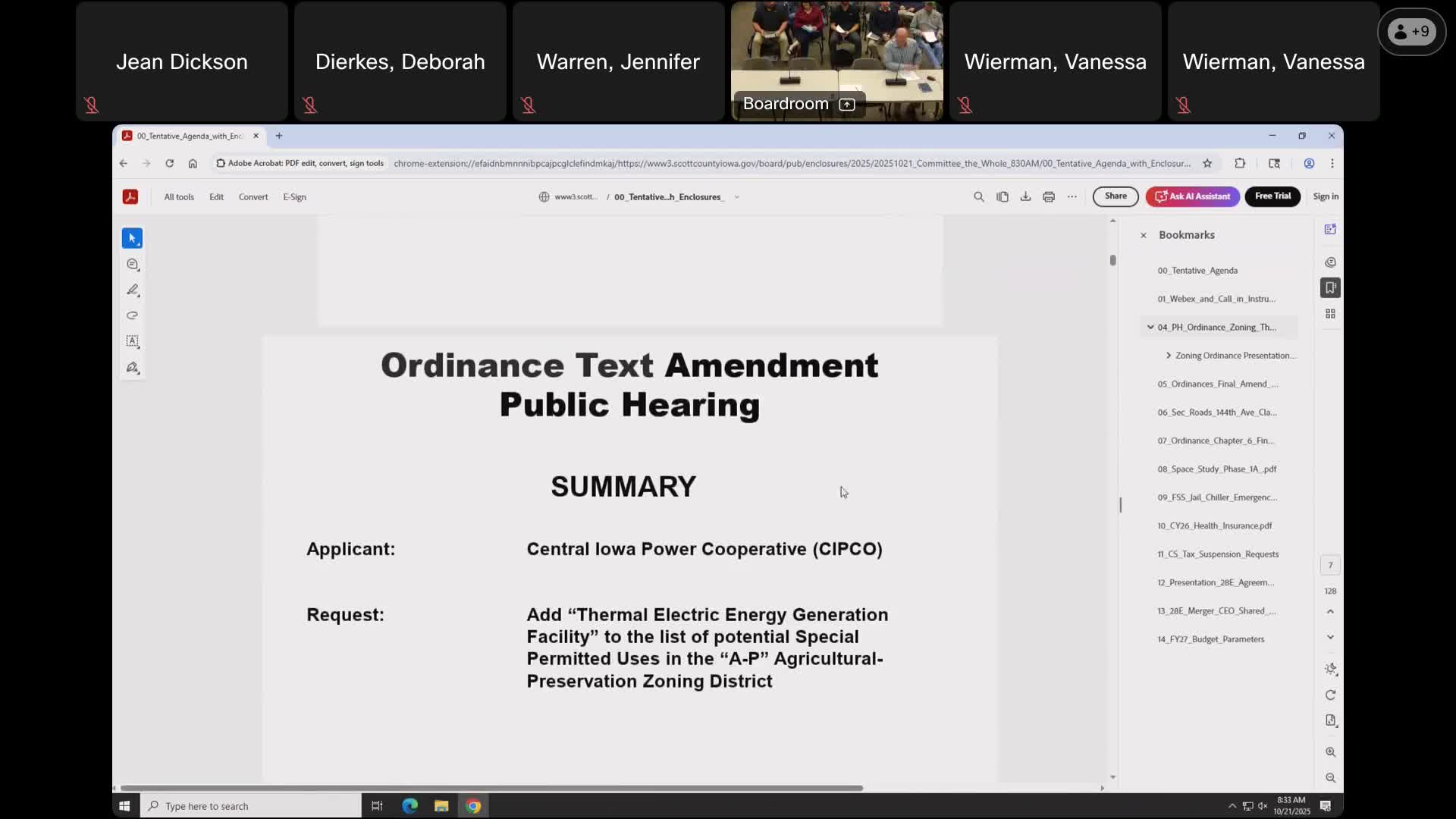
Scott County supervisors opened a public hearing Oct. 21 on a proposed zoning text amendment that would add “thermal electric energy generation facility” to the list of special permitted uses in the county’s Agricultural Preservation zoning district.
Planning staff told the board the change would not approve any site; it would only create a pathway for applicants to request a special use permit. Greg Schaufeld of Planning and Zoning said the Plan & Zone Commission considered the language in multiple public meetings and recommended the draft text unanimously. Schaufeld said the ordinance is written to try to protect agricultural land by steering projects toward existing natural‑gas pipelines and transmission lines and by including a decommissioning requirement if a plant ceases intentional operation for more than a year.
Representatives of Central Iowa Power Cooperative (CIPCO) presented technical and reliability reasons for the change. Kevin Condon, CIPCO director of public affairs, said the cooperative’s members concluded a peaking facility would help fill an approximate 14 percent shortfall in their generation portfolio and reduce reliance on short‑term market purchases. Andrew St. John, CIPCO general manager and CEO, described Hickory Grove Generating Station as a simple‑cycle natural‑gas peaking plant intended to operate about 15–20 percent of the time and to provide rapid, on‑call capacity during summer heat and winter peaks.
Sam Honnold, CIPCO manager of generation engineering, said the proposed facility would be a simple cycle combustion turbine of about 40 megawatts with a roughly 150‑foot stack and an estimated site acquisition footprint of 80–90 acres (about 30 acres of disturbed area). He said the plant would use natural gas with diesel as an emergency backup, and estimated annual water use in the 400,000–500,000 gallon range, largely for evaporative cooling. Honnold said air‑permit limits are likely to restrict run hours (staff noted a draft cap near 3,500 hours per year during permitting), and that emissions and water impacts would be subject to Iowa Department of Natural Resources and Iowa Utilities Board review.
Planning staff emphasized that county action on the ordinance would not substitute for state permits. “Even if a county special use permit were approved, the Iowa Utilities Board and DNR still have statutory authority for siting and environmental permits,” Schaufeld said.
The public comment period included multiple speakers who asked the board to strengthen the draft language. Linda Gollinghorst, representing a group that submitted a petition of 279 residents, asked the board to return the ordinance to planning and zoning to exclude prime farmland, require separate permits for expansions, add a county‑level environmental impact statement and specify closed‑loop water systems. Kay Stender called the 1,000‑foot setback in the draft insufficient and urged buffers of 1.3–3 miles in some rural areas; Jerry Moore raised governance and conflict‑of‑interest concerns related to local commission members and suggested a short moratorium for study. Eileen Givers cited EPA guidance on buffer distances and emphasized health risks. Ryan Drew, a construction trade representative, asked CIPCO for concrete local‑hiring and apprenticeship commitments if the project is built.
Board members asked CIPCO about emergency response coordination, firefighting water access for Maysville and whether the plant could run as a baseload resource if coal units retire. CIPCO said the plant is designed as peaking generation (available on call), not baseload, and noted that larger retirements of other plants could change planning assumptions.
Supervisor Maria moved to open the public hearing and the board voted to do so; the hearing was later closed by motion. Staff advised the board the item is scheduled for a first reading at the Thursday meeting and a second and final reading at a subsequent meeting if the board chooses to adopt the ordinance.
Next steps: the board will hold the first reading on Thursday, after which supervisors may vote to adopt or send the ordinance back to Plan & Zone for additional edits. Any site proposals would require a separate application, site‑plan review and additional county and state permitting.