Get Full Government Meeting Transcripts, Videos, & Alerts Forever!
Get email alerts on the Stadium Development topic
No spam. Unsubscribe anytime.
Port St. Lucie council approves stadium development, operation and non‑relocation agreements for 6,000‑seat Walton and 1 project
Summary
The Port St. Lucie City Council voted to approve three measures that greenlight construction of a 6,000‑seat stadium at Walton and 1, authorizing CRA TIF reimbursement up to $27.5 million over 20 years while the private developer funds construction and must post a 120% performance bond and reimburse public safety costs.
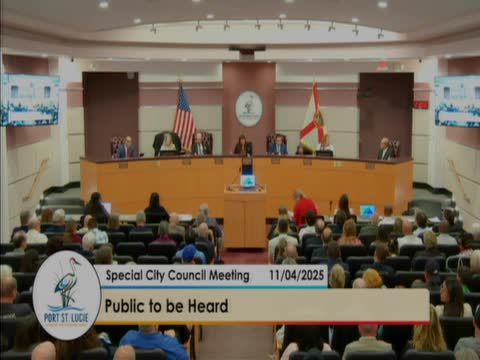
Port St. Lucie — The City Council on Nov. 4 approved three separate measures that authorize construction and operation of a 6,000‑seat multi‑use stadium at the Walton and 1 site and bind a professional USL soccer club to the city.
Jennifer Davis, the city’s project lead, told the council the stadium parcel is just under six acres and that “the developer will fund the entire cost to construct the stadium,” with Community Redevelopment Agency (CRA) tax‑increment financing (TIF) available only as reimbursement. Davis said the CRA reimbursement would be “not to exceed $27,500,000 and payable over a 20 year period,” beginning the year after the certificate of occupancy, and that the developer must post a 120% performance bond and provide a $500,000 deposit on executing the development and funding agreement.
The council approved ordinance 25‑65 (the development and funding agreement), ordinance 25‑67 (the stadium operating agreement) and resolution 25‑R‑74 (a non‑relocation covenant for the team). The operating agreement grants the operator a license to run and manage the stadium for an initial 50‑year term with an additional 25‑year renewal option, allows an operator purchase option during the term, requires a capital reserve fund, and guarantees the city 24 event days per year.
Why it matters: City leaders said the stadium is intended to anchor private investment in the Walton and 1 master plan, spur downtown‑style redevelopment on the east side and create jobs and youth programming. Peter J. Tesch of the Economic Development Council presented modeling that the development could generate substantial one‑time construction output and recurring annual operating output, material he said was based on InPlan economic modeling.
Council members and staff repeatedly emphasized the city will not directly fund construction with general fund dollars. Davis and others noted that TIF reimbursements are restricted to the CRA area and will be paid only after the stadium is built, opened and operational performance benchmarks are met. Davis said, “if they never build a stadium, they don't have any money from the CRA.”
Public reaction was sharply divided. Supporters — including local EDC members, youth soccer organizations and business leaders — described the project as a long‑sought catalyst for downtown activity and youth opportunities. Opponents raised questions about transparency during the pre‑contract negotiations, the adequacy of traffic and acoustic studies, neighborhood impacts from noise and late‑night events, and the economic risks of relying on a minor‑league sports franchise.
Attorney Trent Ackleson, speaking for petitioning taxpayers, urged the council to reject the measures, arguing the agreement left unspecified financial exposure and gave the developer options that could result in public subsidy. The city attorney and staff responded the cited civil litigation concerning the league had been dismissed and that the agreement includes multiple protections for the city.
Council discussion focused on addressing resident concerns while moving forward. Vice Mayor Carballo said the project could help revitalize the eastern side of the city and stressed safeguards would be enforced. Councilwoman Morgan said she had vetted the agreement and supported approval.
What the agreements require and guarantee: the developer must fund construction and post a 120% bond; the CRA may reimburse up to $27.5 million over 20 years after successful operation; the operator must reimburse the city for police and traffic management costs associated with events and maintain insurance and capital reserves; the city will receive half of naming‑rights revenue and retains ticket and parking revenue for city events.
What happens next: staff will continue the permitting and development review processes, perform the traffic and security planning required under the operating agreement, and return to council as additional site plans and operational policies (including a policy on the city’s use of any suite or tickets) are developed.
Quotes (selection): • Jennifer Davis, city staff: “The developer will fund the entire cost to construct the stadium,” and “the CRA TIF reimbursement cannot be applied anywhere else, outside of the CRA.” • Justin Papadakis, USL representative: “Port St. Lucie is gonna be part of the next class of markets where we're bringing all of those elements to.” • Ian Sanderson, Mako Soccer Club president (public comment): “For the kids, this is an amazing opportunity.” • Trent Ackleson, attorney for petitioning taxpayers (public comment): “We demand you stop subsidizing a private failure. Vote no.”
Ending: Council members moved and voted to approve each of the items by voice vote; the council will oversee follow‑up items including traffic management, noise mitigation and the detailed implementation steps described in the agreements.