Get Full Government Meeting Transcripts, Videos, & Alerts Forever!
Get email alerts on the Traffic Safety topic
No spam. Unsubscribe anytime.
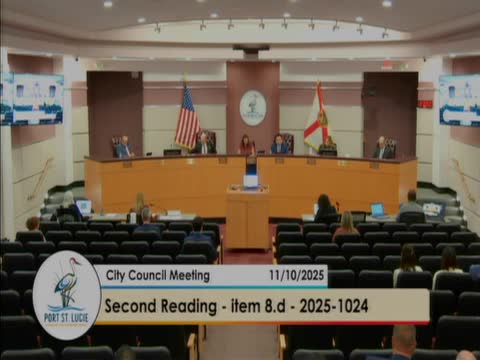
Port St. Lucie council adopts red-light camera ordinance after reopening public hearing
Summary
The City Council approved Ordinance 25-68 to authorize red‑light camera enforcement at high-crash intersections, citing an uptick in 2025 traffic fatalities. Police said cameras target right‑angle crashes; council asked staff to pursue an RFP, define adjudication procedures and plan public education.
Port St. Lucie’s City Council voted to approve Ordinance 25‑68 on Nov. 10, authorizing the use of traffic infraction detectors to enforce red‑light violations at intersections the police deem high‑risk.
The ordinance follows a presentation from Police Chief Nimzick, who told the council that traffic fatalities have increased in 2025 and that right‑angle crashes are a leading contributor. "Even 1 traffic fatality is too many," Nimzick said, and he urged the council to consider cameras at the city’s 10 most dangerous intersections.
City staff and the chief identified intersections with the highest crash counts since 2022 and explained how camera systems work. Nimzick said red‑light cameras typically record vehicles that enter the intersection more than three seconds after the signal turns red and that camera enforcement has been shown to reduce right‑angle crashes, though rear‑end collisions can rise slightly.
Council members pressed for data, legal authority, procurement plans and adjudication procedures. On constitutionality, the chief cited state enabling law and told the council the city would follow the statutory process; he said procurement would likely proceed via an RFP and that vendor contracts would be negotiated before activation. On appeals, the chief said the intent is to process violations as administrative fines with review by a special magistrate.
Members also raised concerns about who receives revenue from fines and the burden of public‑records requests. The chief and staff said vendor contracts typically include equipment, evidence review and a negotiated revenue split, and that public‑records requests would be handled by the agency as required.
Supporters framed cameras as a safety and capacity tool as the city grows. Vice Mayor Carvallo said cameras would help extend enforcement where staffing is limited, and the chief noted the department could run a warning/education period before citations begin. Councilman Motta said he would like more data tying camera deployment to reductions in fatalities and expected to vote no this round while continuing dialogue.
Mayor and council voted to reopen the public hearing at the mayor’s request to allow public comment (none were offered), then reconvened and approved the ordinance on a voice vote during the re‑vote.
Next steps described by staff include developing an RFP to select a vendor, negotiating contract terms (including evidence handling and revenue split), and returning to the council with procurement recommendations and an adjudication framework.