Get Full Government Meeting Transcripts, Videos, & Alerts Forever!
Get email alerts on the Emergency Management topic
No spam. Unsubscribe anytime.
Deputy emergency manager recounts Arizona flash‑flood response, urges North Port to shore up damage assessments and readiness
Summary
Deputy Emergency Manager Mike Navarez described state-level logistics work during Gila County’s monsoon flash flooding, including four fatalities, contractor issues that could jeopardize FEMA reimbursement, and recommendations for North Port on pre-disaster documentation, EOC readiness and HOA outreach.
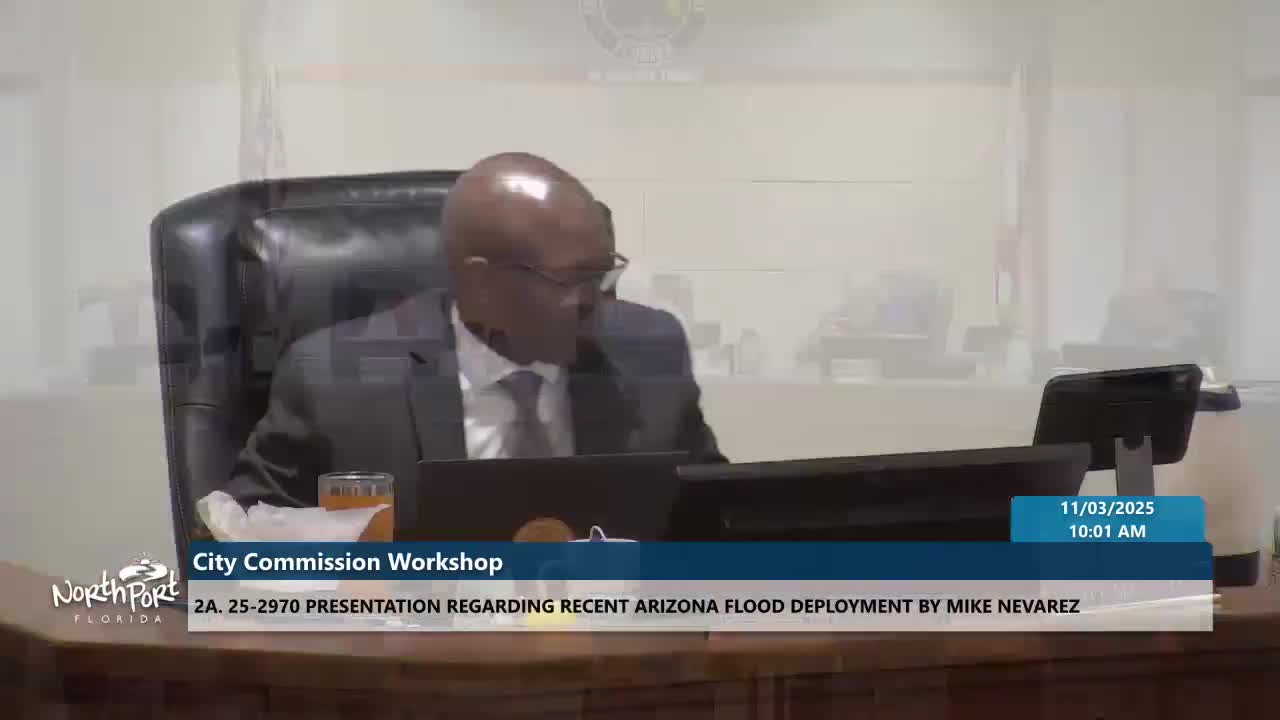
Deputy Emergency Manager Mike Navarez told the North Port City Commission on Nov. 3 that his recent deployment to Arizona’s monsoon floods showed how quickly a desert community can be overwhelmed and why North Port should strengthen pre-disaster documentation and local surge capacity. "They had about 3 inches of rainfall in a short period of time," Navarez said, adding, "in the desert, 3 inches of rainfall is catastrophic," and noting the event caused four fatalities and a hazardous‑materials incident when floodwater toppled a propane distribution rack.
Navarez, who served as the logistics supervisor in the state Emergency Operations Center, described arriving through the Emergency Management Assistance Compact (EMAC) and coordinating resource procurement for cities, counties, tribes and the state. He said one major challenge was that a primary logistics contract had been bid in a way FEMA would not reimburse. "If they use that contract, down years down the line when FEMA goes to pay them back, FEMA would just say, 'no,'" Navarez said, describing the need to pivot to other contracts during response.
Why it matters: Navarez framed the Arizona deployment as a cautionary example for North Port. He urged the city to maintain clear pre‑disaster records so damage assessments can demonstrate a disaster’s incremental impact, to sustain 24‑hour readiness for rapid‑onset events, and to build mutual‑aid relationships and agreements before a crisis.
On federal coordination, Navarez said FEMA’s role depends on whether an event exceeds local and state capabilities; he emphasized two streams of federal assistance — individual assistance for residents and public assistance for governments — and recommended early, organized damage assessments to establish eligibility. "We go through the process of actually using drones and looking at the state of all of our government buildings... to show what the pre‑disaster state is," he said.
Commissioners pressed staff on operational implications. Commissioner Langdon asked whether county or state liaison staff could be embedded in North Port’s Emergency Operations Center; Navarez answered affirmatively if North Port is the primary impacted jurisdiction and can provide space. Commissioners also raised concerns about HOAs and private‑property debris removal. Navarez warned that FEMA’s Private Property Debris Removal (PPDR) program must be activated for FEMA to reimburse debris cleared from HOA property and recommended securing pre‑event agreements and conducting public education so private communities understand documentation and reimbursement limits.
Navarez also described complications from federal staffing shortages, noting he deployed during a federal government shutdown and that some agencies had a reduced footprint. He recommended strengthening the city’s grant and emergency‑management teams to help navigate federal programs and reimbursement rules.
The presentation closed with a call for increased community preparedness and outreach — including hurricane seminars and HOA education — and for the city to continue exercising its damage‑assessment and mutual‑aid procedures. The commission had no formal action; the item was informational and concluded with thanks to Navarez.