Get Full Government Meeting Transcripts, Videos, & Alerts Forever!
Get email alerts on the It Services topic
No spam. Unsubscribe anytime.
Gainesville staff outline plan to bring IT services in-house after one-year SLA with GRU
Summary
City technology director told commissioners the city negotiated a one-year service-level agreement with Gainesville Regional Utilities and expects a FY26 SLA of about $3.7 million while planning a staged migration of servers, networks and user services to city control.
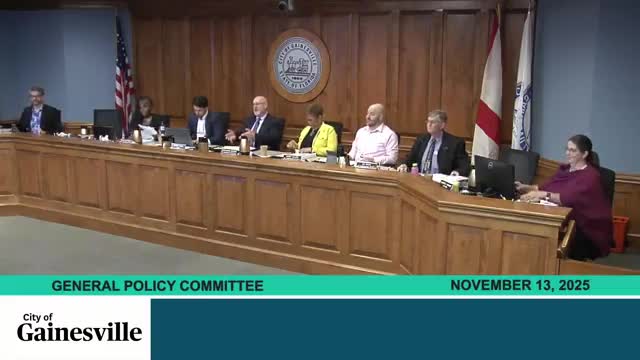
Mayor opened the meeting to an ITSLA update from the city’s technology director. Mister Nagy, the city’s technology director, introduced new members of the technology team and said city leadership had decided to take more IT functions in-house after reviewing increasing costs under GRU’s prior arrangement.
Mister Nagy said the city executed a one-year SLA with Gainesville Regional Utilities on Sept. 29 to provide time for a planned migration. "It is just a 1 year agreement," he said, and added that staff left open the option of defining longer-running, more discreet services with GRU into 2027 if needed.
On costs, Mister Nagy summarized prior estimates and the negotiated FY26 figure: an earlier FY25 estimate was about $5.9 million (brought down to $5.4 million but unsigned), while the negotiated FY26 SLA is roughly $3.7 million. He explained the calculation drivers: Microsoft licensing (2,440 licenses, about 1,400 assigned to city employees, roughly 57%), infrastructure usage (about 35% of existing infrastructure used by the city) and resource labor (adjusted from a prior 50 FTEs at 50% allocation to 47 FTEs at 33%). "We negotiated this year 3,700,000.0 for the SLA," he said.
Commissioners asked how the move would affect auditing and cybersecurity. On that point, Mister Nagy said he has had initial discussions with the city auditor and suggested coordinating a future technology risk assessment once the city has operational footing; he noted that the Workday application was already in the audit plan.
Mister Nagy and commissioners also discussed transition funding: he said the $3.7 million figure creates about $2.2 million in transition dollars; $2 million has already been allocated and additional rollover funds would be used to begin migration work. He cautioned the transition year may not be less expensive because the city will temporarily lose some economies of scale during separation from GRU, and said staff would define and be transparent about any services that remain with GRU.
Several commissioners praised the staff work. Commissioner Chestnut said the effort was “amazing” and noted the city would realize savings; Commissioner Eastman said the negotiated arrangement "seems equitable and reasonable" given the consultant review; Commissioner Book asked for clarification about what is budgeted versus spoken for, and Mister Nagy confirmed the transition dollars had been earmarked for software, technology and onboarding services.
Next steps: staff will proceed with the phased migration and standing up an information-security program and an IT service desk; the SLA is structured as a one-year agreement to allow the city to evaluate progress before committing to a longer-term arrangement.