Get Full Government Meeting Transcripts, Videos, & Alerts Forever!
Get email alerts on the Impact Fees topic
No spam. Unsubscribe anytime.
Melbourne officials review consultant plan to raise water and sewer impact fees to $6,920 per home
Summary
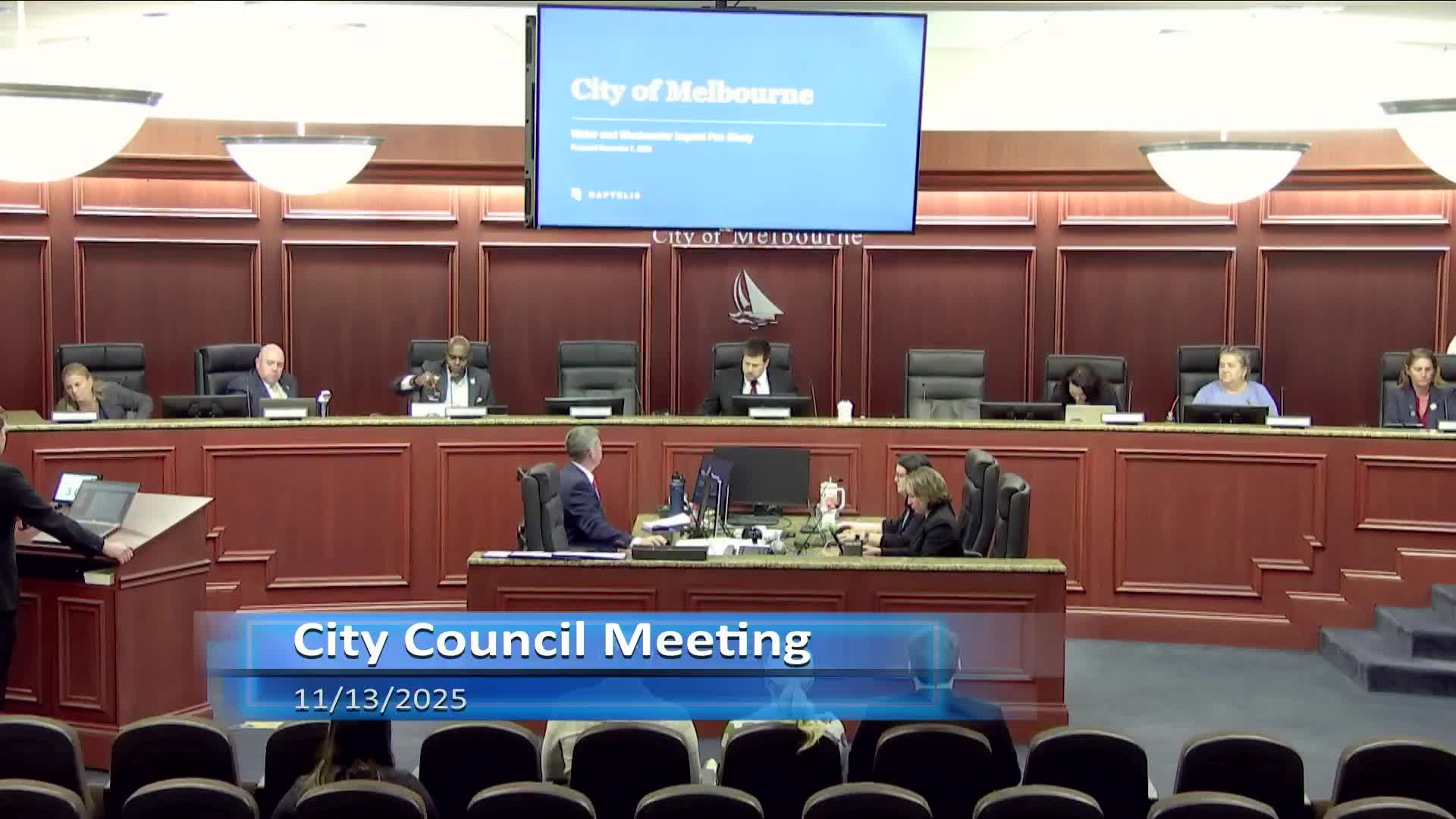
City staff and a Raftelis consultant told a Nov. 13 workshop the city’s combined water and sewer impact fee would rise from $3,750 to $6,920 per equivalent residential connection under the proposed study; council gave staff direction to prepare an ordinance and hold a second workshop on Nov. 25 to consider an extraordinary‑circumstances finding.
Trevor McCarthy, a consultant with Raftelis Financial Consultants LLC, told a City of Melbourne workshop on Nov. 13 that his firm’s updated study supports increasing the city’s water impact fee to $2,755 per equivalent residential connection (ERC) and the wastewater fee to $4,165 per ERC, for a combined fee of $6,920 per ERC, up from the current $3,750 per ERC. “We’re recommending that the city's Council consider our impact fees of $2,755 per ERC for water ... $4,165 per ERC for wastewater,” McCarthy said during the presentation.
McCarthy said the calculations reflect roughly $322 million in water-related assets and about $217 million in wastewater-related assets included as existing and planned capacity in the city’s capital improvement plan, and use a 240‑gallon‑per‑day level of service to convert cost per gallon into a per‑ERC fee. He told council the proposed increases are driven by a mix of factors including construction‑cost inflation, large planned capital projects and projected development growth.
Under Florida law McCarthy summarized, fee increases up to 25 percent must be phased over two equal annual installments; increases between 25 and 50 percent must be phased over four installments and cannot exceed a 50 percent rise over four years. The proposed increases exceed those phase‑in limits, he said, and staff are therefore asking whether the council will consider a formal finding of “extraordinary circumstances” that would allow full implementation more quickly.
McCarthy identified four factors he and staff consider extraordinary: significant increases in construction bids and costs (he cited instances of 70 to more than 200 percent increases in project bids compared with earlier estimates), a projected surge in new residential units (staff referenced as many as 5,000 new units over the next five years), planned expansion‑related borrowing, and an estimated opportunity cost approaching $10 million over five years if the increases must be phased in. “The opportunity cost over the next 5 years is almost $10,000,000,” McCarthy said.
City counsel and staff clarified the legal standard, noting the term “extraordinary circumstances” is not defined in statute and that a statutory change effective Jan. 1, 2026 would raise the approval threshold: post‑2025, an extraordinary‑circumstances finding would require unanimous council approval and would still require phase‑in over time. Council members asked how the new rates would apply to projects already in the pipeline; staff said projects with building permits pulled and supported within the 90‑day effective window would remain at existing rates, but larger developments that have preliminary approvals but lack building permits by the new effective date could be subject to the higher fees on later expansions.
Several council members pressed context: one member noted median home prices rose from $267,000 to $374,000 over five years and argued the proposed fee increase would represent a small percentage of that appreciation. Others emphasized the trade‑off for existing ratepayers if new development did not cover expansion costs: staff estimated nearly $10 million in foregone fee revenue over five years if the increases were phased in and that amount could shift to ratepayers.
No ordinance or vote was taken at the Nov. 13 workshop. Council members gave staff consensus direction to prepare a draft ordinance to amend the city’s water and wastewater impact fees, to schedule the second statutorily required workshop for Nov. 25 at 5:30 p.m., and to place first and second readings on the Nov. 25 and Dec. 9 council agendas respectively. Ross (city staff) said that if the ordinance is adopted as proposed, the consultant and staff expect the earliest possible effective date to be March 10 following the required readings and the statutory 90‑day timing.
The council closed the workshop without public speakers on the topic and adjourned at 6:08 p.m. The Nov. 25 workshop and subsequent ordinance readings will be the next opportunities for public comment and for council to decide whether to make the extraordinary‑circumstances findings and adopt new fee levels.