
Gainesville Fire Rescue outlines inspection gains, community health programs; Impact GMV reports sharp reductions in youth violence
Get AI-powered insights, summaries, and transcripts
Subscribe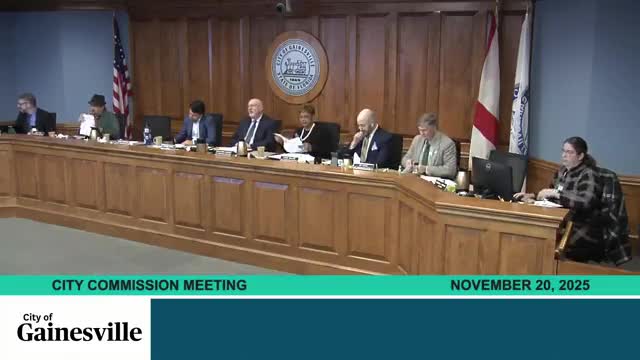
Summary
Gainesville Fire Rescue reported increased inspection activity, faster turnout times and plans to replace two stations by May 2026. The city’s community health and Impact GMV programs — from paramedicine referrals to technology hubs in affordable housing — showed early outcomes including fewer fights reported by participating youth and declines in calls for service at targeted sites.
Gainesville Fire Rescue reported a year of rising prevention and response activity and outlined staffing and station projects that city leaders said will keep up with growth.
Chief Sean Hill House told the City Commission that in fiscal-year quarter 4 GFR inspected nearly 10,000,000 square feet, logged 73 investigative hours, 68 plan‑review hours and 1,303 risk‑reduction activities. Call volume for the quarter was 7,325, about 4,000 in District 1 and 3,000 in District 2. Hill House said turnout time — the interval between alarm and firefighters getting to apparatus — met the national benchmark 91 percent of the time; average travel time was about a minute over the national target and was met 88 percent of the time. He said the department had five operational vacancies and 186 operational personnel and that design on replacement Station 9 is at 100% and Station 3 at 90%, with both expected to break ground by May 2026.
The commission also heard a report from the Community Health Division about how opioid‑abatement settlement funds and other grants are being directed toward transportation and prevention programs. Director Brandy Stone said the city is funding Uber Health rides to help people get to mental‑health and substance‑use appointments, is preparing a public‑education campaign on substance use for spring, and continues to contract nonprofits for services to justice‑involved people.
Stone described the Community Resource Paramedicine (CRP) program’s quarter results: 136 new referrals, 672 patient contacts or attempts, 295 hours of direct patient care, and dozens of service connections including primary‑care referrals and substance‑use treatment linkages.
An innovative barber‑based screening project, Fresh Fades & Healthy Hearts, trained nine barbers to take blood pressure in three barbershops so far; Stone said the program is grant‑funded and expanding. She added that staff will return with a six‑month review that includes outcome data.
Britney Coleman, Impact GMV program manager, reported on gun‑violence prevention and youth engagement work. She highlighted a technology‑hub pilot at Oak View apartments where about 36 children participated and exit surveys showed large self‑reported declines in fighting (from 63 percent to 6 percent in the cohort cited) and improvements in emotional well‑being and school engagement. Coleman said calls for service to that complex dropped roughly 32 percent and gun‑violence‑related calls fell about 75 percent for the period cited; she framed the results as early but promising, noting additional supports and partners were involved.
Commissioners praised the prevention focus. ‘‘These are things that are special to the city of Gainesville,’’ Mayor Ward said, and Commissioner Book called the barber blood‑pressure initiative “innovative.”
What happens next: staff said design work on the two fire stations will continue and CRP and Impact GMV will provide follow‑up metrics at future commission updates.