Get Full Government Meeting Transcripts, Videos, & Alerts Forever!
Get email alerts on the Impact Fees topic
No spam. Unsubscribe anytime.
North Port commissioners OK ordinance drafting on impact‑fee changes after heated debate over government‑use exemptions
Summary
On Nov. 4 the North Port City Commission directed staff to draft an ordinance that would update the city’s impact‑fee deferral program and implement several process clarifications; a proposed government‑use exemption and affordable‑housing fee reductions prompted a split vote and sustained debate.
On Nov. 4, 2025 the North Port City Commission narrowly directed staff to prepare an ordinance revising the city’s impact‑fee framework, voting 3‑2 to adopt staff‑proposed changes that include an expanded deferral program and a set of process improvements.
The commission’s action followed a lengthy staff presentation from Deputy Director Lori Barnes and Director Elena Ray, who framed four options: adopt an affordable‑housing impact‑fee exemption consistent with Sarasota County; consider a government‑use exemption for public facilities (with a clawback if the use changes); expand and make the impact‑fee deferral more usable (staff proposed extending deferrals from three to five years and allowing performance bonds instead of property liens); and adopt several technical process improvements (clarifying accessory‑structure exemptions, how shell buildings are assessed and how outdoor dining is calculated).
“Right now we do have an impact‑fee deferral, but it has been ineffective and completely unutilized,” Barnes told commissioners, recommending changes she said would make the program more usable for leasehold tenants and larger end users.
Supporters argued the changes would help local projects and make the deferral program a practical tool. Eric Card, CEO of RISE Companies, urged the commission to consider exemptions as a way to support a planned VA outpatient clinic in North Port, saying the change would “make a meaningful difference not just to developers but to the veterans who will walk through the doors for decades to come.”
Opponents, including Mayor Stokes and Commissioner Duval, raised concerns about the government‑use exemption and the risk of shifting costs to current taxpayers. Stokes said he was unconvinced that waiving impact fees for outside government entities — such as public hospitals — was appropriate, asking why the city should provide a tax break to organizations that will benefit financially from locating in North Port.
Staff emphasized legal and administrative constraints. Barnes said the city lacks authority to waive fees without code provisions and warned that a purely case‑by‑case approach could raise equal‑protection challenges and expose the city to litigation. She also noted that, under Florida law, certified affordable housing that meets the statutory definition does not require the city to make up waived impact fees.
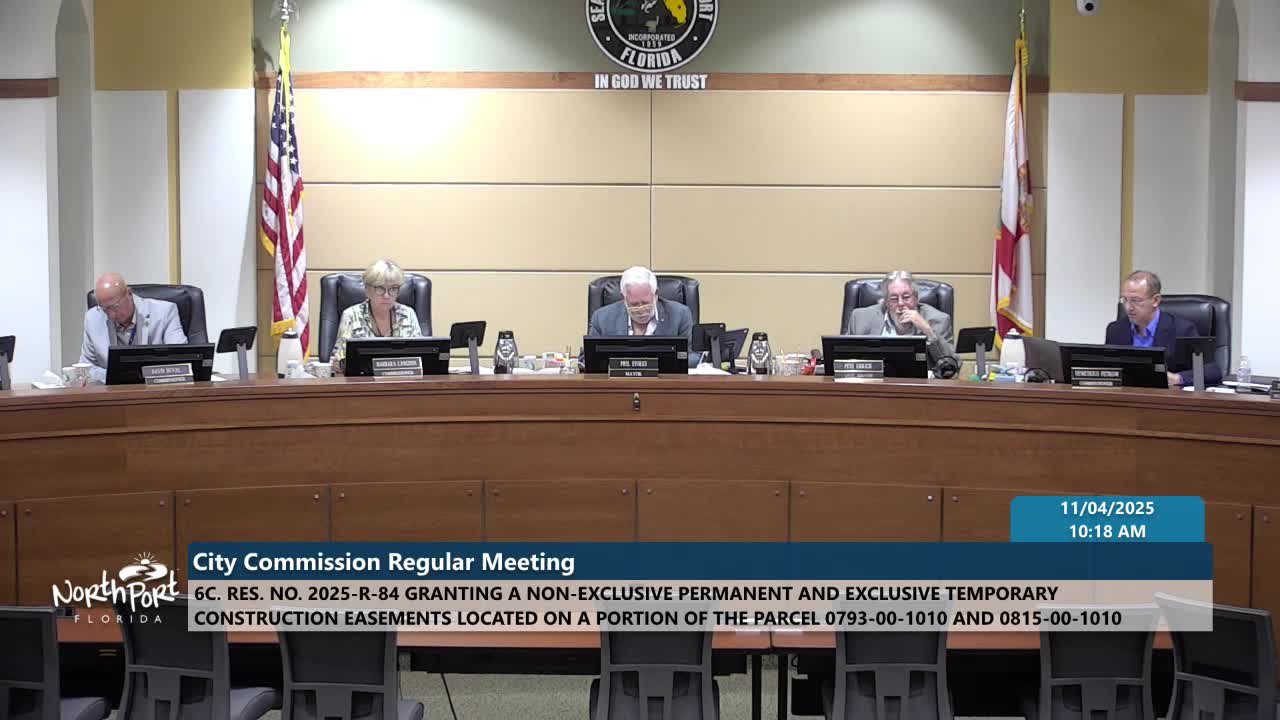
After debate the commission voted 3‑2 to direct staff to draft an ordinance that includes option 1c (the proposed updated deferral program with eligibility and refined program requirements) and option 1d (process improvements). Commissioners Langdon, Emmerich and Petro voted in favor; Mayor Stokes and Commissioner Duval were opposed.
What comes next: staff will return with a draft ordinance outlining the revised deferral program, the proposed process clarifications and attendant code language. The record shows commissioners requested more detail on (1) the expected number of income‑restricted units in the city, (2) the structure for any government‑use exemption (including clawback language), and (3) the mechanics and security for the deferral program (performance bond versus lien).
By the vote, the commission kept the affordable‑housing exemption and a broader government‑use exemption off the immediate directive while asking staff to focus on the deferral and process improvements — an outcome that preserves additional debate on any fee waiver for government entities.
The commission is scheduled to consider the draft ordinance at a future meeting after staff returns with the proposed language and legal review.