
Naples Beach Club public-art program approved; council requires glare mitigation for reflective work
Get AI-powered insights, summaries, and transcripts
Subscribe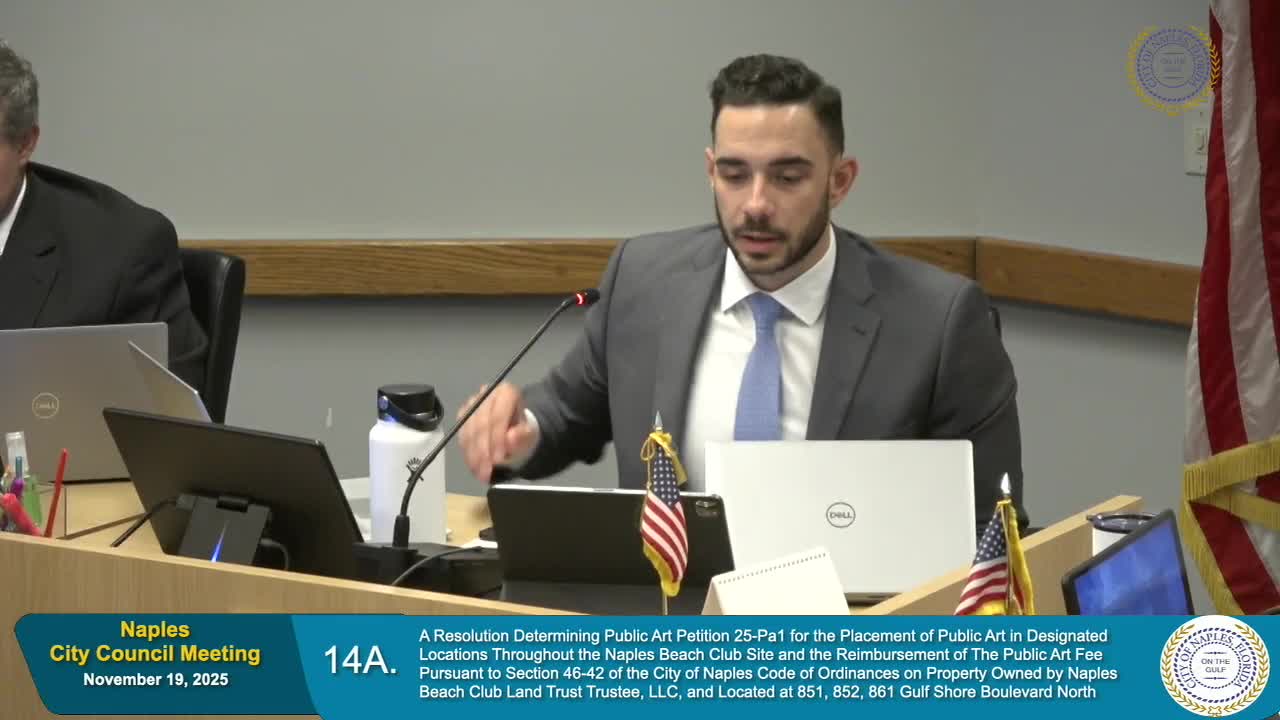
Summary
Council approved a six-piece public-art program for the new Naples Beach Club, including site-specific commissions by David Turner and a first U.S. public commission for Guillaume Castel. The Design Review Board and council required orientation and glare mitigation so a reflective stainless-steel piece does not create a safety hazard in the public right of way.
Naples City Council voted Nov. 19 to approve a multi-piece public-art program for the Naples Beach Club, which the applicant presented as both an aesthetic and an educational program tied to local conservation themes.
Consultants said the program includes six publicly accessible sculptures throughout the Beach Club site '1 two beach pieces and several works placed around Market Square and the property's publicly accessible areas. David Turner, a regional wildlife sculptor with existing public works in Naples, is commissioned to create a large "Florida Shell" inspired by the horse conch and several bird/waterfowl pieces that will be sited on publicly accessible areas. The program also features a contemporary abstract commission by French sculptor Guillaume Castel, intended as his first continental U.S. public commission.
Council and DRB discussion focused on material, orientation and safety. DRB recommended approval with a condition to orient the 'Samari' (stainless/corten) sculpture so reflective faces do not create glare toward the public right of way or interfere with sightlines for drivers or golfers. Planning staff said the code requires public-art pieces to be publicly accessible but does not require them to be placed in the public right of way; the proposed installations meet that standard by being located in publicly accessible parts of the private property.
Conservation groups expressed support for the program; the Conservancy of Southwest Florida noted that the horse-conch sculpture and educational QR code idea could connect art viewing to local habitat and species-conservation content. Petitioner representatives said plaques and QR codes will provide links to dynamic educational material and local stewardship partners.
Council approved the public-art petition by unanimous vote with the DRB-recommended condition. Staff will work with the petitioner to finalize orientation and maintenance details and to confirm that lighting and reflective materials comply with turtle-lighting rules and other night-sky or safety restrictions.
Next steps: final placement and installation plans will come back through DRB/staff for confirmation of orientation and maintenance commitments, and the petitioner will install plaques/QR integration for public education.