
FDLE seeks dozens of budget increases for facilities, cybersecurity, forensics and wellness
Get AI-powered insights, summaries, and transcripts
Subscribe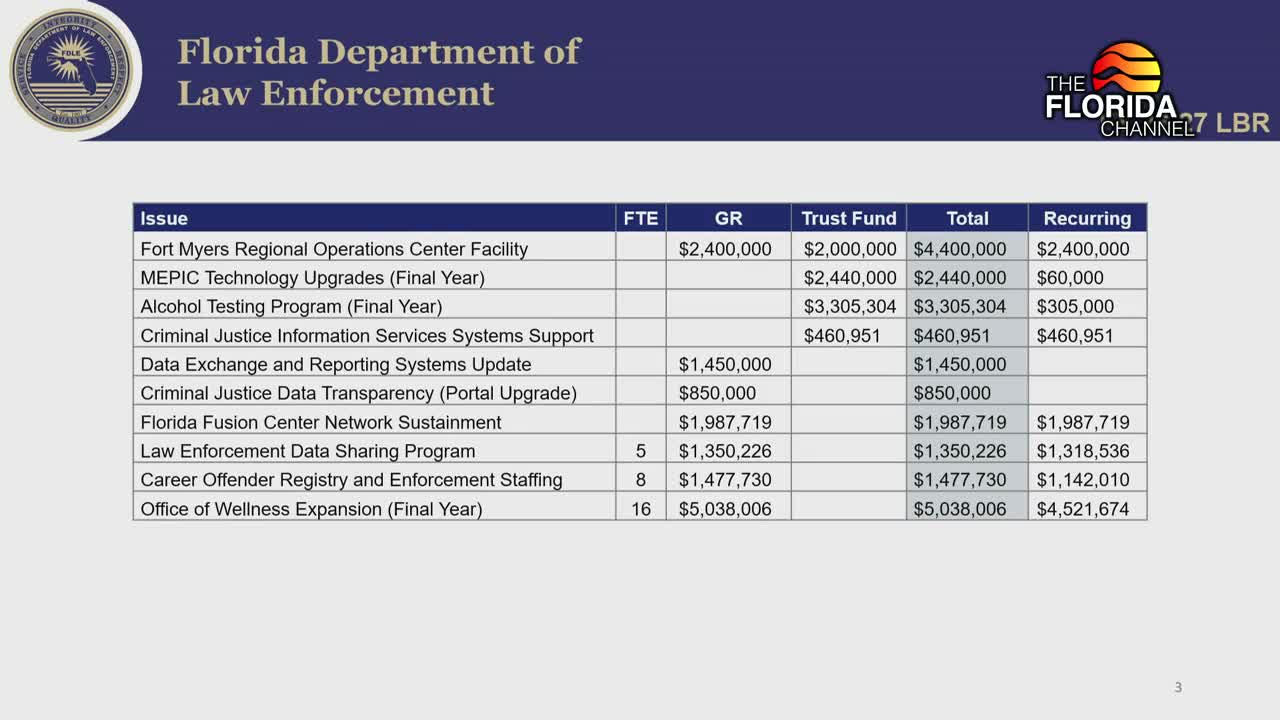
Summary
Florida Department of Law Enforcement presented 28 line items to the Senate Appropriations Committee on Criminal and Civil Justice, asking for funding for a Fort Myers operations center, technology upgrades, breath‑test replacements, cybersecurity, a wellness program expansion and a cryptocurrency‑seizure unit.
The Florida Department of Law Enforcement told the Senate Appropriations Committee on Criminal and Civil Justice that it needs new recurring and nonrecurring funding across technology, facilities and personnel to maintain statewide public‑safety services.
Deputy Commissioner Mike Phillips told senators FDLE’s request includes a $4.4 million first‑year payment for a 25‑year lease of a 65,000‑square‑foot Fort Myers Regional Operations Center (anticipated completion October 2026) and a $2 million tenant‑broker fee. He described the current Fort Myers building as damaged by Hurricane Ian and said the agency selected a site roughly three miles inland.
Phillips outlined a series of technology and equipment requests: $2.4 million in trust‑fund authority for the final year of the missing/endangered‑persons clearinghouse upgrade; $3.3 million to purchase remaining breath‑test instruments and migrate from older Intoxilyzer equipment; $460,000 in recurring trust‑fund authority for critical public‑safety contract renewals (criminal histories, data‑transparency platforms, uniform arrest affidavit workflows); and $1.4 million to align data exchanges with updated IEPD/IAPD standards.
FDLE also asked for $850,000 in nonrecurring funds to upgrade its criminal justice data transparency repository; $1.9 million to move Florida Fusion Center analyst positions from federal grants to state support; and $1.3 million plus 5 FTE to shift maintenance of the LINCS law‑enforcement data program onto general revenue. Phillips said LINCS includes all 67 county sheriffs and more than 200 municipal police departments.
On investigative capacity, FDLE requested $1.4 million and 8 FTE to create a career‑offender registry unit; $2.5 million to replace 57 investigative vehicles (split $1.5M trust fund / $1.0M general revenue); and $1.1 million to modernize digital forensics by moving analysis into secure cloud environments so regional investigators can access results more quickly.
The agency asked for $4 million to meet FBI/CJIS cybersecurity standards, $500,000 to maintain forensic‑lab equipment contracts, and $800,000 to cover rising lab service and supply costs. Phillips said vendors are shifting to subscription pricing models and warned of approximately 10% cost increases for supplies.
Phillips also sought $5 million and 16 FTE to expand FDLE’s office of wellness for current and former law‑enforcement officers, describing peer‑support seminars and a three‑day retreat model that FDLE officials say has helped officers in crisis. He told senators, “we’ve seen an officer who was on the verge of committing suicide” improve after attending a seminar.
FDLE reported growth in financial‑crime work and requested $4.6 million and 10 FTE to expand its cryptocurrency seizure program; Phillips said the unit handled 61 cases and achieved about $11 million in seizures in the prior year. He also described a $15 million SAFE program for fentanyl eradication that FDLE credited with thousands of arrests and large drug seizures.
On personnel and workload, Phillips said certified‑officer misconduct cases rose 79% between 2018 and 2024 and asked for $378,244 and 4 FTE to handle that caseload. He warned that some previously nonrecurring items must be made recurring to avoid service interruptions.
Senators asked for documentation and context on several points. Senator Smith asked FDLE to provide the underlying data supporting the 79% misconduct increase, and also raised whether expanding body cameras (for example, to the Florida Highway Patrol) would be helpful; Phillips said many reviewed cases are off‑duty or internal matters where body cameras might not add evidence. Senator Wright raised concerns about small agencies bearing the cost of frequent public‑records requests that are used by third parties for “pay‑to‑play” websites, and Phillips agreed the workload is a growing issue.
The department said it would follow up with requested data and that Deputy Director Charles Murphy would present the CJIS updates that followed.
Next steps: FDLE gave a line‑by‑line presentation and offered to provide senators with underlying data and follow‑up details; committee members requested those staff follow‑ups prior to appropriation decisions.