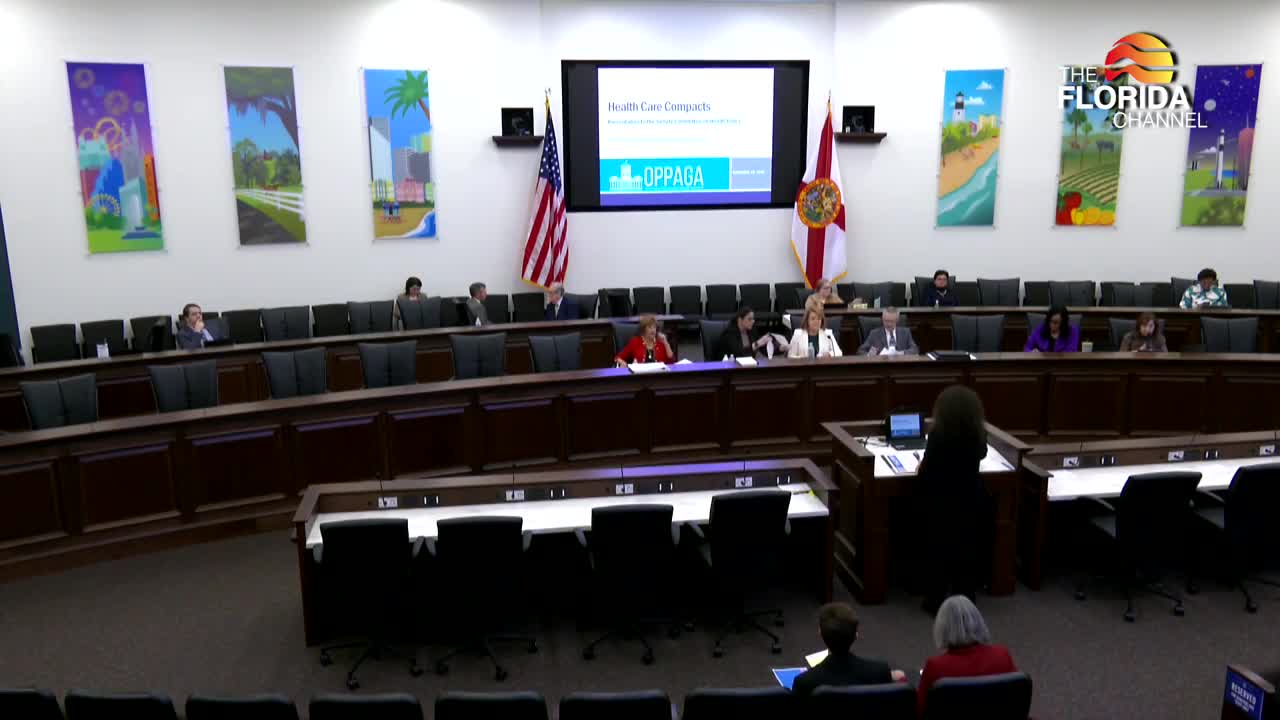
OPPAGA brief: interstate healthcare compacts ease portability but evidence of workforce gains is limited
Loading...
Summary
OPPAGA presented a review of interstate healthcare licensure compacts, noting administrative advantages and risks (fees, scope‑of‑practice conflicts) and finding limited evidence compacts alone reduce workforce shortages; Florida has passed legislation to join six compacts, three of which are active.
OPPAGA staff summarized research and stakeholder interviews about interstate healthcare licensure compacts and alternative pathways for out‑of‑state practitioners.
Wendy Scott, OPPAGA's staff director for Health and Human Services Policy, told the committee compacts can facilitate licensure portability, enable data sharing for disciplinary action, and support emergency surge capacity. She noted licensure‑by‑endorsement and telehealth registration are alternatives that Florida already uses; the 2024 Mobile Act expanded endorsement for many professions.
But Scott emphasized limits and potential downsides: compact commissions may charge annual assessments, states may need IT and administrative investments to implement compacts, and some compacts' definitions could conflict with Florida law on scope of practice — for example, the APRN compact could allow some out‑of‑state APRNs to practice without Florida's supervisory requirements. OPPAGA found little reliable evidence that compacts, on their own, materially reduce workforce shortages and recommended careful consideration of fees, scope‑of‑practice differences, and data systems before joining additional compacts.
Committee members asked how licensure‑by‑endorsement differs from compacts, and Scott explained endorsement grants a Florida license while compacts enable multistate practice under a compact process. The presentation concluded with the observation that Florida has enacted enabling statutes for several compacts but only some are active pending commission actions and implementation work.
Next steps: Committee members thanked OPPAGA and indicated continued interest in how compacts and endorsement pathways interact with Florida policy choices.