
Jacksonville startup Starcatcher demonstrates power beaming, plans initial satellite to extend spacecraft lifetimes
Get AI-powered insights, summaries, and transcripts
Subscribe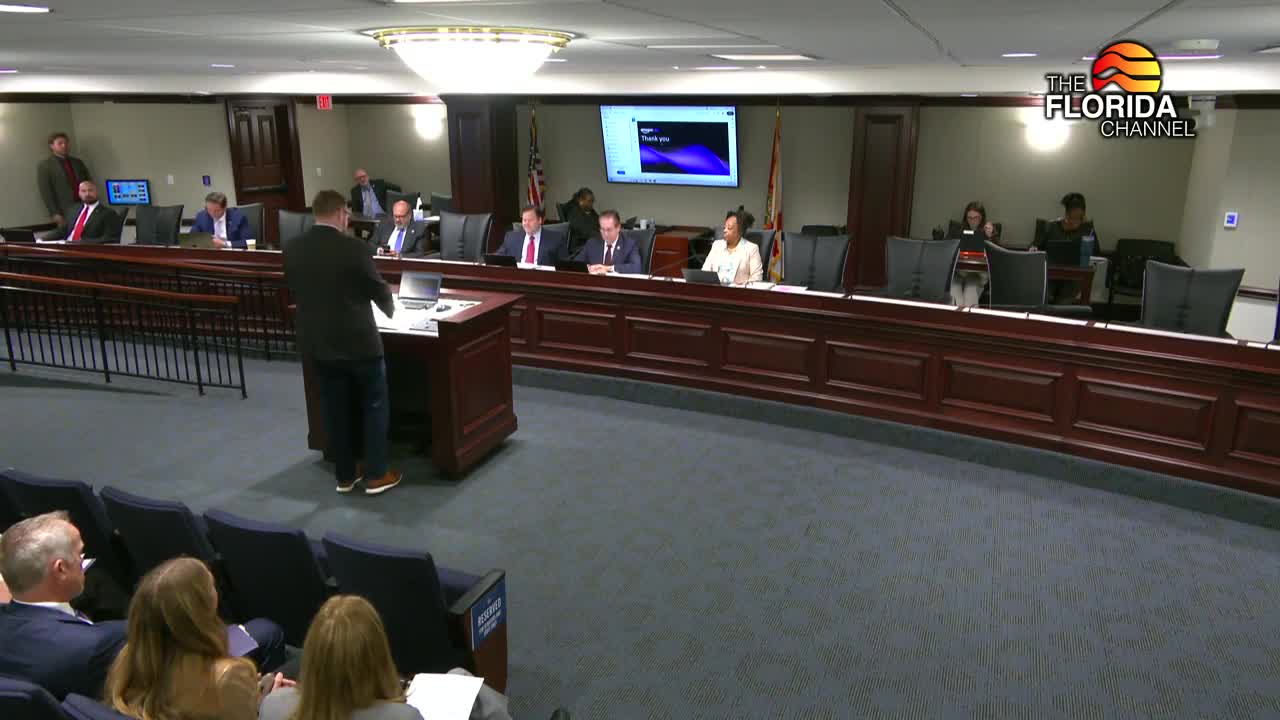
Summary
Starcatcher Industries described terrestrial demonstrations delivering up to 1.1 kilowatts over a kilometer, said it raised a $12 million seed round, has 39 letters of support and plans a SpaceX rideshare launch in Q4 next year to test in-space power transmission.
A Jacksonville-based startup told the Florida Senate committee it is developing space-based power-beaming to augment satellites’ onboard solar power and extend operational lifetimes.
Andrew Rush, president and CEO of Starcatcher Industries, said the company is building a constellation that collects solar energy, conditions it into wavelengths compatible with client spacecraft, and then transmits that energy via multi-wavelength laser (a broadly described 'bent-pipe' or relay architecture). He framed the technology as a solution to rapidly rising satellite power demands and described terrestrial demonstrations: a football‑field test delivering about 100 watts and a later test on a Cape Canaveral runway delivering about 1.1 kilowatts — which Rush said exceeded a DARPA benchmark.
Rush said Starcatcher raised a $12,000,000 seed round in July, is scaling from three founders to about 35 employees, and has letters of support or power purchase agreements from 39 companies and government interest including Space Florida funding of demonstration work. He said the company will build its first satellite and expects to launch on a SpaceX rideshare mission in Q4 next year to demonstrate space-to-space or space-to-satellite power transfer.
In technical questioning, Rush explained the principal in-space loss is diffraction (spreading of a beam over distance) rather than atmospheric absorption, described the team's approach to mitigate losses by design and economies of scale, and said the system minimizes onboard battery storage by delivering power in real time and by using relay satellites in higher orbits to support satellites in eclipse.
What this means: If feasible at scale, power beaming could let operators increase spacecraft capability and extend lifetimes without major on-board battery changes. Starcatcher’s terrestrial demonstrations and planned in-orbit test are early milestones; several technical, regulatory and safety questions remain unresolved in public testimony.
Next steps: Company expects an in‑space demonstration via a Q4 rideshare launch next year; the committee recorded the briefing and followed with technical questions.