
Experts spar over existential risk, job displacement and platform manipulation at Arizona hearing
Get AI-powered insights, summaries, and transcripts
Subscribe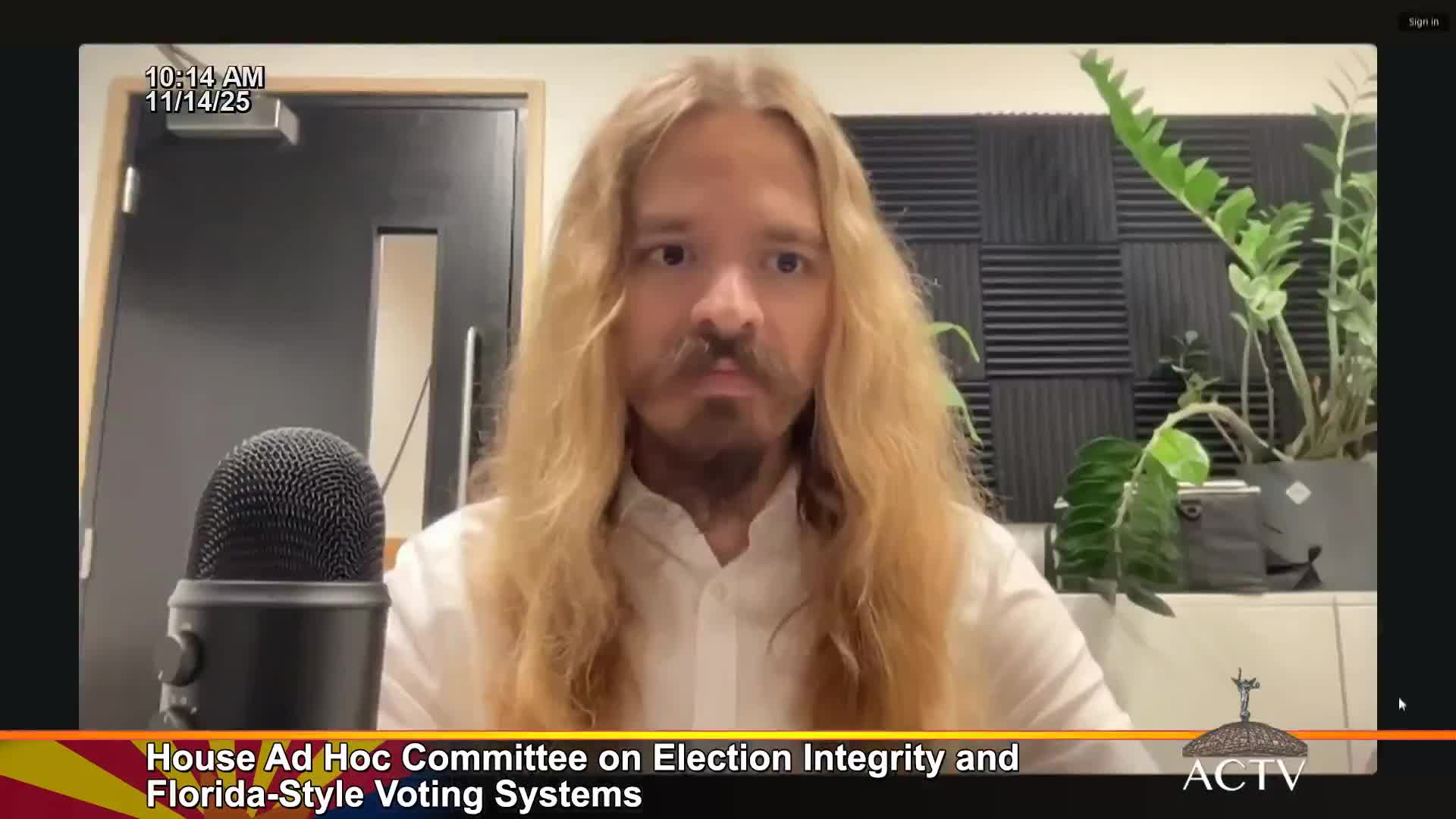
Summary
Witnesses differed sharply: some warned of near‑term existential and mass‑job risks and urged strict controls; others emphasized adaptation and free‑speech limits. Dr. Robert Epstein presented monitoring data alleging large platform influence over elections; Connor Leahy and others urged international verification or prohibition of advanced systems.
PHOENIX — The Arizona select committee heard sharply divergent expert views on the long‑term risks posed by artificial intelligence, ranging from calls to outlaw development of uncontrollable systems to arguments that society can adapt through education and standards.
Connor Leahy, founder of Conjecture, described the prospect of superintelligence as an existential threat and urged international verification regimes and strong limits on development. Leahy said that building systems capable of autonomous planning and self‑improvement could outpace human control and recommended diplomatic efforts analogous to nuclear verification.
Dr. Robert Epstein, a senior research psychologist, described a long‑running monitoring program that captures ephemeral, personalized content delivered to volunteer devices. Epstein told the committee his team has published peer‑reviewed studies and asserted that platform algorithms have already shifted votes and shaped public opinion; he said his monitoring showed Google activity that, in his view, altered vote outcomes and that political bias measured in some Google outputs rose after 2024. He also warned that children interact with AIs in ways parents may not see and argued that a large share of jobs could be at risk from automation.
Committee members pressed witnesses on methods and timelines. Several lawmakers said they are anxious about economic disruption, possible manipulative targeting by platforms and the difficulty of regulating rapidly evolving systems. Others urged balanced policy that protects voters and workers while preserving free expression.
The committee did not act on the claims but asked staff to schedule follow‑up testimony from election administrators, university researchers and state cybersecurity officials to evaluate both the practical security posture and the empirical basis for platform manipulation claims.