
Milford wetlands agency continues review of Wheeler's Farms redevelopment after questions on runoff, invasive species and maintenance
Get AI-powered insights, summaries, and transcripts
Subscribe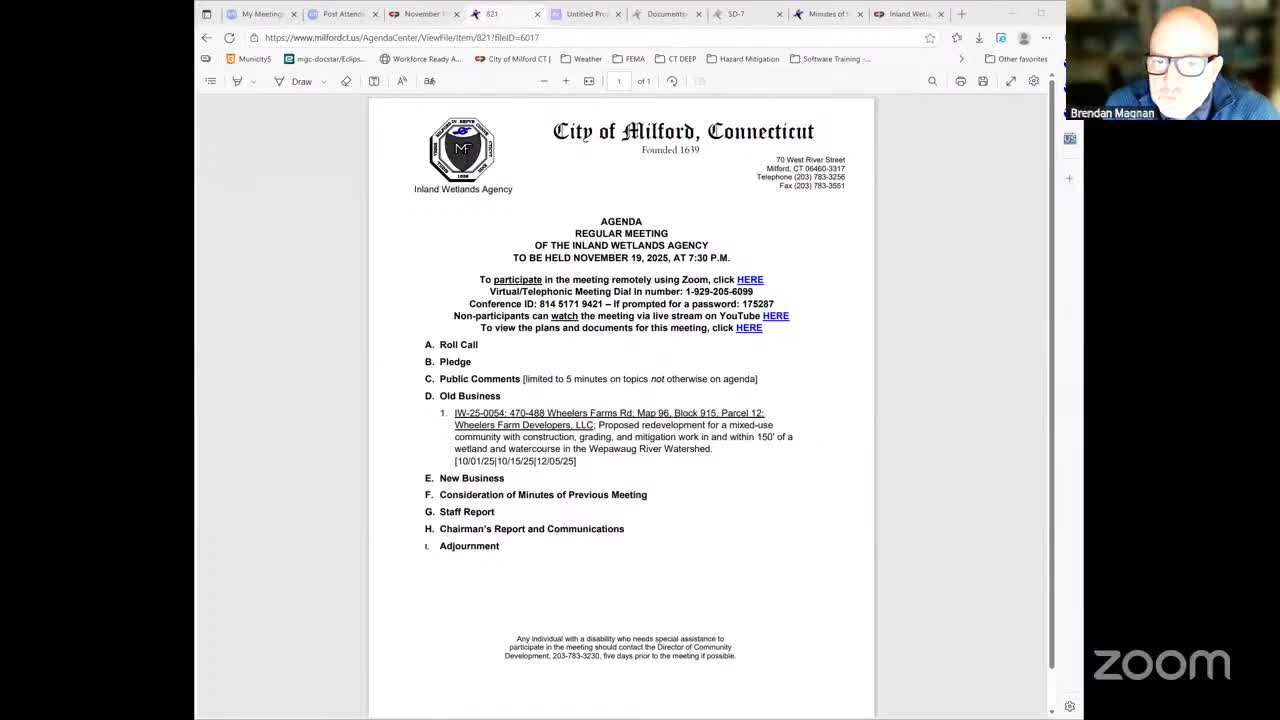
Summary
The Milford City Inlands Wetlands Agency on Nov. 19 continued consideration of a mixed‑use redevelopment at 470–488 Wheelers Farms Road after applicants agreed to supply engineering and wetlands responses. Commissioners pressed the team on stormwater discharge to a detention pond, phragmites removal and long‑term maintenance.
Patrick O'Leary, vice president of development and acquisitions for Continental Properties, told the Milford City Inlands Wetlands Agency on Nov. 19 that the proposal for 470–488 Wheelers Farms Road (IW250054) aims to redevelop the former Crown Corporate Plaza into a mixed‑use community while minimizing wetland impacts. "We do not believe as we address these comments... that they will have any significant impact on the plans themselves," O'Leary said, adding the team will submit revised plans and responses to staff and the city engineer before the next meeting on Dec. 3.
The proposal covers an approximately 47‑acre site and would retain two office buildings while adding an age‑targeted 150‑unit building, multiple multifamily buildings and amenities. Engineer Darren Overton said the site sits on a watershed divide between the Housatonic and Wepawag river systems, and that a portion of the project lies inside the 150‑foot upland review area that triggers agency jurisdiction for regulated activities. Overton said the design includes a detention basin, stormwater conveyance to existing riprap swales and treatment features intended to meet local and state water‑quality standards.
Megan Fogarty, the team's wetland scientist, described the wetlands at the southeast corner of the property as occupying about 1.8 acres and including a palustrine red maple swamp and a constructed detention feature. "The wetlands... occupy about 1.8 acres," Fogarty said, and she stressed there are no proposed direct impacts to the wetland itself; the applicant identified roughly 76,000 square feet of regulated activity within the 150‑foot upland review area associated with the age‑targeted building and adjacent improvements.
Commissioners focused on several technical and operational topics. They asked whether original wetland flags appear on the engineering figures (the applicant pointed to figure 2/sheet 5 in the submission packet), whether dog‑park surfacing could introduce microplastics (the applicant said the dog park is outside the URA and details will be provided), and whether impervious runoff from parking is pretreated before reaching the detention basin. Overton and Fogarty said existing manholes and older design elements appear to provide some water‑quality function, the team is not proposing to modify the historic outfall, and littoral plantings and other treatment trains are expected to provide additional capture and nutrient removal; they also said they could evaluate added measures such as a hydrodynamic separator if access allows.
On invasive plants, commissioners asked how phragmites would be handled. Fogarty and the applicant said a wetland‑approved herbicide program (including targeted techniques such as "snip and drip") is the typical and proposed approach, and that treated stands would be allowed to die in place rather than be mechanically removed to avoid destabilizing soils. Commissioners asked for a post‑construction maintenance and monitoring plan for restoration plantings; Fogarty said the team has not yet filed a management plan but would be amenable to providing one if requested by the commission.
The team also discussed construction sequencing and timing (site work for the watershed area was estimated as a short, single construction season with overall site work staged across the site), proposed permeable parking in selected rows (not the entire parking area), and pool deck drainage that the applicant said would be self‑contained and not routed to the wetland.
The chair recommended the agency take no action tonight and wait for the applicant's written responses and revised plans so the town engineer can complete review before the Dec. 3 meeting. The applicant agreed to submit materials next week and to accommodate any necessary extension of the statutory review window. The item was continued to the Dec. 3 meeting; no final permit or enforcement action occurred at the Nov. 19 session.
The commission also recommended adding educational signage (including pollinator‑pathway placards) and asked the applicant to add long‑term maintenance commitments for planted areas and erosion controls. The next procedural step is for the applicant to file the revised plans and responses to staff and engineer comments prior to the Dec. 3 meeting.