
Public‑health officials warn CDC/ASPR funding uncertainty threatens preparedness
Get AI-powered insights, summaries, and transcripts
Subscribe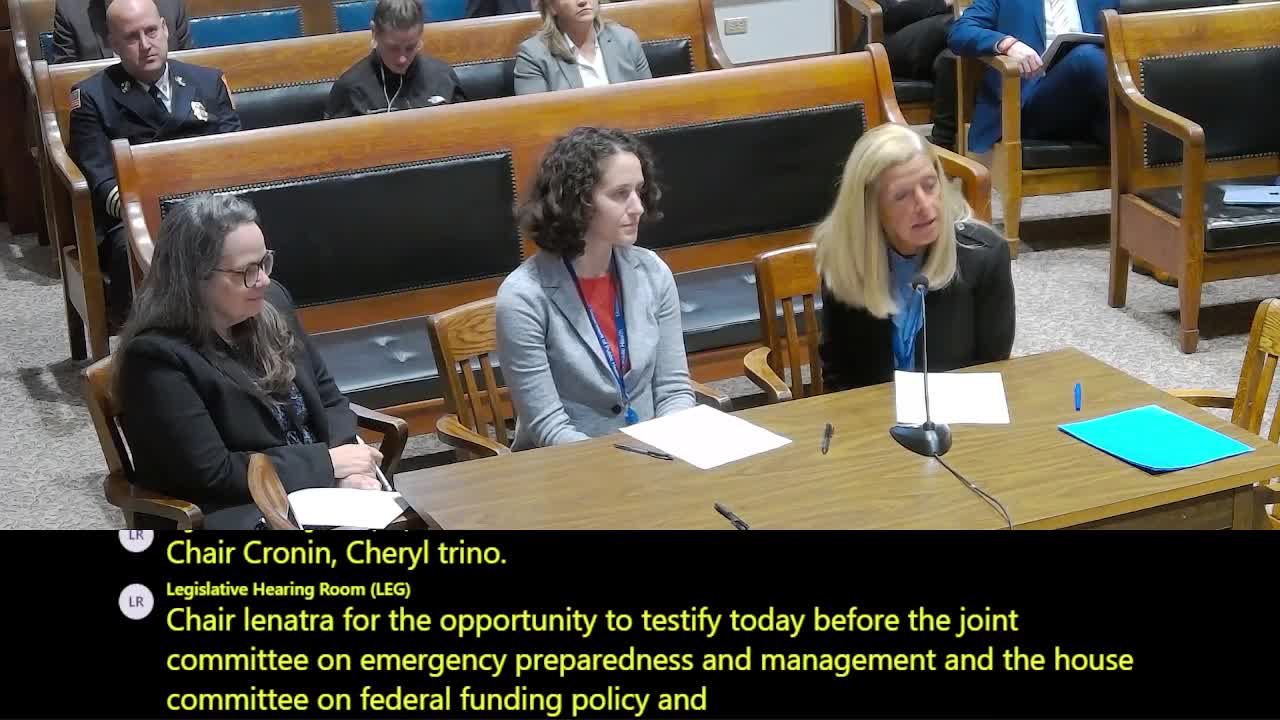
Summary
Public‑health leaders told legislators that the Department of Public Health depends on federal grants (CDC, ASPR, ELC) for nearly all preparedness activities, that some lab programs and BioWatch funding are paused or expiring, and that COVID-era funding will taper off by mid‑2026 unless replaced.
Karen Maleski, director of the Department of Public Health’s Office of Preparedness and Emergency Management, told the committee that DPH’s flagship public‑health warehouse in Franklin — a 75,000‑square‑foot facility adjacent to MEMA — now houses PPE, diagnostics, clinical equipment and medication stockpiles intended to keep the state ready during emergencies.
Maleski said roughly $18,000,000 in federal grants (CDC Public Health Emergency Preparedness and ASPR Hospital Preparedness Program) underpin DPH’s preparedness activities and that the administration’s FY26 proposal would eliminate ASPR and reduce CDC support. "We are dependent on 90% of our funding from the federal government," she said.
Cece Dunn, deputy director of the Bureau of Infectious Disease and Laboratory Sciences, described the state public‑health laboratory’s role and capacities: it performs chemical and biologic threat testing 24/7, operates as a tier‑1 biologic response lab, and supports epidemiologic response. Dunn said Epidemiology and Laboratory Capacity (ELC) funding and BITTLES funding (lab operations) are significant — roughly $6,500,000 and $3,500,000 per year respectively — but that those grants have been reduced in the past and could be further cut in FY26. She also noted BioWatch funding had expired and the program was paused.
DPH witnesses discussed hospital capacity monitoring and a state effort to automate capacity reporting (an ACORN capacity reporting network developed with GE Healthcare). They reported recent average hospital occupancy around 90.3% over the prior three days and said surveillance and supply‑chain tasks supported by federal grants would need to be scaled back if funding expires.
Legislators asked for follow‑up numbers on seasonal respiratory viruses and workforce impacts; DPH agreed to provide more precise figures and additional detail on AI‑related threats to lab and surveillance operations. Speakers recommended sustained state support or replacement funding before federal grants lapse.