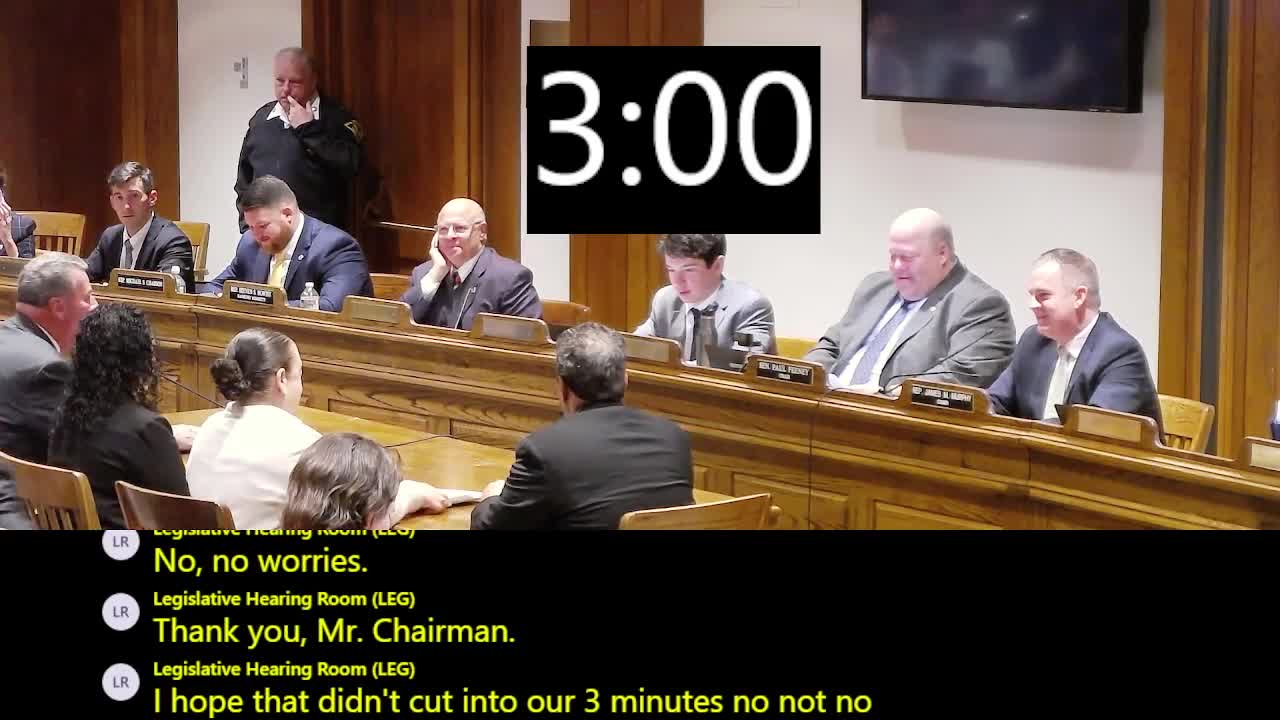
Families of two student athletes urge mandatory EKG screenings in Massachusetts hearing
Loading...
Summary
Families of two teens who died after sudden cardiac events told the Joint Committee on Financial Services that a brief EKG added to athletic physicals could detect hidden heart conditions. Sponsors said the bill (H.B. 4622, “Freddie’s Law”) would start pilot screening programs and work with the Department of Public Health and MIAA.
Representative Thomas Walsh introduced H.B. 4622, called “Freddie’s Law,” as a late‑file bill aimed at adding an electrocardiogram (ECG/EKG) to pre‑participation physicals for high‑school athletes.
The bill’s advocates centered personal testimony. “A test that takes only a few minutes,” Adele Labonte said of an EKG while describing the sudden cardiac arrest that took her son, Freddie Espinel. Labonte told the committee she believes a screening would have detected a hidden condition and pleaded for insurance coverage and statewide screening access.
Jason and Melissa Facey testified about their son JJ, who died two days after his first college practice in August 2024. Jason described the episode, the hospital care and the screening clinic work he and volunteers began afterward. He said community EKG clinics identified abnormal results in several students and argued that ECGs are a "first step" that would lead to follow‑up care: “The ECGs are the first step and then it leads to everything else,” he said.
Committee members probed feasibility, asking whether ECGs alone are sufficient and how follow‑up diagnostics would be handled. Senate Chair Paul Feeney and others acknowledged the families’ testimony while asking for more evidence about test yield, false positives and logistics. Feeney asked whether EKGs should be complemented by other testing such as echocardiograms or ultrasound; Jason Facey and volunteers answered that EKGs detect 80–90% of arrhythmia‑related issues in screening programs and said abnormal findings would trigger cardiology referral.
Health professionals and athletic trainers on the panel offered both support and caution. Several athletic‑care volunteers described low‑cost, rapid screening workflows using portable devices and offsite cardiologist reads; one volunteer summarized the process: a short electrode application, data upload and cardiologist interpretation with benign results returned by email within days and concerning results by phone.
Opposing voices on medical grounds emphasized evidence and infrastructure concerns. A sports cardiology practitioner noted that national medical societies do not currently endorse universal ECG screening for all athletes, citing concerns about false positives, downstream testing capacity and inconsistent evidence that universal screening reduces mortality. She urged the committee to prioritize proven, scalable measures—wider CPR/AED access and training—while continuing to evaluate screening models.
The committee did not take formal action at the hearing. Sponsors asked the committee to continue discussion, refine implementation mechanics (who reads ECGs, insurance coverage, pilot programs) and coordinate with the Department of Public Health and the Massachusetts Interscholastic Athletic Association.
Next steps: staff and sponsors signaled follow‑up work on cost, logistics and clinical protocol before the committee considers formal advancement of H.B. 4622.