Get Full Government Meeting Transcripts, Videos, & Alerts Forever!
Get email alerts on the Remote Participation Town Meetings topic
No spam. Unsubscribe anytime.
Concord, Wayland and others press lawmakers to allow remote participation at town meeting
Summary
Concord and Wayland officials told a joint committee they have plans and technology to let registered voters participate and vote remotely in open town meeting (H4522). Witnesses described authentication, live transcription, a public audit table and planned local education efforts; committee did not act.
Supporters of a Concord home‑rule petition (H4522) told the Joint Committee on Election Laws that remote participation in open town meeting could expand access for residents who cannot attend in person.
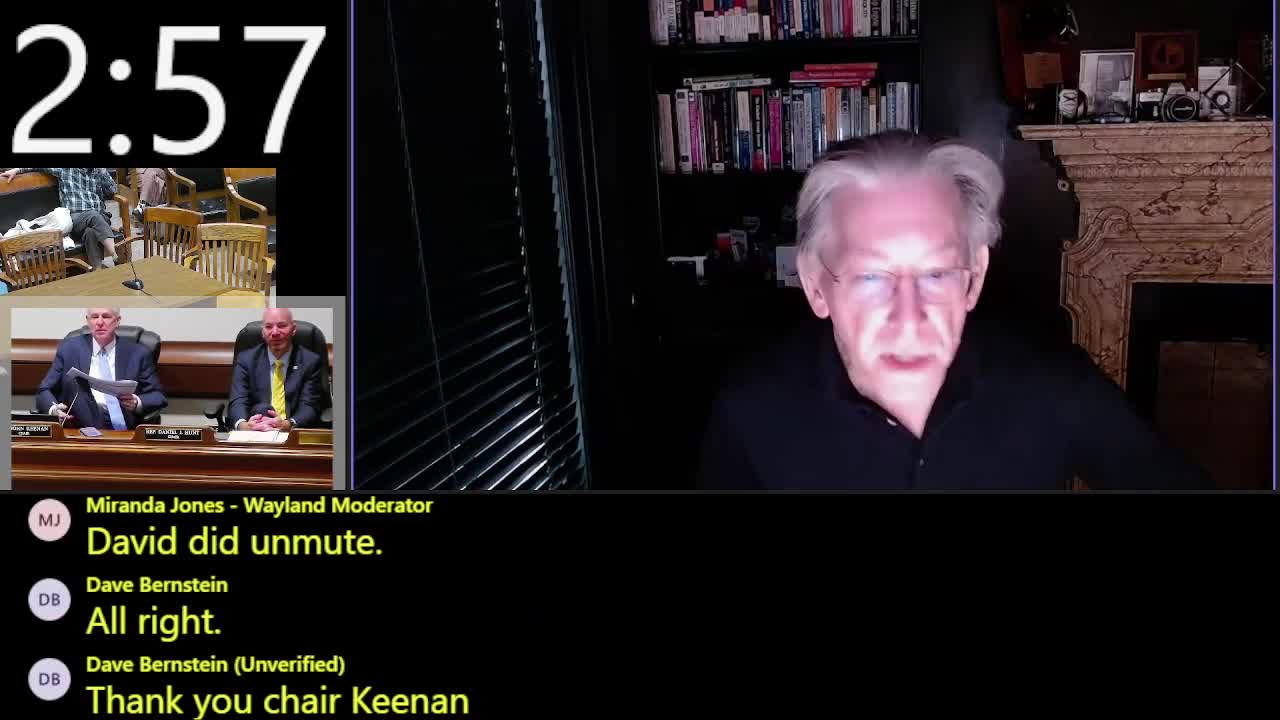
Miranda Jones, moderator of Wayland's town meeting, and David Bernstein, chair of Wayland's electronic‑voting committee, described technical and operational safeguards they say would protect the integrity of hybrid deliberations. Bernstein outlined a browser‑based system that uses voter codes, two‑way video for check‑in (a still image retained for the session), live transcription for remote participants and a public audit table allowing voters to verify that their votes were recorded correctly. Bernstein said the design intentionally avoids facial‑recognition technology.
Concord residents and town officials including David Carr, David Allen, and Select Board member Wendy Rebelli told the committee Concord voters and town bodies have repeatedly supported pilot steps; a town study committee and a survey indicated strong local backing. "Concord is prepared to support implement both of these measures as soon as they are authorized," Rebelli said, adding Concord's existing voting equipment is RCV‑compatible and staff have brief implementation plans.
Testimony acknowledged trade‑offs: some speakers said remote participants may not fully share the in‑room deliberative experience, while others argued the representativeness gains justify a pilot. Committee members pressed witnesses on equity for residents without smartphones or reliable Internet; Bernstein and others suggested local accommodations (on‑site devices or transport to town facilities) and borrowing existing voter‑education materials.
The committee did not take a vote on H4522. Supporters offered to provide technical documentation and sample educational materials to committee staff if requested.
Sources: testimony to the Joint Committee on Election Laws from Miranda Jones (Wayland moderator), David Bernstein (Wayland electronic‑voting chair), David Carr and David Allen (Concord residents), and Wendy Rebelli (Concord Select Board).