Get Full Government Meeting Transcripts, Videos, & Alerts Forever!
Get email alerts on the Higher Education Capital topic
No spam. Unsubscribe anytime.
Mass. hearing on BRIGHT Act advances $2.5 billion plan for campus repairs as lawmakers press for equity and decarbonization details
Summary
The Joint Committee on Bonding, Capital Expenditures and State Assets heard testimony supporting House Bill 5493 (the BRIGHT Act), a proposal to leverage Fair Share surtax revenue to issue bonds and unlock roughly $2.5 billion for public higher-education capital projects. Officials and campus leaders urged quick deployment while legislators debated distribution, decarbonization costs and labor protections.
President Meehan, Secretary Gorkowitz and multiple campus presidents urged lawmakers Thursday to back House Bill 5493, the BRIGHT Act, a proposal to finance major repairs and modernization at Massachusetts public higher-education campuses.
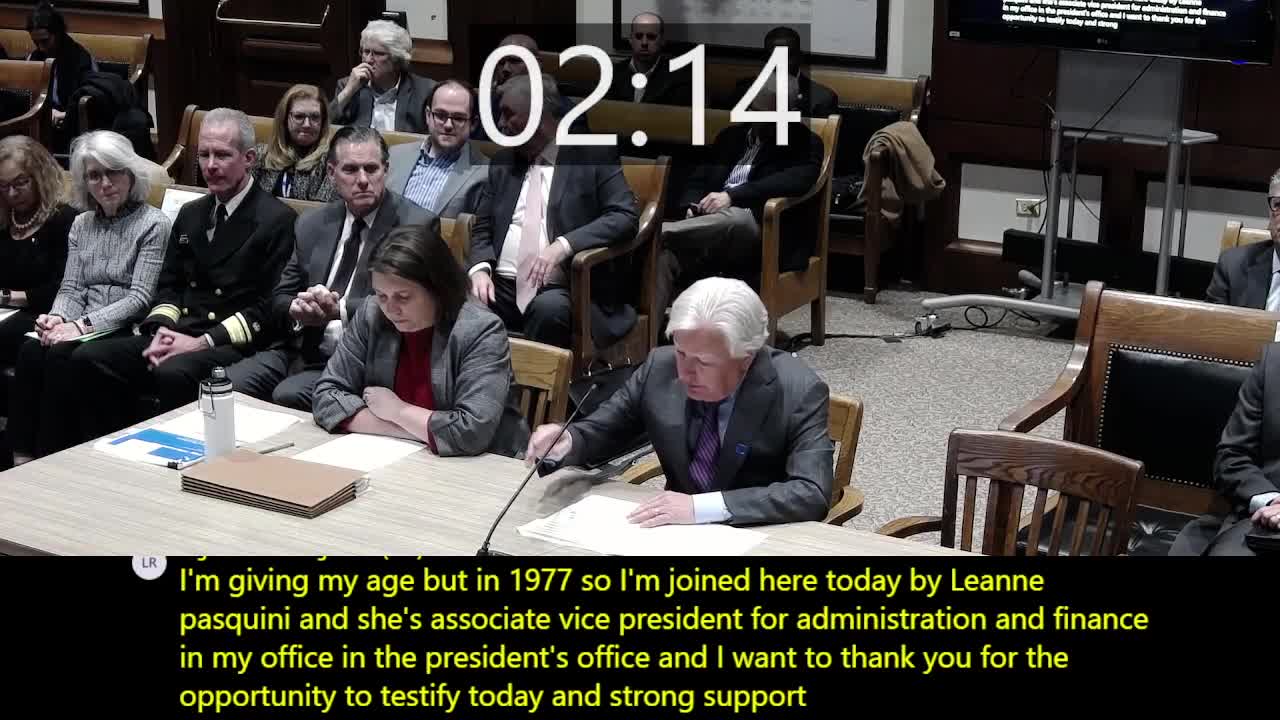
President Meehan, representing the University of Massachusetts system, told the joint committee the system is confronting a $4.8 billion deferred maintenance backlog and that the BRIGHT Act would be "a generational investment in public higher education." He described aging building stock, the system's biennial capital plan and data-driven prioritization processes designed to target the most urgent facility needs.
The administration’s financing plan, presented by Secretary for Administration and Finance Gorkowitz, would use a portion of Fair Share surtax receipts to support special-obligation bond financing modeled after the Commonwealth Transportation Fund. Gorkowitz said the administration proposes $2.5 billion targeted to the public higher-education systems over a 10-year horizon, plus $500 million in authorizations for smaller modernization, planning and workforce grants. He cited FY24 and FY25 surtax receipts of roughly $2.46 billion and nearly $3.0 billion, respectively, as the revenue source for the structure.
Commissioner Noah Ortega of the Department of Higher Education emphasized the student-facing rationale: more than 135,000 students attend the state's public colleges and universities, and modern lab and classroom space supports retention, workforce preparation and equitable access. Commissioner Adam Bakke of the Division of Capital Asset Management and Maintenance told the committee that higher education represents a large share of DCAM’s building portfolio and that decarbonization and deferred-maintenance needs together amount to multiple billions statewide.
Lawmakers probed several policy and program details. Senators and representatives repeatedly asked whether the proposed authorization — roughly $2.5 billion in principal — is adequate against larger estimates of system needs; one legislative member cited a working-group figure he described as $25 billion in combined needs. Secretary Gorkowitz called the proposal a "first step" that the administration expects to fully program and deliver over a decade and said the financing structure should receive a strong credit rating when marketed, given its revenue model and design.
Several members raised distributional concerns. The administration proposes allocating funds broadly by square footage and historic legislative practice (the proposal allocates roughly 50 percent to the UMass system and the remainder among state universities and community colleges), but campus presidents and community-college leaders urged a more proportional or equitable split — several asked for a one‑third/one‑third/one‑third distribution to reflect enrollment and growing community-college demand. The Council of Presidents and multiple individual presidents pressed for an increased cap or a multi‑year authorization horizon to avoid re‑creating past underspending problems.
Questions about labor and procurement practices surfaced repeatedly. Representative Saunders and witnesses discussed project labor agreements; President Meehan said PLAs have been used on some UMass projects and that the UMass board includes a representative of organized labor. Building-trades witnesses urged explicit procurement language to ensure decarbonization work and utility-led projects remain subject to public-bid and prevailing-wage rules.
Committee members also asked about how BRIGHT funds would leverage private or federal money and the program’s expected local economic impact. UMass leaders said projects often catalyze private fundraising and naming opportunities and that large-scale campus work would create construction jobs statewide. Building-trades representatives framed the bill as a jobs bill and urged prompt execution to take advantage of currently available contractors and apprenticeships.
On technical tradeoffs, members pressed DCAM and campus leaders about whether to prioritize comprehensive decarbonization (which can be costlier up-front) or phased energy-efficiency upgrades. DCAM officials argued that integrated projects can achieve efficiency and decarbonization benefits simultaneously and that targeted funding for lab modernization and master planning would make projects shovel-ready.
What’s next: the hearing produced no formal vote on the bill. Committee leaders closed a lengthy public record and said staff would circulate an electronic poll for internal committee business before moving to executive session. If passed by the committee, the measure would proceed through the legislature for further deliberation and potential amendment on allocation, procurement language and programmatic details.
Key quotes from the hearing:
"This legislation and the funding attached to it represents a generational investment in public higher education," President Meehan said in urging support for the BRIGHT Act.
"We propose $2,500,000,000 for universities and community colleges," Secretary Gorkowitz said, adding the plan also authorizes $500,000,000 for targeted programs and planning.
"Decarbonization alone could consume a large share of the traditional capital plan if we don't secure additional resources," Commissioner Bakke warned, framing the BRIGHT Act as a way to avoid shifting the entire burden onto other state priorities.
The committee requested additional written follow-ups on project-labor policies, the UMass Building Authority's PLA rules, and details about the administration's prioritization tools and shovel-ready project lists.