
Early Education staff announce November C3 updates: new attestation and 50% workforce requirement for centers
Get AI-powered insights, summaries, and transcripts
Subscribe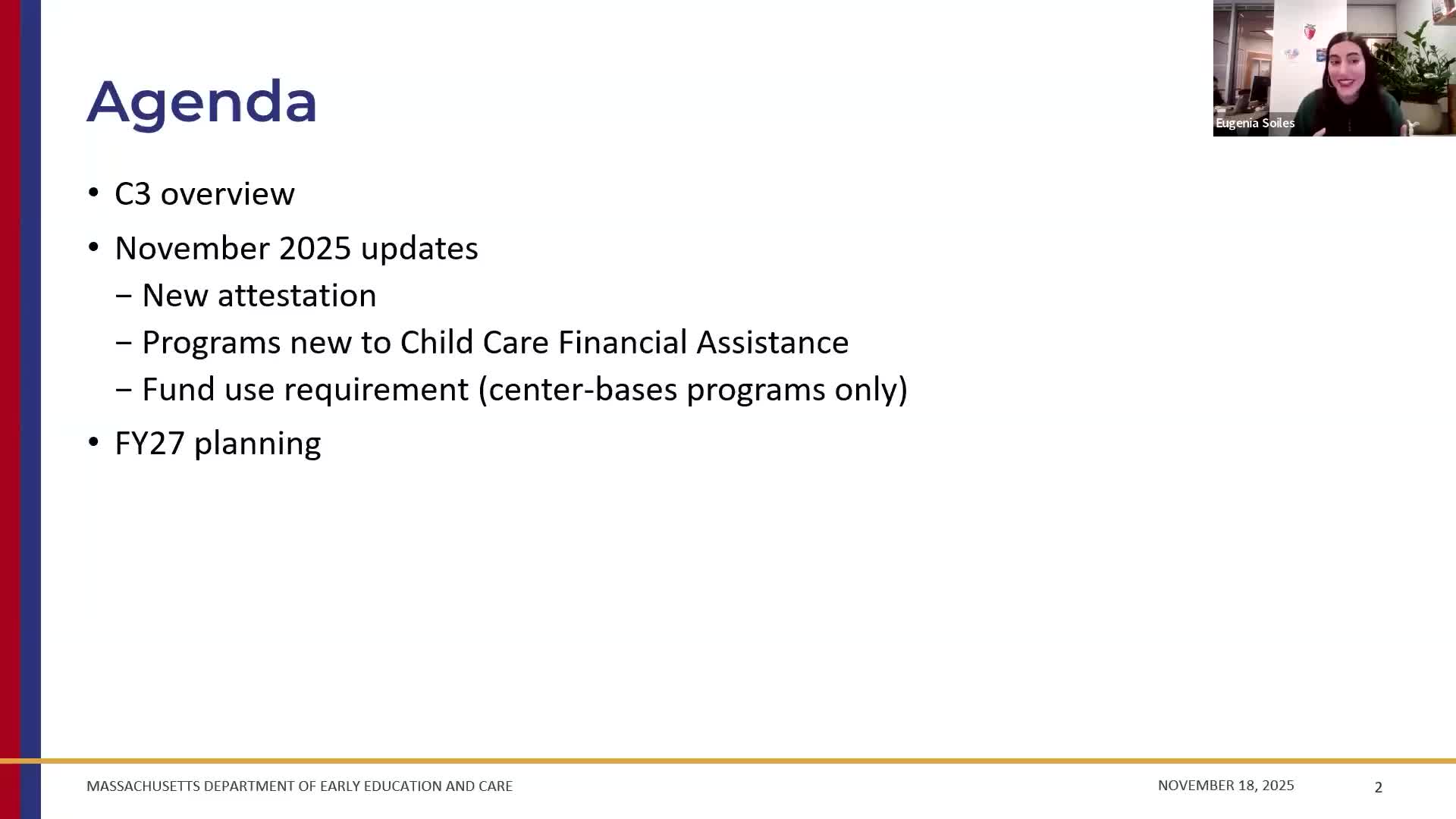
Summary
Department of Early Education and Care staff told providers in an online session that November updates to the C3 funding run will not change the formula but will change allocations; programs receiving C3 must attest to willingness to enroll children using Child Care Financial Assistance vouchers and center-based programs must direct 50% of C3 funds to workforce investments.
In an online information session, Department of Early Education and Care staff outlined changes to the C3 funding run that take effect in November, including a new statutory attestation for programs receiving C3 funds and a requirement that center-based programs spend half of their guaranteed C3 allocation on workforce investments.
The department said the underlying C3 formula — made up of a licensing/capacity component, a base-rate index and an equity adjustment — is not changing. Staff warned, however, that program allocations can shift when the formula is re-run to reflect changes in recent 12-month enrollment and voucher counts. "The formula we just reviewed is not changing; what can change is the amount programs receive once the formula is re-run," staff said during the session (translated from Portuguese).
Assistant Commissioner for Family Access and Engagement Tereza Nicolas described Child Care Financial Assistance (CFA) as a state-funded program that helps low- and moderate-income families pay for child care across settings from infant care through before-and-after-school and summer programs. Nicolas said providers that wish to receive CFA payments must be licensed or have an approved license extension and must complete required documentation and coordination with local referral agencies. "Child equity is critical support for many families," Nicolas said (translated).
One new statutory requirement presented in November is that every program receiving C3 funds must attest in its application that it is willing to enroll children who use CFA vouchers and accept referrals. That attestation will appear in the monthly C3 application and the department said it will publish a public list of programs that have made the attestation on its website.
Staff also explained how CFA reimbursement rates are set: they depend on provider type (for example, family-based versus center-based), region, and child age group, and may include a parental share amount. Programs were told to expect monthly payments once eligibility and enrollment are established.
A central change for center-based programs is a workforce-investment rule covered in the session. Alicia, an associate senior commissioner-level presenter, said the department will require that 50% of a center’s guaranteed C3 funding be used for workforce investments, such as salaries, benefits, recruitment and retention, and professional development. As Alicia put it during the session (translated), "If your monthly C3 is about $100,000, then $50,000 of that funding will be allocated toward workforce investments." Staff advised programs to review which funding streams currently pay staff and to allocate workforce funds using FTEs or by location as appropriate.
The department urged providers to submit their November applications promptly so programs can understand what they will receive for the final two months of the year. Staff said recertifications and inputs for October through December must be completed by Dec. 30; after that the department will close that quarter and begin a new cycle. The department said it anticipates the next detailed analysis in January 2026 and plans targeted training sessions and additional communication for center-based providers in early 2026.
During a participant comment near the close of the session, an attendee thanked staff and noted the department had received $175,000,000 this cycle but said additional funding would be needed for more significant changes to the C3 formula and allocations. Staff reiterated that public comment opportunities will continue and that they will bring formal proposals to relevant governing bodies before making major changes.
The department said slides and a recording of the session will be posted and that staff are available by email to answer questions not resolved in the meeting. The department also encouraged programs to contact leadership and CPAs to help identify permissible uses of C3 funds and to plan spending and accounting changes.