Get Full Government Meeting Transcripts, Videos, & Alerts Forever!
Get email alerts on the Criminal Justice topic
No spam. Unsubscribe anytime.
Joint Judiciary hearing: advocates urge end to lifetime parole for juveniles and phased 'raise the age' while victims' families warn of public-safety risks
Summary
Dozens of people with lived experience, reentry groups and legislators told the Joint Committee on the Judiciary that S1087/H2051 to end lifetime parole for people sentenced as juveniles and H1923 to raise juvenile jurisdiction warrant action; victims' family members and some survivors urged caution, saying the measures could remove important supervision tools.
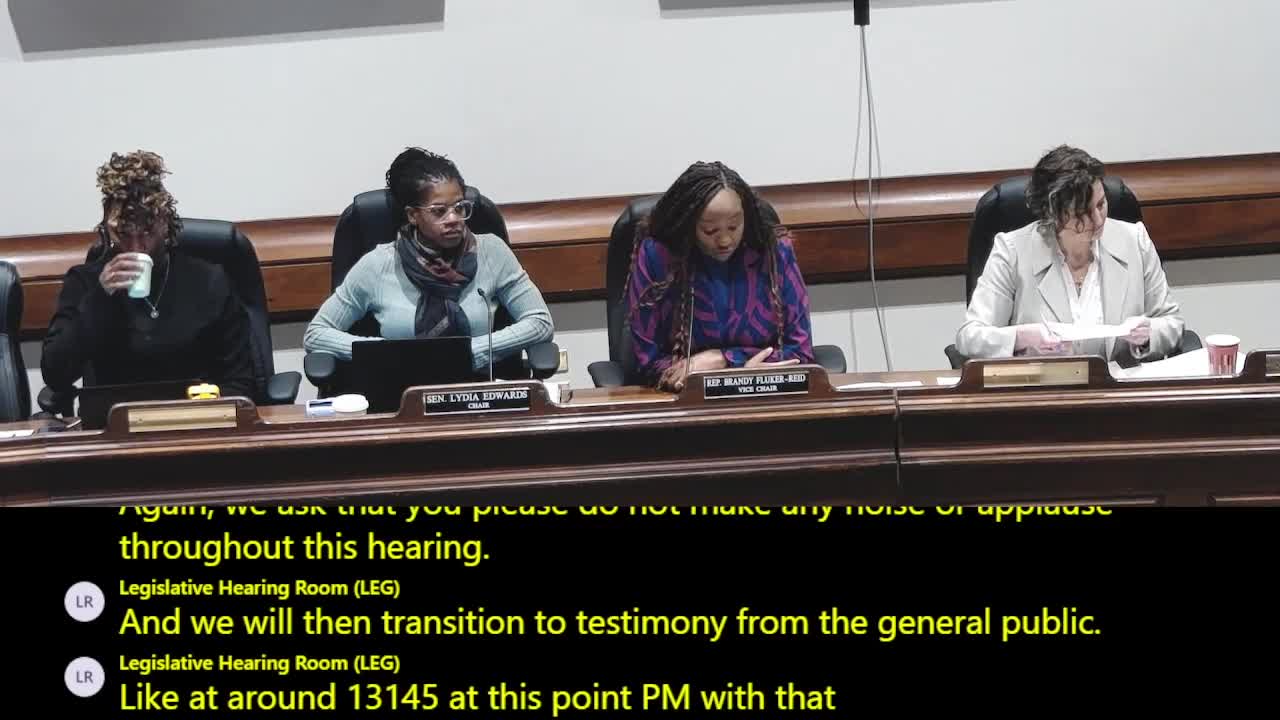
Vice Chair Brandy Flicker Reid and Senate Chair Lydia Edwards convened a packed joint hearing where S1087/H2051 (end lifetime parole for juveniles and emerging adults) and H1923 (raise the age) drew the largest turnout.
Supporters filled the room and the virtual queue. People who had been incarcerated starting as juveniles described childhood trauma, brain development and decades of rehabilitation and said lifetime parole keeps them trapped in fear. "Lifetime parole tells us that freedom for some is never fully earned," said Kyron Gorham, an Emerson Prison Initiative student speaking from custody. Multiple witnesses—including representatives of UTEC, the Transformational Prison Project and formerly incarcerated speakers—said the bills would restore stability, improve employment and reduce unnecessary returns to custody for technical violations.
Advocates and some legislators framed H1923 and S1087/H2051 as narrowly targeted reforms. Senator James Eldridge described S1087 as applying to people sentenced for loss-of-life offenses between ages 14 and 21 who have served at least 15 years and remained law-abiding for three years on parole; he said the measure would be applied retroactively for eligible people.
But several family members of homicide victims and survivors testified in opposition, arguing that removing lifetime parole would reduce tools to protect the public from seriously dangerous people. "Eliminating lifetime parole removes one of the only tools we have to protect families from the rare but extremely dangerous offenders," said Jasmine Jeffrey, who identified a relative killed by an offender age 20.
Other witnesses gave fiscal and programmatic context: attorneys, law professors and advocacy groups cited research on brain development and recidivism and presented budgetary estimates and program needs for juvenile-focused services and reentry supports. Some testified that ending lifetime parole could save money by reducing decades of supervision costs and lowering reincarceration for technical violations; others argued the cost to public safety was unclear.
The hearing produced no formal committee votes. Chairs and witnesses emphasized the need for further technical drafting and stakeholder work, and the committee invited written testimony and follow-up materials ahead of consideration.