Banks, credit unions and consumer advocates warn of rising scams; FTC data cited at legislative hearing
Loading...
Summary
At a Nov. 18 committee hearing, banking and consumer-protection witnesses described detection and education efforts, urged better coordination and cited FTC estimates that Oregonians lost roughly $125 million to scams in 2024, with older adults disproportionately affected.
Banking and consumer-protection representatives told the House Interim Committee on Commerce to Consumer Protection on Nov. 18 that scams are growing in scale and sophistication, and that coordinated prevention and rapid-response systems are essential to limit financial losses.
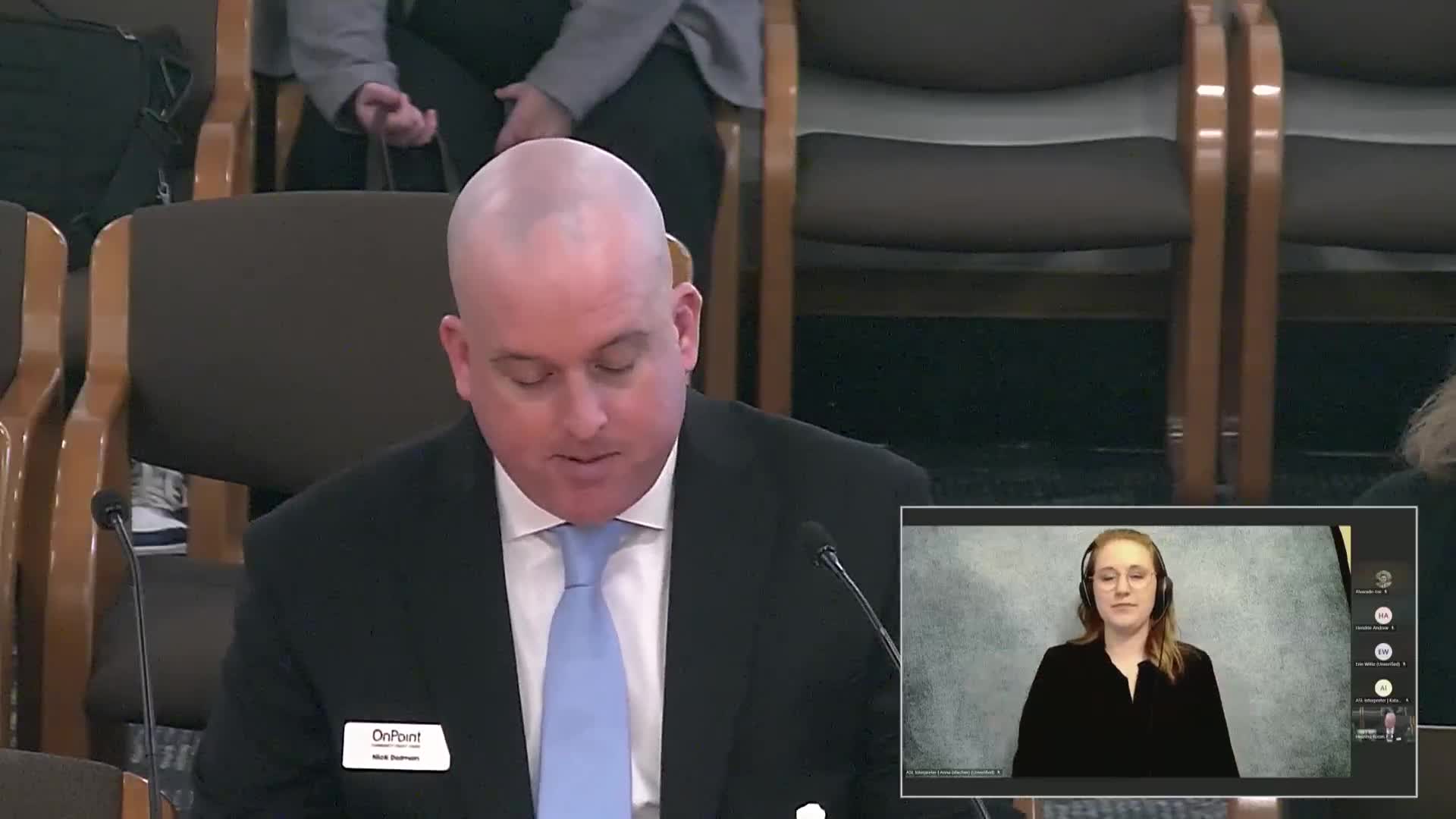
Nick Dolman, fraud manager at OnPoint Community Credit Union, said OnPoint uses real-time systems, staff training and transaction monitoring to detect and interrupt suspicious activity; he gave an example where investigators delayed a transfer and prevented a large loss after identifying a receiving account tied to known fraud. "System design and consistent education can interrupt a scam," Dolman said, describing fraud training and outreach the credit union conducts.
Pam Lovett (Oregon Credit Union Association) summarized federal privacy and consumer-protection obligations facing credit unions, including the Gramm-Leach-Bliley Act, and said regulators regularly examine institutions' compliance with those rules.
Kevin Christensen (Oregon Bankers Association) and Betsy Steinberg (Pioneer Trust Bank) described industry training programs, the Bank Safe initiative with AARP, and the utility—and limits—of tools such as account holds and the Bank Secrecy Act for identifying suspicious activity and elder financial exploitation.
Consumer Federation of America director Erin Wittie cited Federal Trade Commission estimates showing roughly $125,000,000 in losses to Oregonians from fraud in 2024 and warned that losses are likely underreported; she said the FTC estimates consumers report as little as 2% to 6% of actual losses, and that fraud categories such as crypto-related scams and payment-app schemes contribute to the totals.
Committee members asked about statewide magnitude and trends. Panelists said precise statewide totals are difficult to assemble quickly, urged improved interagency coordination and funding for investigators, and emphasized the need for rapid bank response when customers report suspected fraud.
Speakers did not request a specific bill at the hearing but offered to work with legislators on ways to strengthen enforcement, reporting and victim assistance.