Get Full Government Meeting Transcripts, Videos, & Alerts Forever!
Get email alerts on the Behavioral Health Workforce topic
No spam. Unsubscribe anytime.
State’s $80M workforce investments show early gains in credentialing and retention, OHA tells committee
Summary
Oregon officials reported progress from multi-million-dollar investments in behavioral health workforce incentives — including scholarships, waived fees, clinical supervision grants and loan repayment — and said the programs have increased credentialing and retention so far, though long-term monitoring continues.
State officials told the Senate Interim Committee on Early Childhood and Behavioral Health that recent state and federal investments in behavioral health workforce programs are producing measurable increases in credentialing and retention, while acknowledging more work is needed to scale the pipeline.
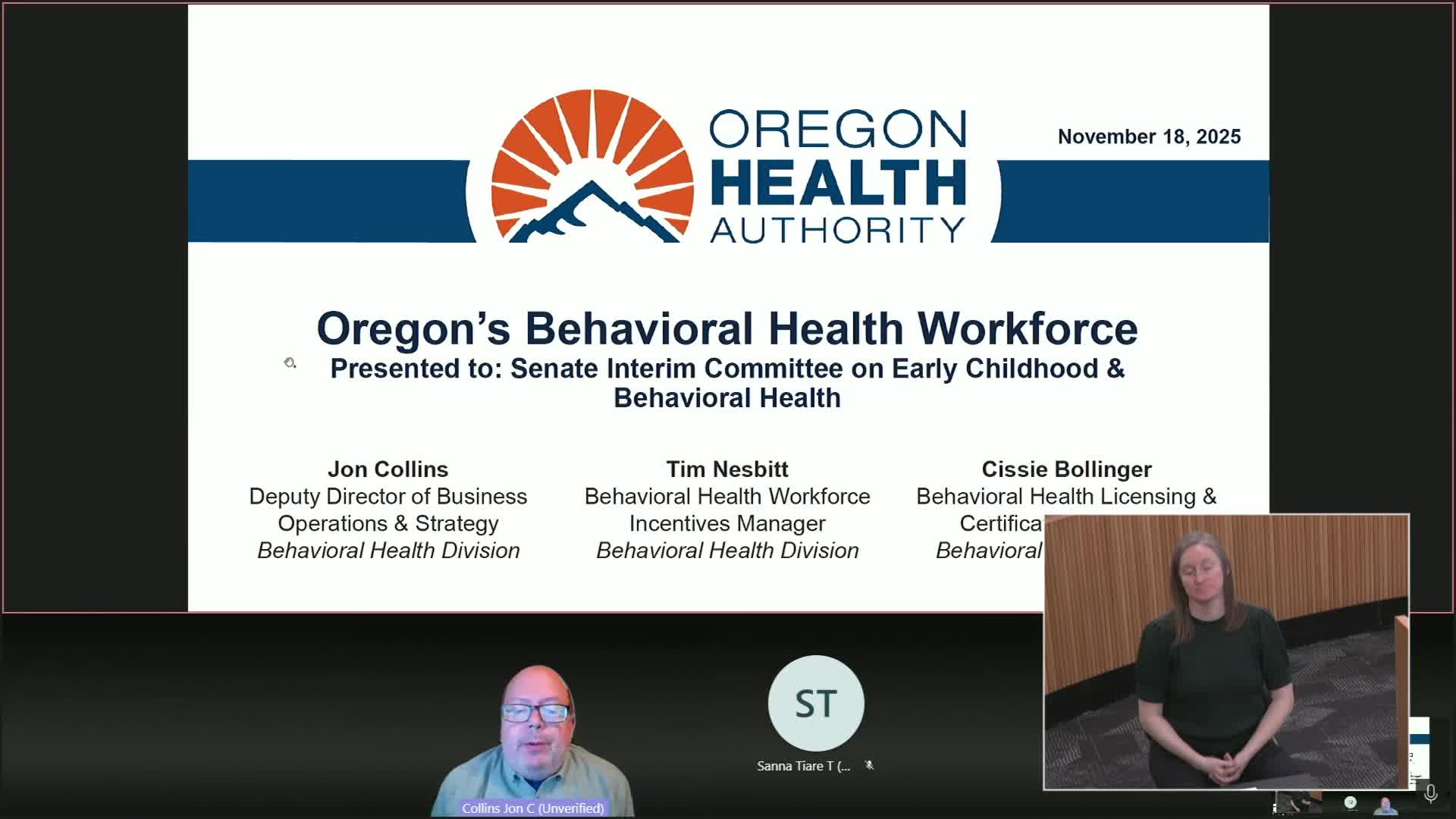
Tim Nesbitt, manager of OHA’s Behavioral Health workforce incentives team, reviewed programs funded through House Bill 2949 (2021) and subsequent appropriations. Nesbitt said the bill "appropriated $80,000,000" split between workforce incentives and clinical supervision and that those funds supported scholarship and tuition assistance, credential-fee waivers, loan repayment, bonuses and clinical supervision expansion.
Nesbitt cited program metrics including hundreds of scholarships and tuition awards, thousands of registrations for lower-barrier certified roles, and high retention rates for supervisees and supervisors in clinical supervision grants (mid-to-high 80 percent range). He noted loan repayment awards (about $15.8 million to providers across 25 counties), with an average award of roughly $65,000 and 89% retention during service commitments.
The division also described targeted investments in specialty training: OHA has supported child and adolescent psychiatry (CAP) fellowship positions at OHSU and a developmental pediatrics program to expand clinical capacity; Nesbitt said the state aims to reach about 10 CAP fellows by the 2026–27 academic year.
Nesbitt highlighted expansion of career and technical education (CTE) programs at several high schools to build early pipelines into behavioral health careers, including paid internships and peer-support certifications for students.
Why this matters: committee members said expanding the credentialed workforce — especially child and family specialists — is essential to improving access to behavioral health services for children and families. OHA said many programs are still within expected timeframes for credentialing and that results should grow as multi-year investments mature.
What’s next: OHA will continue rolling out its House Bill 2024 grant program, prioritize child and family providers in applications, and monitor metrics; the committee scheduled additional follow-up and requested clarifications on specialty program counts.