Advisory council endorses new bachelor’s‑level youth behavioral health credential to expand early‑intervention workforce
Loading...
Summary
A Systems of Care Advisory Council subcommittee recommended creating a bachelor’s‑level youth and family behavioral health license overseen by the mental health regulatory agency/Board of Psychology; proponents say it will expand prevention capacity in schools and primary care and diversify the workforce while requiring supervision by master's‑level clinicians.
A subcommittee formed under House Bill 4,151 recommended that Oregon create a new bachelor’s‑level youth and family behavioral health provider license to expand early identification, prevention and culturally responsive care for children and families.
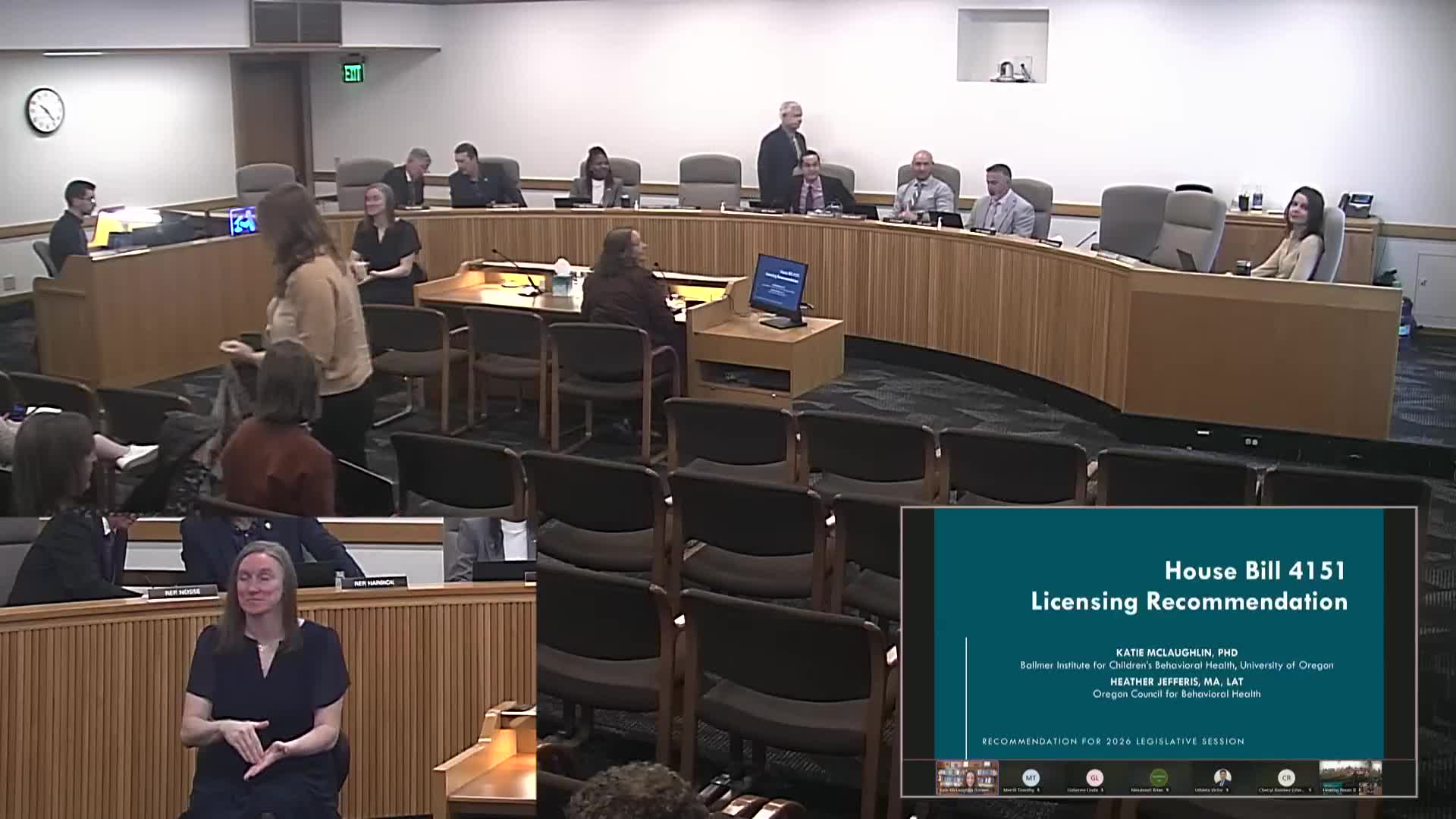
Dr. Kate McLaughlin (Ballmer Institute for Children’s Behavioral Health) told the committee the Systems of Care Advisory Council endorsed a detailed legislative recommendation to establish a distinct credential that would be overseen by the state mental health regulatory agency and implemented through the Board of Psychology. “The recommendation is for a new bachelor's level youth and family behavioral health provider license,” she said.
Scope and guardrails: The proposed credential would emphasize early identification and brief prevention‑oriented interventions in settings such as pediatric primary care, schools and community organizations. It would not permit independent practice or diagnosing; licensees would require supervision by a master's‑level licensed provider and would be prohibited from opening independent private practices. The recommendation includes required coursework, supervised applied practice and a qualifying exam with culturally responsive training requirements.
Rationale and expected impacts: Advocates said the credential would create a professionalized entry rung that enables billing pathways, improves retention, and increases racial and ethnic diversity in the workforce. McLaughlin and Oregon Council for Behavioral Health representatives presented Oregon data showing licensed master's‑level providers are majority non‑Hispanic white while entry‑level qualified mental health associates are substantially more diverse; they argued a new bachelor’s credential would help diversify the clinical pipeline.
Oversight and costs: The mental health regulatory agency and the Board of Psychology indicated willingness to oversee the credential and told the subcommittee the implementation costs could be absorbed without adding new full‑time equivalents.
Next steps: The recommendation was approved by the full Systems of Care Advisory Council and proponents plan to advance a committee bill during the 2026 short session. Committee members signaled support and asked for additional implementation details in forthcoming bill drafts.