ODOT, DEQ and industry groups outline EV charging grants, legal risks and incentives
Loading...
Summary
State and industry witnesses told the Senate committee about NEVI and other federal funds, ODOT and DEQ grant programs, and federal regulatory actions that could affect Oregon’s clean-vehicle progress; ODOT described NEVI and EVC RAA funding, DEQ outlined ~$70 million in 2025 rebate and heavy-duty funding, and industry groups urged continued stable incentives and grid investments.
State officials and industry groups told the Senate Committee on Transportation that federal funding and recent federal policy moves create both opportunities and legal uncertainty for Oregon’s electrification efforts.
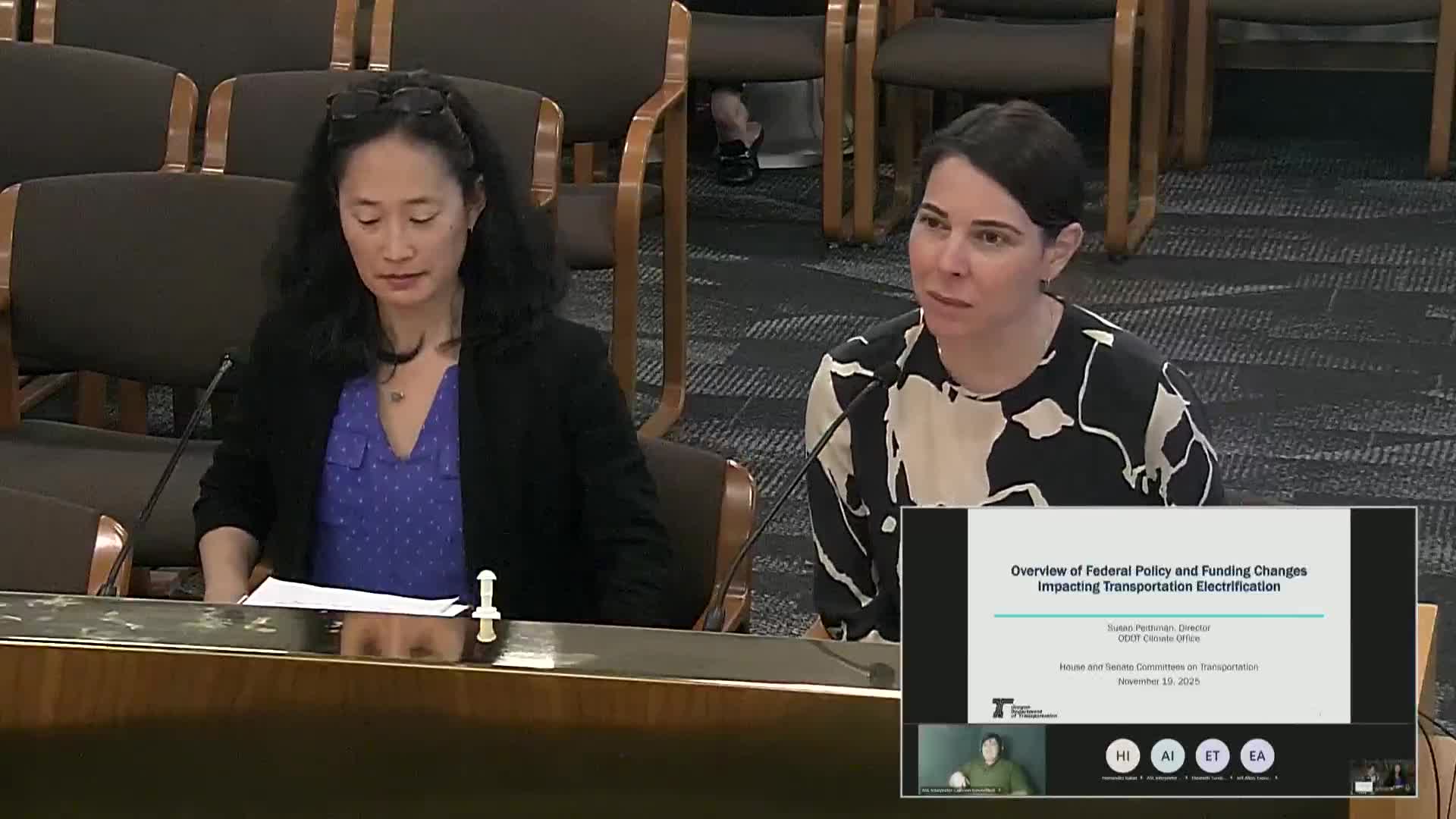
Susan Piethman, director of ODOT’s climate office, described ODOT programs that guide public charging deployment and use of federal funds. She said NEVI formula funds (stated in testimony as $52,000,000) will help create a corridor backbone of high‑powered chargers and that ODOT has been awarded $10,000,000 in discretionary EVC RAA funds to repair and upgrade chargers. Piethman noted the Federal Highway Administration briefly suspended NEVI guidance, that Oregon joined a multi‑state lawsuit and that a preliminary injunction restored access; ODOT has obligated the full amount available through fiscal year 2025 and plans additional funding rounds and grant opportunities intended to award funds by 2028.
Rachel Sakata of the Department of Environmental Quality warned of recent federal actions that could undercut federal greenhouse-gas and clean-vehicle rules — including an EPA proposal to rescind the 2009 endangerment finding and Congressional action that affects waivers for California standards and federal credits — and described DEQ’s 2025 funding portfolio of about $70,000,000 for light, medium and heavy-duty zero-emission vehicle rebates and charging programs. She said legal uncertainty may slow some enforcement and that the state is working to preserve incentives.
Industry witnesses (Elizabeth Turnbull of the Alliance for Transportation Electrification and Jeff Allen of Fourth) described market interest in EVs, utilities’ TE plans and the need to fix the road-user charge and sustain rebate windows to preserve equitable access. Allen recommended adjustments to Oregon’s per-mile road-user fee and urged more stable funding for the Clean Vehicle Rebate program to avoid oversubscription and unpredictable application windows.
Witnesses emphasized the need for reliable fast-charging on corridors, grid readiness for medium/heavy-duty charging, and targeted community charging programs for rural and multifamily housing. Committee members raised reliability and geographic-coverage concerns as barriers to wider EV adoption in remote areas.