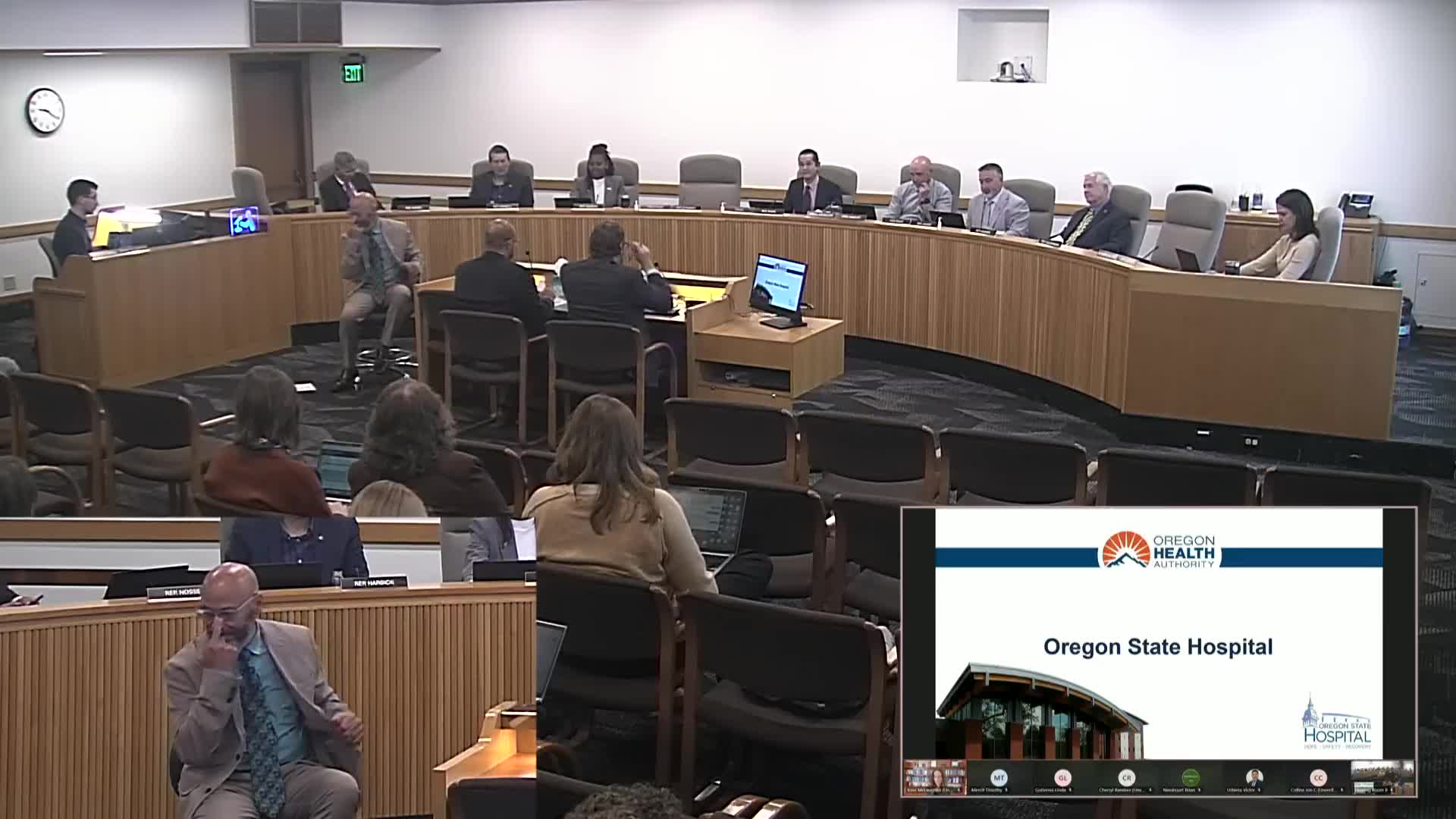
Oregon State Hospital sees shift toward aid‑and‑assist population; officials warn capacity and staffing remain constraints

House Interim Committee on Behavioral Health · November 19, 2025

Get AI-powered insights, summaries, and transcripts

Subscribe
AI-Generated Content: All content on this page was generated by AI to highlight key points from the meeting. For complete details and context, we recommend watching the full video. so we can fix them.

Summary

Oregon State Hospital leaders told the House committee that aid‑and‑assist (competency restoration) patients now make up the largest share of inpatients, driving throughput pressure, recurring wait lists and reliance on agency nursing; they outlined interactions with the federal Mink/Bowman order and House Bill 2005 changes.

Oregon State Hospital (OSH) leaders told the House Interim Committee on Behavioral Health that the hospital’s patient mix and admission dynamics have changed substantially over the last decade, increasing strain on beds and staffing.

Dave Baden, deputy director of policy and programs at the Oregon Health Authority, said the hospital system includes approximately 3,000 staff and serves, on average, about 700 patients across Salem and Junction City. He described OSH as the state’s highest‑level psychiatric backstop, treating individuals with the most complex needs and providing inpatient medical/psychiatric care and competency restoration litigation support.

Dr. Amit (interim chief medical officer) described the patient breakdown and clinical implications: “For the aid and assist patients, they are typically coming in because they are not able to stand trial. So our main focus here is to restore competency.” He explained aid‑and‑assist admissions are often short, high‑intensity stabilization episodes (roughly three months) with limited background information at intake; GEI (guilty except for insanity) patients are typically a longer‑term PSRB population needing skills training and gradual step‑down placement.

Capacity and throughput: OSH staff reported increasing admission orders (110 admissions in October was cited as a recent example) and a persistent wait list for inpatient beds. Baden said new 16‑bed secure residential treatment facilities materially move wait lists when they open, but they do not eliminate statewide capacity constraints when demand is rising.

Legal and policy interaction: Baden summarized how the federal Mink/Bowman ruling and House Bill 2005 (passed in the most recent long session) interact with OSH operations, noting HB 2005 adjusted restoration timelines and created distinct community restoration limits. Baden said OHA must continue to comply with the federal order and that the agency is monitoring how state changes and court practices affect admissions and discharges.

Staffing and sentinel events: Committee members pressed OSH leadership on workforce and safety. Baden said clinical leadership turnover has been addressed with a new clinical leadership team and said the hospital has made progress on seclusion and restraint metrics through focused reporting and training. He called out nurse staffing as the hospital’s most acute hiring challenge: while psychiatry and psychology positions are largely filled, nursing vacancies force OSH to rely on contracted agency nurses with significant budgetary impacts.

What the committee asked for: Members sought more detail on capacity planning, options for separating forensic and civil commitment populations, and the prospects for federal waivers or changes to Medicaid/IMD rules to support larger or differently configured facilities. OSH officials said these were ongoing discussions with counties, jails and federal stakeholders and that they will continue to support the legislature with data and updates.

Next steps: OSH and OHA staff said they will continue workgroup coordination with counties and judicial partners and return to the committee with requested analyses and updated throughput/capacity numbers.