Lifetime Citizen Portal Access — AI Briefings, Alerts & Unlimited Follows
State officials outline Oregon’s EV infrastructure programs and warn of federal regulatory headwinds
Loading...
Summary
ODOT and DEQ outlined federal formula and discretionary EV infrastructure funds (NEVI, EVC RAA, charging and fueling grants), described state rebate funding of roughly $70 million for 2025, and urged stability amid federal changes that could reduce vehicle emissions oversight and tax credits.
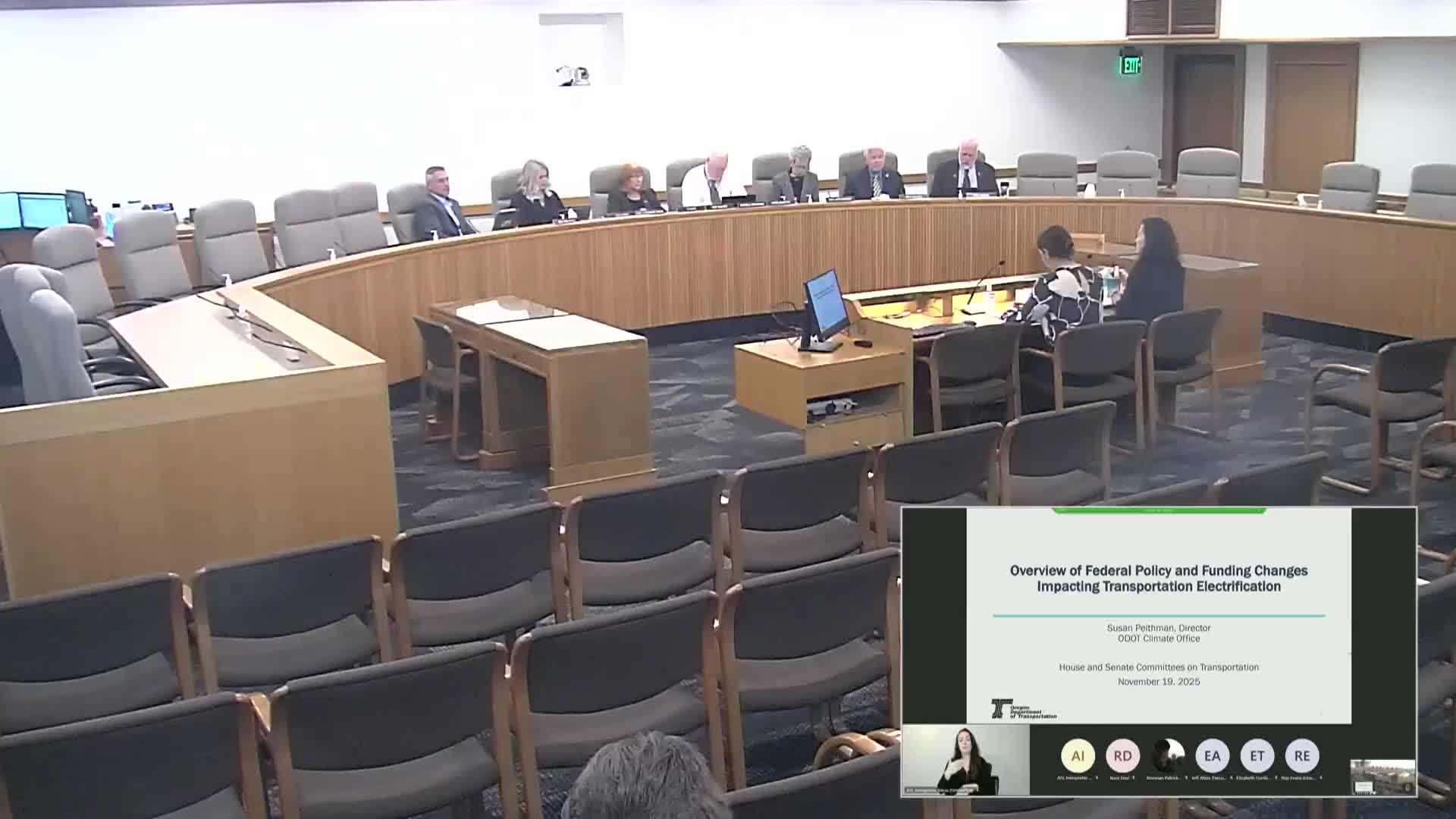
Susan Peithman, director of the Oregon Department of Transportation Climate Office, told the House Interim Committee on Transportation that ODOT is focusing on three priorities for transportation electrification: a backbone fast‑charging network along major highways, community-level level‑2 charging in multifamily and public parking, and medium- and heavy‑duty charging and hydrogen refueling on freight routes.
Peithman described ODOT’s Transportation Electrification Infrastructure and Needs Analysis (TINA) as the data-driven roadmap guiding public investment. She said federal funding from the Infrastructure Investment and Jobs Act (IIJA) notably increased resources for EV charging. Key programs she named included the National Electric Vehicle Infrastructure (NEVI) formula program and discretionary grants for medium- and heavy-duty charging. Peithman said NEVI provides roughly $52,000,000 in formula funds to Oregon to create a corridor backbone with chargers roughly every 50 miles and that ODOT has obligated funds for fiscal years 2022–2025 and is preparing requests for FY2026 obligations.
On reliability, Peithman said ODOT won a discretionary reliability grant (EVC RAA) of $10,000,000 to repair and replace fast and level‑2 chargers and that grant agreements for NEVI include a 97% uptime requirement and five‑year maintenance commitments. She described a Community Charging Rebate program that has run three rounds (about 600 level‑2 ports installed so far) and said a forthcoming NEVI Notice of Funding Opportunity will have $32,000,000 to fund roughly 39 stations along five corridors (I‑84, US‑20, US‑26, US‑97 and US‑101).
Rachel Sakata, Transportation Strategy Section Manager at the Oregon Department of Environmental Quality, warned lawmakers that recent federal actions—including an EPA proposal to rescind the 2009 greenhouse gas endangerment finding and House Resolution 1 eliminating penalties for CAFE noncompliance and rolling back federal EV tax credits—could undercut vehicle emissions regulations and federal incentives that have supported EV adoption. Sakata said DEQ filed comments opposing the EPA action and that Oregon has about $70,000,000 in funding for the 2025 program year for light, medium and heavy‑duty zero‑emission vehicles and charging infrastructure: $48,000,000 for light‑duty rebates (including $16,000,000 from the vehicle privilege tax and $30,000,000 from a federal CERTA grant) and roughly $33,000,000 for medium/heavy‑duty programs.
Industry speakers including Elizabeth Turnbull of the Alliance for Transportation Electrification and Jeff Allen of Forth emphasized continued private investment and the need for state policy stability. Turnbull, representing utilities, automakers and charging providers, said managed charging and utility Transportation Electrification plans are important tools for integrating EV load. Allen urged lawmakers to address fairness in Oregon’s Road User Charge and to stabilize rebate funding so the market remains predictable.
Committee members asked about total program costs and grid access. Peithman said ODOT would provide a digest of the NEVI state plan with funding obligations by fiscal year. On grid capacity and transmission for DC fast charge locations, ODOT acknowledged that utility coordination and additional infrastructure planning are needed and committed to follow up with details.