OEA: Oregon avoiding recession for now; $309 million revenue uptick tied to one-time corporate settlements
Loading...
Summary
State economists told joint revenue committees that Oregon has so far avoided recession and the Q4 revenue forecast improved about $309 million, largely because of one-time corporate tax settlements and timing changes from federal tax law; risks from a pending tariff ruling and missing federal data remain.
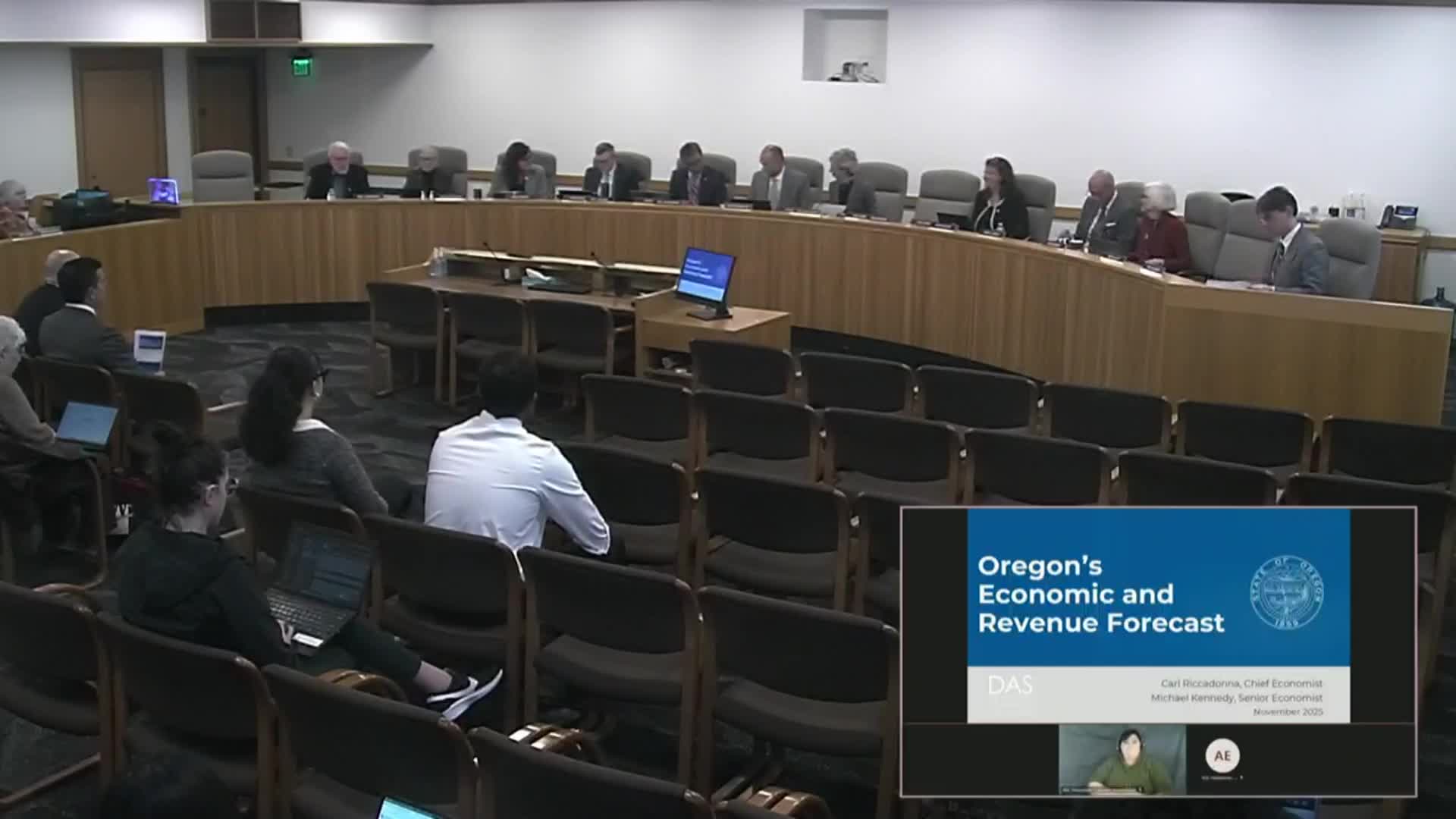
SALEM — The Office of Economic Analysis told the joint Senate and House interim revenue committees on Thursday that Oregon’s economy has continued to decelerate without tipping into recession, and that an unexpected rise in corporate tax receipts improved the state’s revenue outlook by about $309 million.
"We have continued to steer clear of recession," said Carl Riccadonna, State of Oregon chief economist, summarizing OEA’s updated Q4 (December) economic forecast. Riccadonna warned the committees that the outlook still faces major risks including a pending Supreme Court tariff ruling, the Federal Reserve’s interest-rate path and recent federal data gaps caused by a government shutdown.
The revenue update came from Michael Kennedy of the Office of Economic Analysis, who said the $309 million improvement is composed of a modest economic boost and a larger, more specific inflow of corporate income tax payments. "It really was related to prior tax years," Kennedy said of the corporate uptick, and added that Department of Revenue review showed much of the money is settling past liabilities rather than reflecting stronger current activity.
OEA officials emphasized that they are treating most of the corporate inflows as known, one-time funds that can be counted toward the current ending balance but should not be interpreted as durable growth in corporate tax receipts. Kennedy noted that corporate tax liability is highly concentrated: about 2% of firms account for roughly 90% of income tax liability, meaning individual firm actions can materially affect quarter-to-quarter receipts.
On the broader economy, OEA said U.S. and Oregon growth have slowed since the pandemic but are projected to reaccelerate in 2026 if current assumptions hold. Riccadonna estimated a roughly 25% probability of recession over the next 12 months and identified the Supreme Court tariff decision as an especially large swing factor: his office’s back-of-the-envelope national estimate was on the order of hundreds of billions of dollars in GDP impact if tariffs were overturned, which would translate into roughly $2–3 billion in Oregon tax effects under one scenario.
Labor-market measures painted a mixed picture. Riccadonna said new unemployment filings and continuing claims have not shown the large spikes typical of past recessions, but he highlighted localized stress including recent WARN notices and company layoffs. He cited Intel’s announced layoffs (an additional 669 on Nov. 13, bringing a total reported figure to 3,178) as a meaningful regional employer shock. Representative Levy raised timber-mill closures and rural layoffs, and Riccadonna said those events would appear in WARN notices and unemployment tallies.
Committee members asked how OEA handled missing federal data from the shutdown. Riccadonna said the office substitutes private-sector proxies (ADP payrolls, credit-card spending, job postings, ODOT vehicle registrations) and expects most federal releases to resume within weeks; he said OEA will incorporate the missing data into the February forecast if necessary.
Kennedy reviewed alternative scenarios and cautioned that the largest forecast revisions historically occur after April filing season; he reminded the committees that two Aprils remain in the current biennium for tax-filed adjustments. He also cited the state’s reserve estimate, saying the reserve sits near $3.4 billion — roughly 9.7% of the general fund — while urging fiscal prudence given uncertainty.
The meeting was informational; no motions or votes were taken. The Senate members adjourned to allow House members to continue the briefing.