Get Full Government Meeting Transcripts, Videos, & Alerts Forever!
Get email alerts on the Behavioral Health Policy topic
No spam. Unsubscribe anytime.
State agencies and advocates dissect early implementation of HB 2,005; timelines on community restoration take effect
Summary
Oregon judicial and health officials and representatives of prosecutors and defense counsel told the House Judiciary committee that key parts of House Bill 2,005 are now live — community restoration timelines began Sept. 29 — and outlined staffing, data, information‑sharing and bed shortages that complicate rollout and could prompt future legislative fixes.
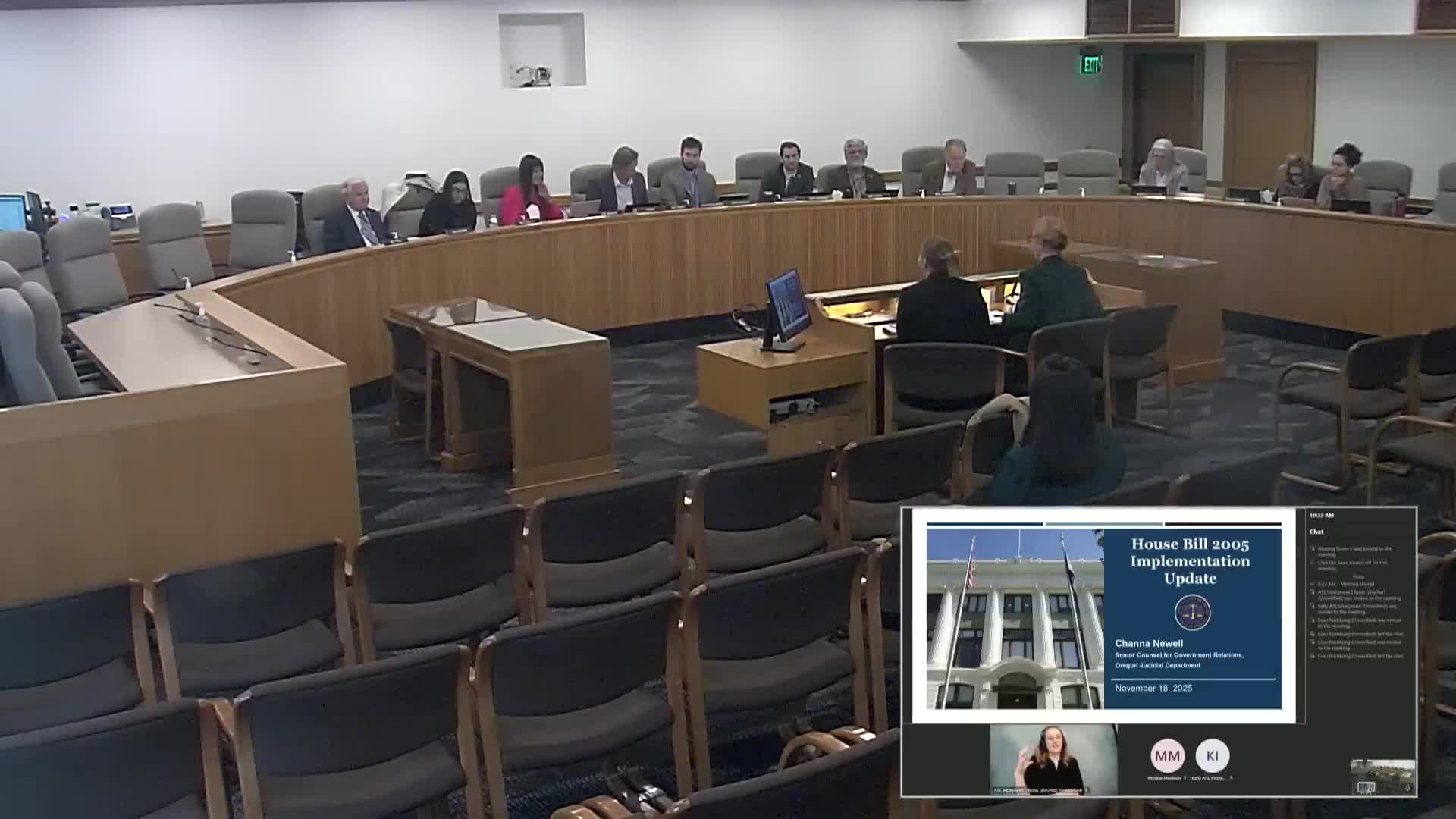
State judicial and behavioral‑health officials, district attorneys and defense attorneys briefed the House Interim Committee on Judiciary on Nov. 18 about the initial rollout of House Bill 2,005, a sweeping package of behavioral‑health and competency‑restoration reforms passed last session.
Channa Newell of the Oregon Judicial Department walked the committee through the bill’s components — changes to civil commitment, aid‑and‑assist procedures, limits on time a person may remain in community restoration and new timelines for certain state‑hospital commitments — and noted that some statutory hospital timelines are currently superseded by a federal court order. She said the community‑restoration timelines in statute took effect Sept. 29 and that the first set of statutory deadlines for that cohort will arrive in late December.
"The community restoration timelines affect individuals who are found unfit and ordered into community restoration after September 29," Newell said, and she warned that cases already in the system before that date are not covered by the new timelines, creating two separate populations requiring different administrative treatment.
The Oregon Health Authority’s Krista Jones described rulemaking, temporary rules that went into effect Sept. 29, expanded training for examiners and hospital staff, form revisions and ongoing community engagement. Jones identified administrative burdens, training gaps and limited next‑level treatment resources — especially secure residential treatment beds — as significant obstacles to implementation.
District attorneys’ representatives said they are preparing CLEs and office hours for prosecutors and are watching litigation over retroactive application of the new timelines. Melissa Marrero of the Oregon District Attorneys Association said courts across the state are seeing motions seeking retroactive application of the timelines, and DA offices are concerned about safety planning and victim notice if large numbers of cases are moved abruptly.
Defense attorneys and mental‑health public defenders said two populations in community restoration — those placed before and after Sept. 29 — are being treated differently in practice and that people who were placed before Sept. 29 risk being deprioritized for evaluations. Lisonbee Knights of the Criminal Defense Lawyers Association said the split has created a bottleneck for people who may have been in community restoration for a year or more and whose evaluations now appear deprioritized.
Speakers across the panel emphasized information‑sharing challenges (what to make public, what must be protected), the need for additional data to track how civil commitments relate to later aid‑and‑assist cases, and the possibility that implementation details could require technical fixes in the 2026 short session or during the 2027 legislative session.
The committee did not vote on statutory changes. Members asked agencies to return with monthly data and proposed administrative fixes; presenters signaled openness to refining forms, training and interagency data flows to reduce the bottlenecks identified.