Get Full Government Meeting Transcripts, Videos, & Alerts Forever!
Get email alerts on the Public Safety topic
No spam. Unsubscribe anytime.
Oregon DOJ launches SPIRE pilot in Washington County to target organized crime
Summary
Attorney General Dan Rayfield and Washington County District Attorney Kevin Barton described SPIRE, a DOJ pilot deploying analysts, forensic examiners and special agents to identify and prosecute multi‑layered organized crime — beginning in Washington County with the aim of proving a model that can be expanded statewide.
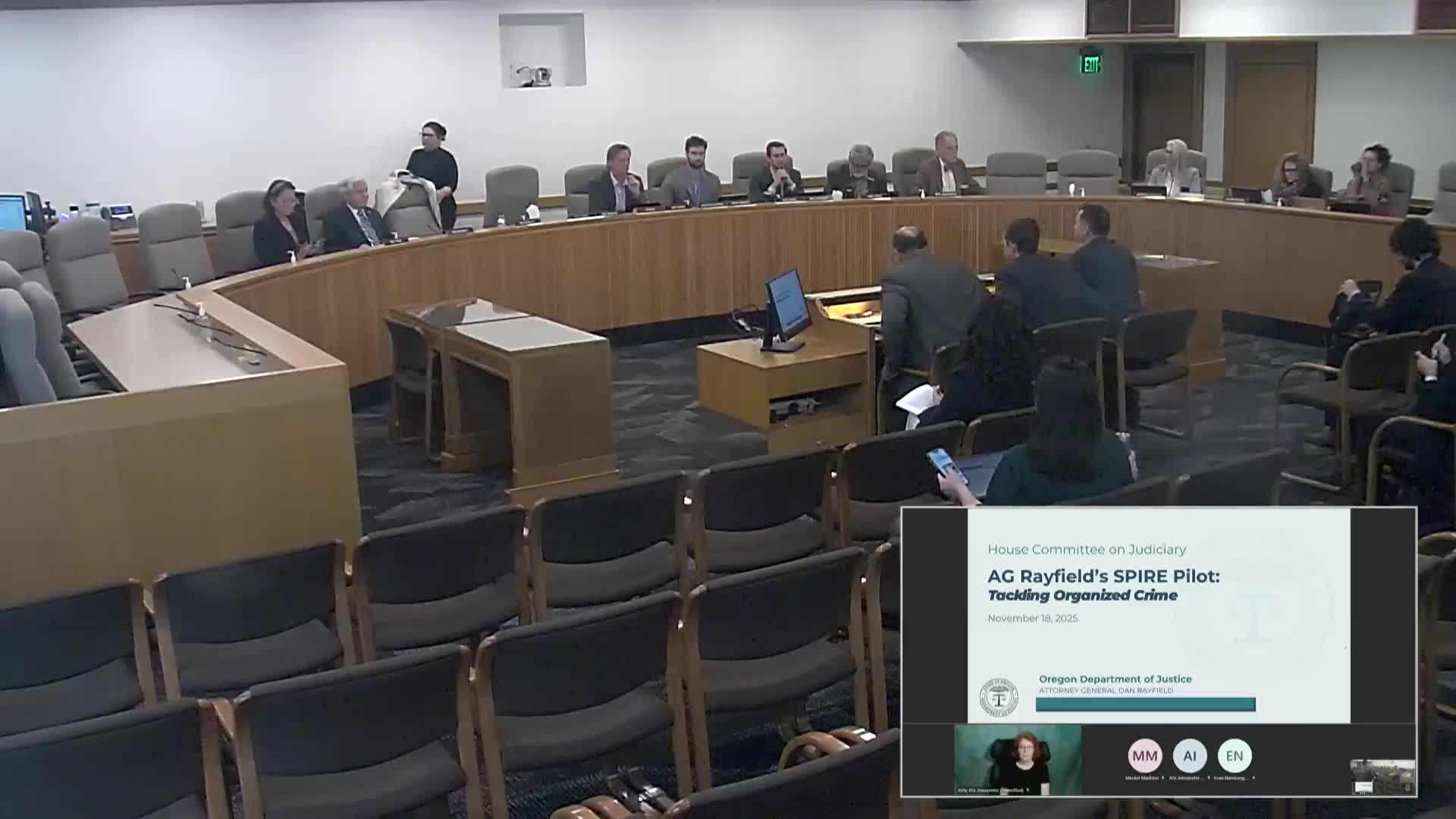
Attorney General Dan Rayfield told the House Interim Committee on Judiciary on Nov. 18 that the Oregon Department of Justice has launched a pilot program, SPIRE, to give local law enforcement investigatory capacity against organized and multi‑layered criminal enterprises.
"What we realized in these conversations is that there was a gap in our public safety network," Rayfield said, describing how the pilot teams provide forensic examiners, analysts, special agents and assistant attorneys general to help identify upper‑level organizers and to support prosecutions that local agencies lack the resources to carry through on their own.
Washington County District Attorney Kevin Barton described catalytic‑converter theft rings and organized retail theft as examples of crimes that can be layered and difficult for local offices to unmask. He said the SPIRE pilot is intended as a proof of concept in Washington County to demonstrate whether an invested DOJ team can identify and prosecute the higher‑level players who insulate themselves from prosecution.
Rich Austria, an assistant special agent in charge with DOJ, explained the operational model: two agents assigned to identify lower‑level actors, four agents for mid‑level investigations to map schemes and identify transportation and storage networks, forensic teams to extract device data and analysts to compile timelines that can support court orders and wiretaps. "That is our pilot program, the SPIRE," Austria said, describing the layered approach and DOJ assistance that led to prosecution in a large catalytic‑converter investigation.
Committee members asked how SPIRE’s success will be measured. Barton said prosecutors will look at both objective measures — cases opened and prosecuted that would otherwise have been missed — and subjective measures such as community perceptions of safety. Rayfield and Barton said DOJ already partners with federal agencies on multi‑jurisdictional matters and that the pilot is designed to be interoperable with federal and local partners.
The committee raised funding and scalability questions: DOJ said current resources are limited and expansion would depend on legislative decisions and budgetary priorities. Rayfield said the pilot is intended to show value and, if successful, to support requests for additional legislative funding to replicate the model across regions.
No formal vote was taken; members asked DOJ to return with updates if the pilot is expanded and for metrics the committee could monitor.