
Officials warn lawmakers utility insolvency, wildfire liability and reinsurance pressures threaten investments and affordability
Get AI-powered insights, summaries, and transcripts
Subscribe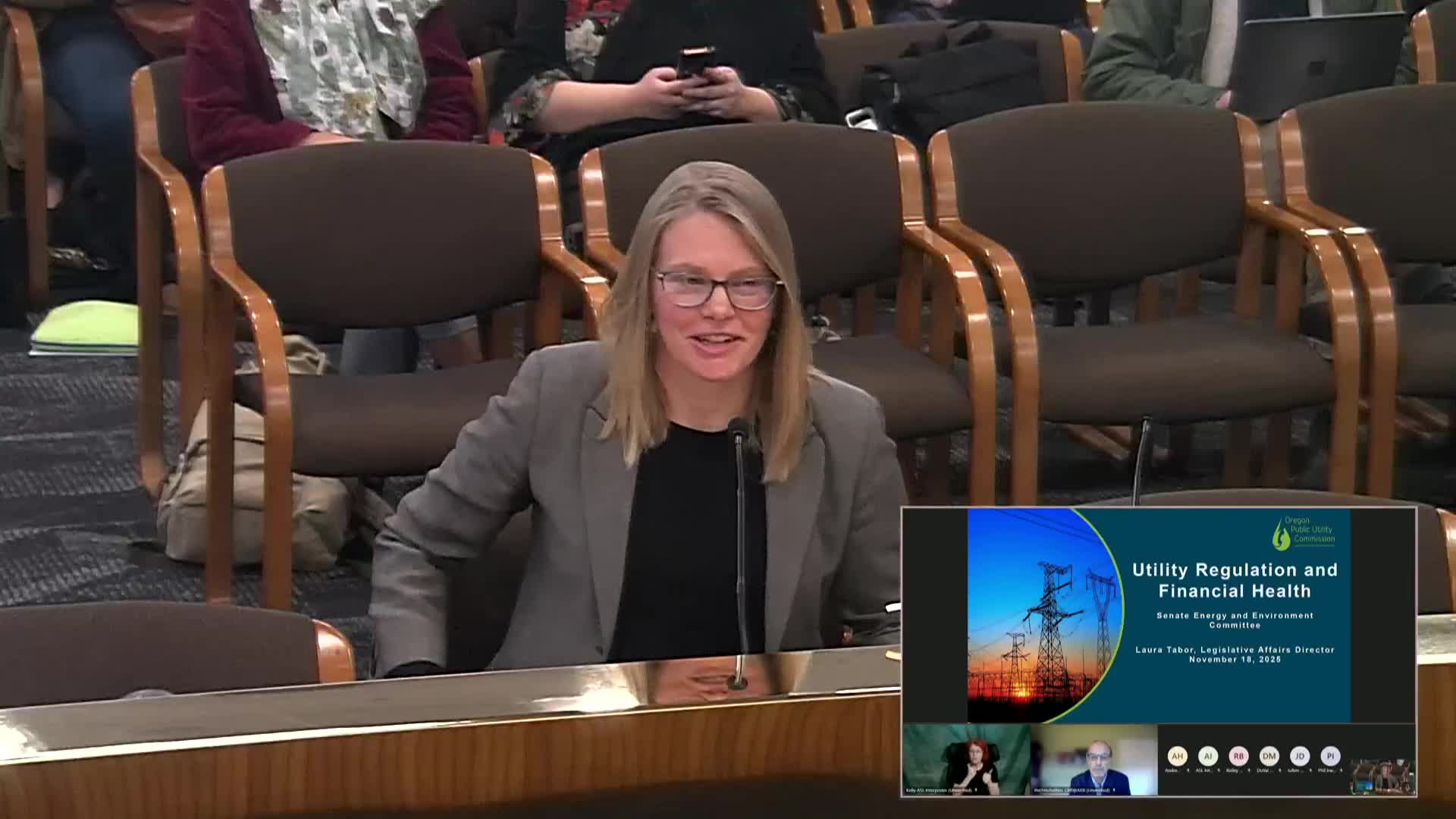
Summary
PUC and industry witnesses told the Senate committee that utilities’ financial instability raises borrowing costs, slows investment, risks renegotiation of contracts in bankruptcy, and could shift costs to ratepayers; co‑op insurers reported sharp reinsurance cost increases that threaten coverage availability.
A panel including the Oregon Public Utility Commission’s legislative affairs director, a former California PUC commissioner, a market analyst and representatives of electric cooperatives told the Senate Interim Committee on Energy and Environment that financial stress at investor‑owned utilities and rising wildfire liability could slow investments, increase rates and in extreme cases lead to bankruptcy processes that weaken state policy control.
Laura Taber, legislative affairs director for the Oregon Public Utility Commission, explained the mechanics regulators use to set rates — reviewing forecasted operating costs, capital investments for prudency and setting a return on equity — and warned that financial instability raises borrowing costs and counterparty risk, which can reduce access to capital and slow interconnection and other investments. “When the PUC does rate regulation…we have to balance customer and utility needs,” she said, describing how higher borrowing costs translate into higher rates for customers.
Former California PUC commissioner Cliff recounted the PG&E bankruptcy and the practical consequences for ratepayers, regulators and state policy. He cited California figures, saying PG&E spent close to $700 million during bankruptcy and the California PUC spent over $30 million on its own legal and advisory costs; he emphasized that bankruptcy proceedings can allow courts to renegotiate power purchase and other contracts and can dilute state policy objectives.
Julian Wold Smith, an equity analyst, and panelists urged more robust planning for wildfire mitigation and liquidity backstops so utilities can survive catastrophic payouts without immediately losing access to capital. “The region is imperiled by its lack of preparedness with respect to wildfires…,” Julian said, advocating safety certification processes and planning for rapid, organized payouts.
Representatives from electric cooperatives and their insurer described the rapidly changing insurance market for wildfire liability. Phil Irwin of Federated Rural Electric Insurance Exchange said Federated writes coverage for virtually all U.S. electric co‑ops and has seen reinsurance layers shrink and premiums rise steeply — citing replacement of a $30 million reinsurance layer with a $20 million layer and noting that the cost per $1 million of coverage has climbed from roughly $6,000 to about $26,000 for some accounts.
Lawmakers asked whether mitigation spending meaningfully reduces liability and emphasized the difference between investor‑owned utilities and consumer‑owned co‑ops when designing protections. Committee members signaled interest in follow‑up hearings and staff work on distinguishing protections for different utility types and on policy tools to address wildfire liability.