Get Full Government Meeting Transcripts, Videos, & Alerts Forever!
Get email alerts on the Reoregon Cdbg Dr topic
No spam. Unsubscribe anytime.
OHS details $422M ReOregon disaster recovery plan, HARP closures and delivery bottlenecks
Summary
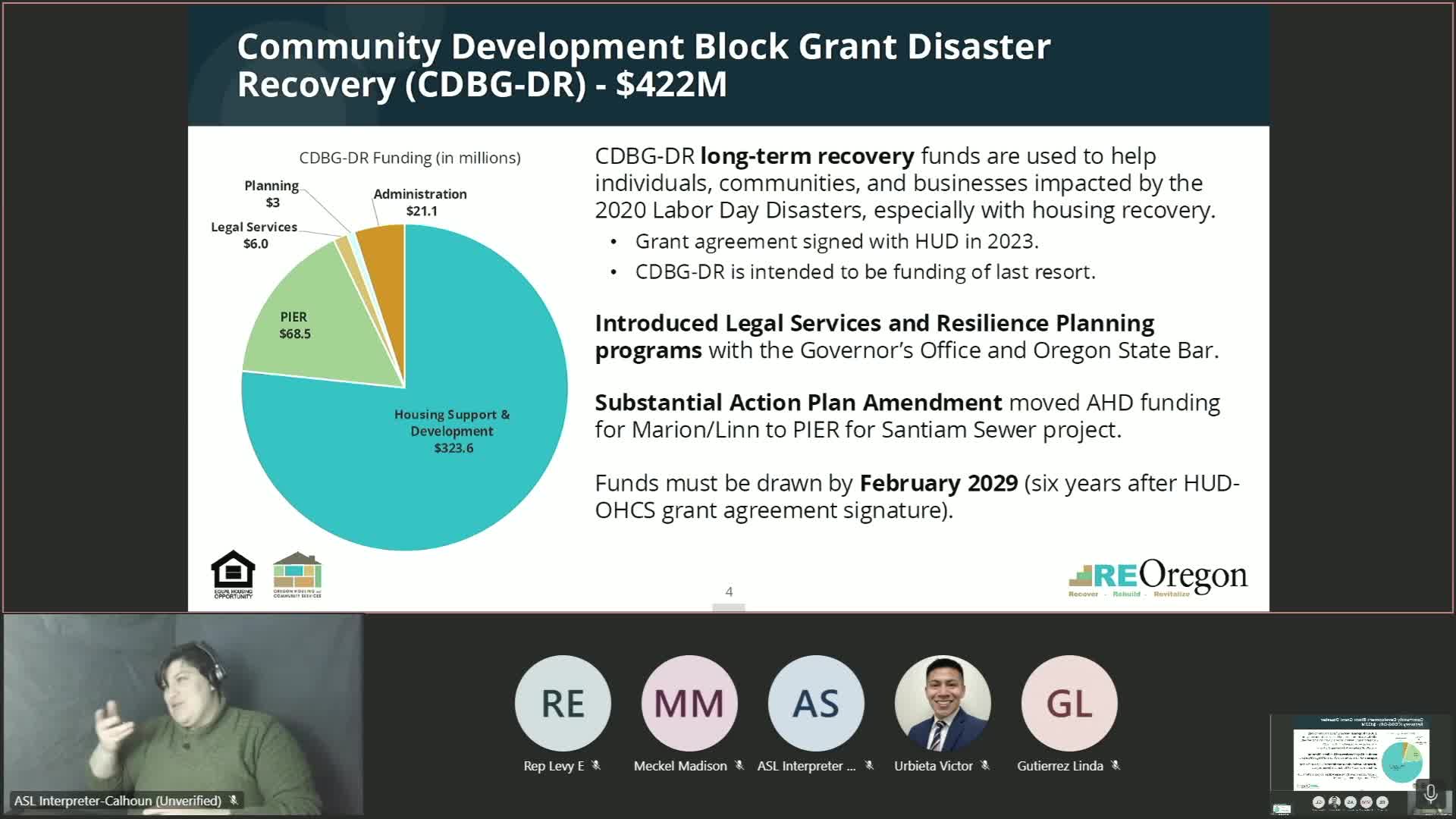
Oregon Housing and Community Services told the committee it has obligated substantial ReOregon CDBG‑DR projects from a $422 million federal submission, launched HARP reimbursements up to $100,000 and will close new HARP intake at year‑end while advancing active applications through 2026 to completion.
Oregon Housing and Community Services (OHCS) presented an update on the ReOregon disaster recovery program funded with Community Development Block Grant — Disaster Recovery (CDBG‑DR) funds the state requested in 2023.
Shannon Marhein (director of disaster recovery and resilience) said Oregon’s CDBG‑DR request totals $422,000,000 and OHS distinguishes among ‘‘obligated’’ (approved projects in the grant), ‘‘awarded’’ (contracts signed and available for drawdown) and ‘‘expended’’ (amount drawn down and paid to projects under the reimbursement model). Marhein warned the reimbursement structure slows reported expenditures until local contractors complete permitting and work; she said many construction projects are obligated and under contract but permit and local procurement timelines slow drawdowns.
Program highlights included PEER planning and infrastructure (roughly $60 million), roughly $104 million of affordable housing development projects currently in the pipeline, and housing support services including a down‑payment assistance and housing counseling component. OHCS reported nearly 900 HARP eligibility questionnaires were completed statewide and described a newly introduced reimbursement option allowing up to $100,000 for eligible homeowners who did eligible post‑disaster work and qualify for HARP reimbursement.
Marhein said the HARP intake will close to new applicants at the end of December 2025, but anyone with an active application in December will be advanced through 2026 to logical completion (building, reimbursement or other outcome). The agency said it has begun weekly and biweekly case conferencing with long‑term recovery groups (LTRGs) and has empowered staff to resolve unusual legal or eligibility issues quickly rather than rely on slow escalation.
Committee members asked about income eligibility and permitting delays. OHCS said the program generally targets low‑to‑moderate income households (roughly 120% AMI or less with an overall grant target of 70% LMI) and acknowledged permitting and local capacity are a major bottleneck to moving construction projects from contract to expenditure. OHCS said staff are auditing project pipelines, convening local partners and are prepared to consider reallocation if projects cannot meet milestones.
Marhein emphasized lessons learned: the need for early data sharing between response and recovery partners, better cross‑agency coordination, trauma‑informed streamlined intake and proactive legal support for unusual title or lot‑line issues. OHCS said it has advanced some contracts so that local LTRGs and subrecipients can carry HARP intake and outreach through June 2026.