Get email alerts on the Education Ai topic
No spam. Unsubscribe anytime.
Oregon panel outlines K–12 AI rules and HEC’s NVIDIA ambassador program
Summary
District IT and state higher‑education officials told the Senate Education Committee that K–12 AI use should be governed by classroom‑level guidance while the Higher Education Coordinating Commission is launching an AI ambassador program with NVIDIA funded by CHIPS Act dollars to train faculty and expand AI instruction.
Chair Frederick convened the Senate Interim Committee on Education on Nov. 18 for a panel on artificial intelligence in Oregon schools and colleges, where district and state officials described local policies and a new higher‑education training program backed by NVIDIA.
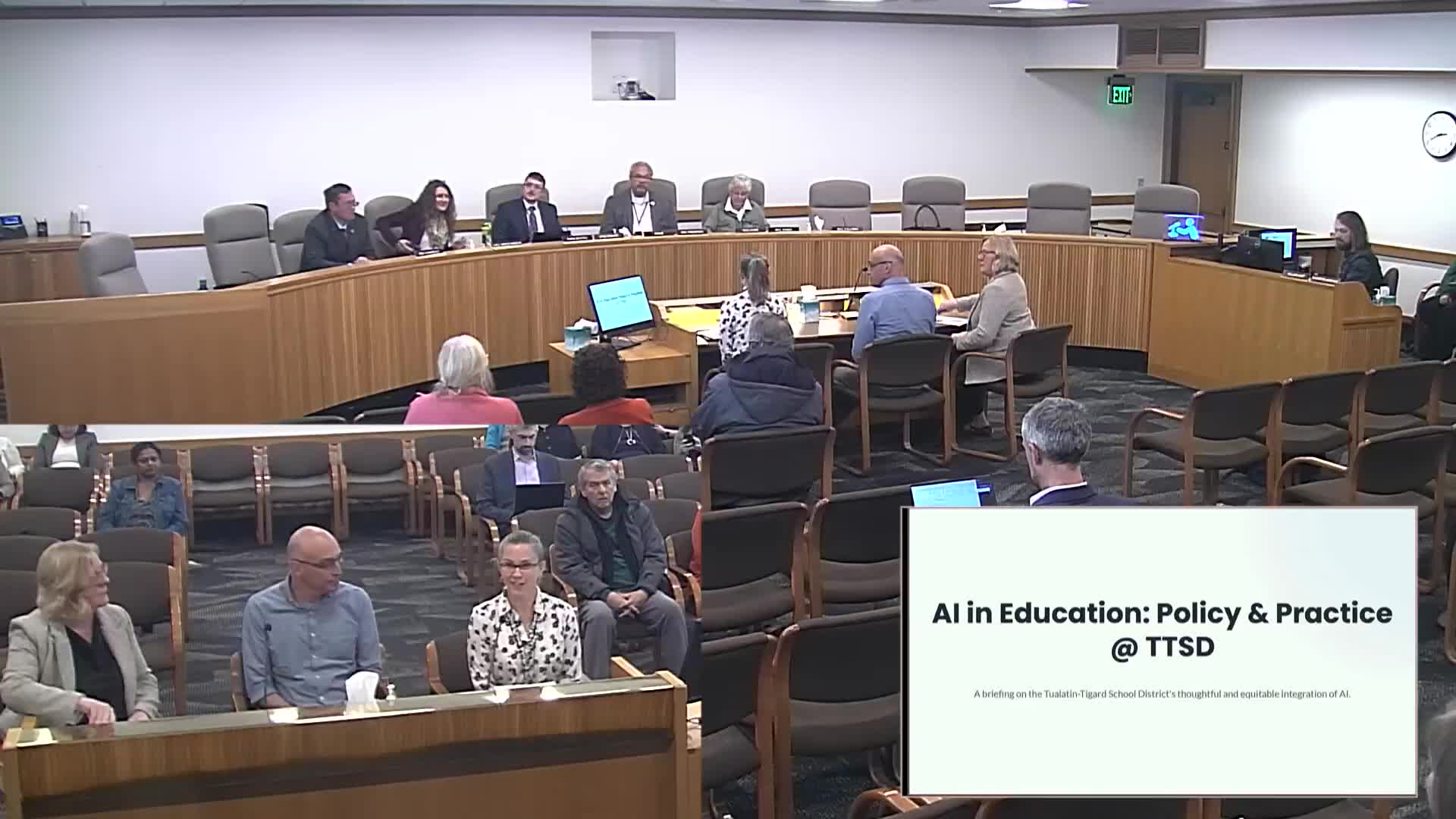
Susan Bernard, IT director for Tigard‑Tualatin School District, told the committee the district avoided a single, all‑purpose AI policy and instead adopted two complementary policies—an academic‑integrity policy and a responsible‑use‑of‑technology policy—and translated them into classroom guidance and teacher training. Bernard said the district uses a ‘‘stoplight’’ system (green/yellow/red) by assignment to indicate when AI is allowed, allowed with conditions, or not allowed, and that teachers have adjusted instruction and assessments to emphasize critical thinking and reduce opportunities for misuse. "We didn't want to block access, but we were also very thoughtful," Bernard said, noting AI detectors are imperfect and the district relies on conversations with students and restorative practices when misuse is suspected.
Jennifer Purcell, director for Future Ready Oregon at the Higher Education Coordinating Commission (HEC), described a separate but related effort at the postsecondary level: an MOU announced April 24 between the state and NVIDIA to expand AI education. HEC will administer an "AI ambassador" program that provides stipends to Oregon college and university faculty to participate in NVIDIA’s Deep Learning Institute train‑the‑trainer curriculum. Purcell said NVIDIA is waiving course fees for Oregon faculty and HEC has set aside about $1,500,000 from a $10,000,000 CHIPS Act allocation to fund stipends. "A $1,000 stipend will be awarded for each course up to five courses," she said, adding that applications are expected to open in early December and informational sessions will run in December and January.
OSU researchers who presented the research and workforce context said robotics and AI are embedded across industries—from agriculture to oceanography to older‑adult care—and called for building degree pipelines. Con Tumer, director of OSU’s Collaborative Robotics and Intelligence Systems Institute, described existing graduate programs (including a recently launched AI graduate program) and plans for bachelor’s and interdisciplinary master’s degrees in coming years.
Committee members pressed presenters on age‑appropriate uses of AI in K–12 classrooms, data privacy and whether AI risks replacing teachers. Bernard said district practice focuses on middle‑ and high‑school instruction and that elementary use occurs in walled‑garden environments and by tightly scripted, teacher‑controlled prompts. "Our focus is more at high school for sure, but middle school as well," she said. OSU presenters and district officials said AI is being used to enhance accessibility and differentiation for students with special needs and to reduce routine workloads for adults rather than replace them.
The hearing produced no formal action; committee members asked for follow‑up materials, including district AI policies and further information on HEC’s ambassador program once applications open.
AI generated
The text on this page is AI generated. Summaries, highlights, analysis, and video transcripts are all produced from the original source material.
AI can make mistakes, so if you spot one, and we will fix it for everyone.
Note: the source content is unaltered by us. Any content source we link to, be it a video, an audio recording, or a document, is presented exactly as its publisher released it. That publisher is usually a government body, sometimes an individual official or another organisation.