Get Full Government Meeting Transcripts, Videos, & Alerts Forever!
Get email alerts on the Corrections Health topic
No spam. Unsubscribe anytime.
Oregon DOC outlines geriatric care push as older justice‑involved population grows
Summary
Oregon Department of Corrections officials told the Senate panel that people aged 55+ are an increasing share of incarcerated populations, DOC implemented an electronic health record pilot and is planning staffing and facility changes to address mobility, ADA and chronic care needs.
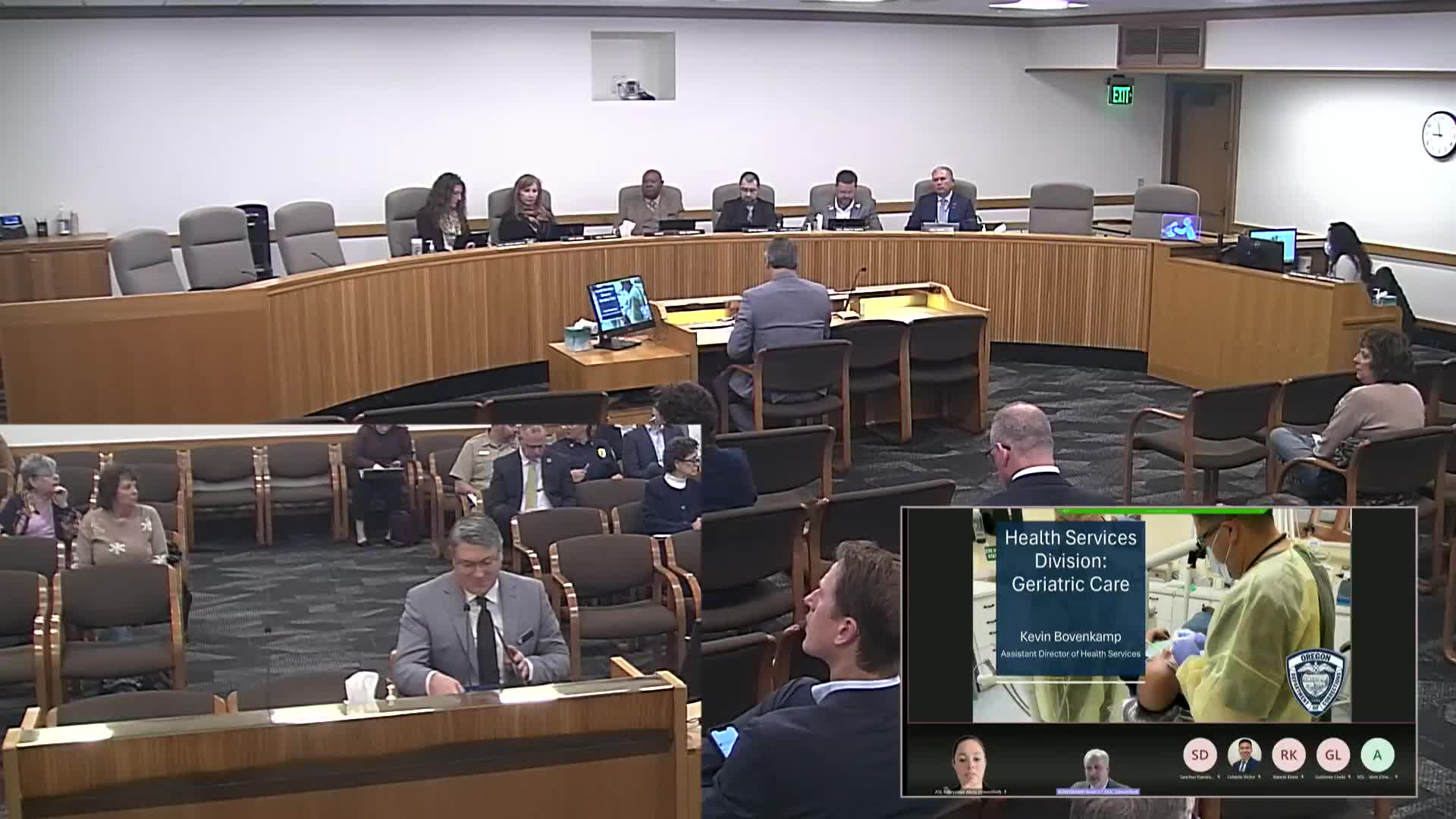
Assistant Director Kevin Bovekamp, representing the Oregon Department of Corrections (DOC) health services, told the Senate committee that an aging correctional population is stressing facilities and medical services and that DOC is tackling four immediate priorities: clear specialty appointment backlogs, implement an electronic health record (EHR) system, strengthen quality improvement and adjust health services structure and staffing.
Bovekamp said the proportion of people aged 55 and older in custody rose from about 12% a decade ago to about 18% recently, and could continue to grow. He noted many older facilities were not designed for wheelchairs or memory‑care needs and that DOC must weigh on‑site care, telehealth and off‑site transports, which pose security and clinical risks.
“As we return around facilities, we're looking at places where we may be able to house people more safely and effectively,” Bovekamp said, and reported the EHR rollout began at Oregon State Penitentiary and will continue to three more sites in January 2026. He added DOC is recruiting for a chief of quality improvement and developing new policies to track outcomes more consistently.
Bovekamp also described staffing constraints: state classifications lack some community health roles (medical assistants, CNAs), forcing DOC to rely on registered nurses for functions that could otherwise be performed by lower‑cost positions, which strains staffing budgets and hiring.
On policy levers, DOC noted its compassionate release statute exists but is narrower than in other states, limiting avenues for moving frail people into community care. Committee members thanked DOC and asked for follow‑up; Chair Manning said the panel will request additional briefings as DOC finalizes structural recommendations.
What’s next: DOC will provide follow‑up material and the committee plans additional oversight of EHR rollout, staffing classification changes and feasibility of housing designs better suited for geriatric care.