
State economist: modest reacceleration expected but Oregon still faces a budget shortfall
Get AI-powered insights, summaries, and transcripts
Sign Up Free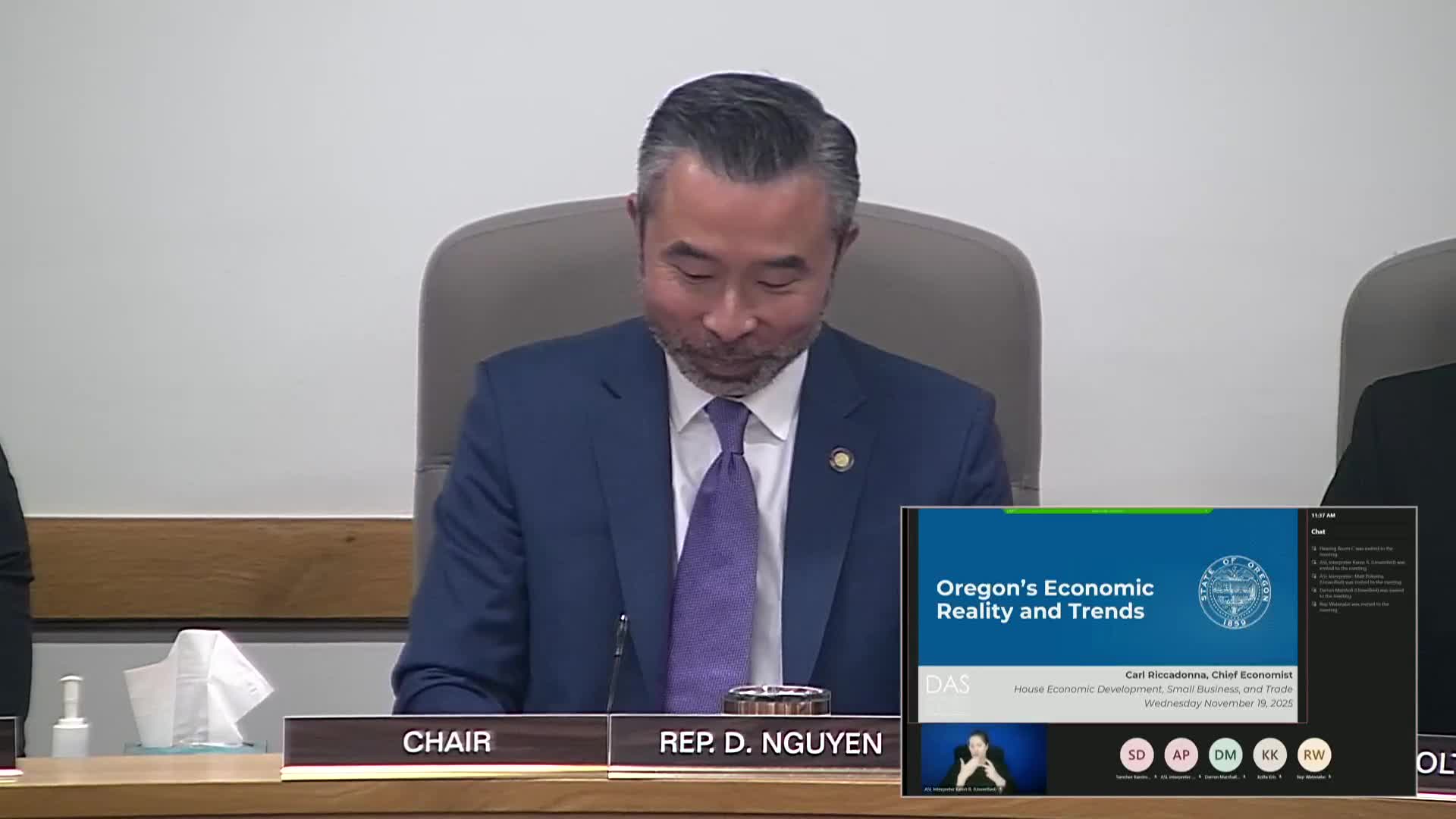
Summary
State Chief Economist Carl Ricadonna told the House committee the updated revenue forecast points to a modest reacceleration into 2026 driven by interest-rate cuts and federal tax changes, but Oregon remains in a projected $63 million deficit and faces data uncertainty from earlier federal shutdowns.
Carl Ricadonna, State of Oregon chief economist, told the House Committee on Economic Development, Small Business and Trade on Nov. 19 that the state—s updated revenue forecast shows modest improvement but leaves Oregon still operating with a budget shortfall.
Ricadonna said the state is in a decelerating economy that is likely to reaccelerate in 2026 as interest-rate cuts, federal tax changes and lower-than-expected tariffs feed through to activity. "My own office would ascribe the probability of recession in the next 12 months at about 25%," he said, noting private-sector forecasters put the risk slightly higher.
The presentation focused on three drivers of the projected upturn: expected Federal Reserve rate cuts, federal tax-law changes enacted earlier this year (referred to in testimony as HR 1), and a smaller effective tariff profile than was initially announced. Ricadonna emphasized that recent corporate tax inflows that improved the revenue outlook included large reconciliations from prior tax years and cautioned those are one-time effects, not recurring revenue.
Ricadonna gave specific budget figures: the prior-quarter deficit had been roughly $373 million; the current projection narrows the shortfall to about $63 million. He stressed the number is sensitive to volatile series such as corporate estimated payments and the missing federal data that followed the government shutdown earlier this year. "We don't have all the information available to us right now," he said, explaining private-sector proxies (ADP, purchasing-manager surveys) were used to supplement delayed Bureau of Labor Statistics releases.
On the labor market, Ricadonna said Oregon has seen some softening — unemployment claims and WARN notices have risen — but not yet at levels typical of recessions. He noted divergence across sectors: services (including health care) have shown gains while goods-producing industries like construction and manufacturing have been weaker.
Ricadonna flagged policy and data uncertainties, including the pending Supreme Court review of the federal tariff authorities that could materially change the outlook and the lagged effects of monetary policy. "When you're driving through fog, slow down," he said, describing the forecast—s incrementalist approach.
Consultant John Topona, who closed the meeting, framed the broader policy choice the forecast informs: "Pursue modest, deliberate economic growth or accept the cost of standing still." Topona urged attention to housing supply, K-12 outcomes, wildfire and climate risks, tax structure and regulatory modernization to support any deliberate growth strategy.
What—s next: The committee heard testimony from industry and regional economic development groups about retention and competitiveness, which lawmakers said will inform trade-offs in the 2026 short session. No formal votes were taken at the informational meeting.