Get Full Government Meeting Transcripts, Videos, & Alerts Forever!
Get email alerts on the Drought Funding topic
No spam. Unsubscribe anytime.
Lawmakers pressed Ecology on drought fund use and federal data gaps as staff warned of monitoring vulnerabilities
Summary
During the committee hearing Ecology officials said drought response funding has been used for basin projects this year, highlighted vulnerabilities in federal monitoring networks (NRCS SNOTEL, USGS gauges), and noted statutory limits (one transfer per fiscal year) that could complicate repeated emergency top-ups.
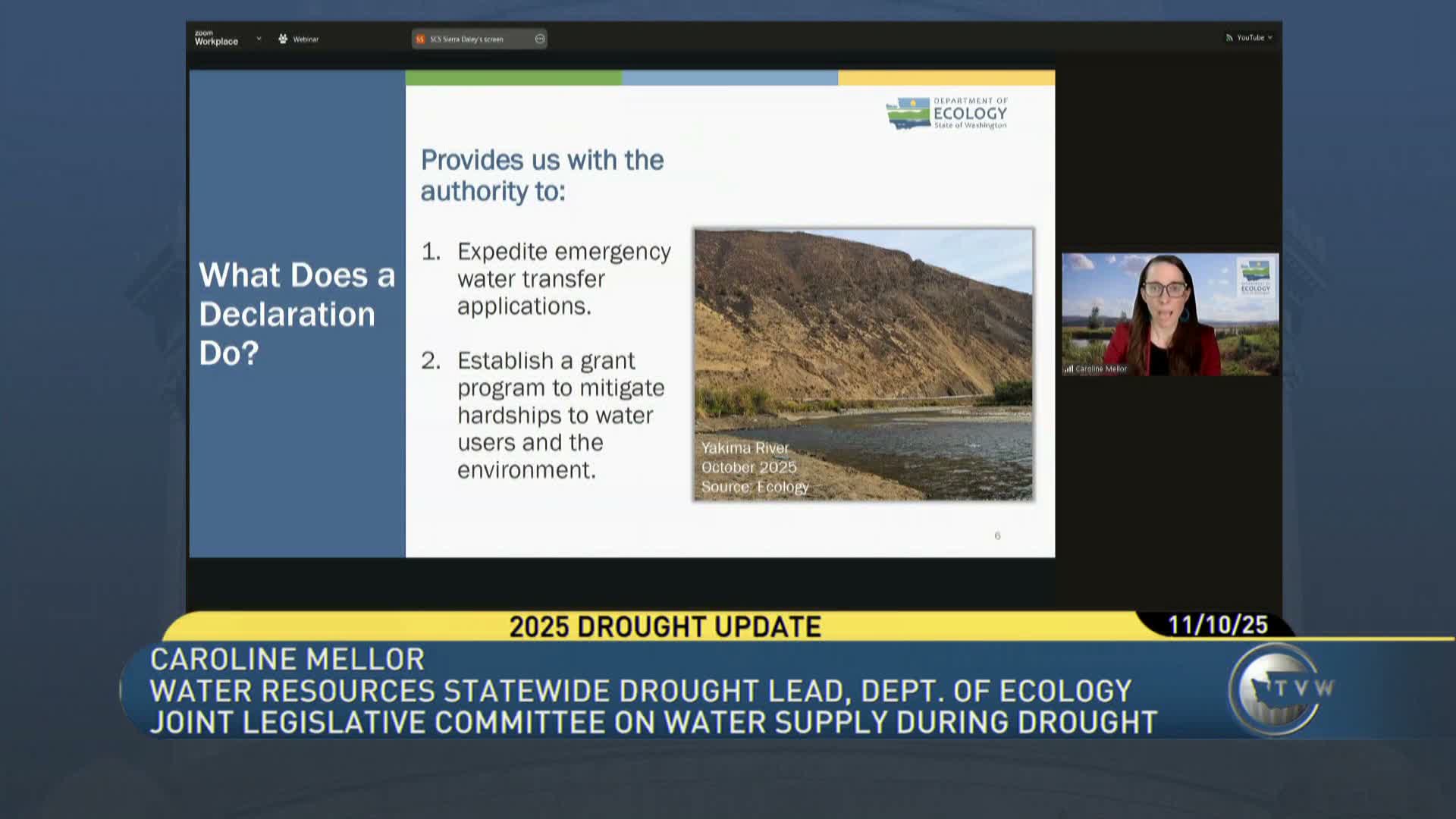
Department of Ecology staff told the joint committee that the state's Drought Emergency Response Grant and the drought emergency response account were used this year to support projects in the Yakima and Dungeness basins, and that Ecology currently expects available funds to cover anticipated winter applications.
Caroline Mellor said statutory changes in 2023 (HB 1138) made emergency response funding accessible upon a drought declaration; she warned the statute also limits the drought account to one transfer per fiscal year, which could create timing problems when drought declarations recur in a single fiscal year.
Committee members asked about examples and amounts. Mellor cited Rosie Irrigation District leases as a project in 2025 for just over $1,000,000 and said other awards this year were smaller (she cited approximate figures for Clallam Conservation District, Jamestown-related funding and Benton Conservation District, and offered to follow up by email with specific numbers). Mellor emphasized match requirements can be a barrier for smaller public entities seeking funds.
Members also focused on monitoring and data infrastructure. Ecology staff said the state depends on federal partners for snowpack and real-time gauge data, and that staffing reductions and some gauge losses at agencies such as the Natural Resources Conservation Service (NRCS), the U.S. Geological Survey (USGS) and others have reduced monitoring capacity in recent years. The loss or non-replacement of data collection staff, plus recent federal personnel changes and a shutdown, complicated real-time management and interagency coordination this year, participants said.
Lawmakers raised policy options in a broader committee discussion, including whether to increase the drought fund balance, revisit reservoir proposals such as Black Rock or Springwood, and explore insurance-like mechanisms for drought. Committee members and staff agreed those are complex choices that would need fiscal and technical study; no formal legislative decisions were taken during the session.