Get Full Government Meeting Transcripts, Videos, & Alerts Forever!
Get email alerts on the Yakima Basin topic
No spam. Unsubscribe anytime.
Ecology issued about 1,500 curtailment orders in Yakima Basin as reservoirs ran near empty, staff tell lawmakers
Summary
Department of Ecology officials told legislators that extreme reservoir depletion in the Yakima Basin prompted curtailment orders to protect senior water rights; Ecology said the actions were unprecedented, compliance was widespread and recovery will depend on multiple winter conditions.
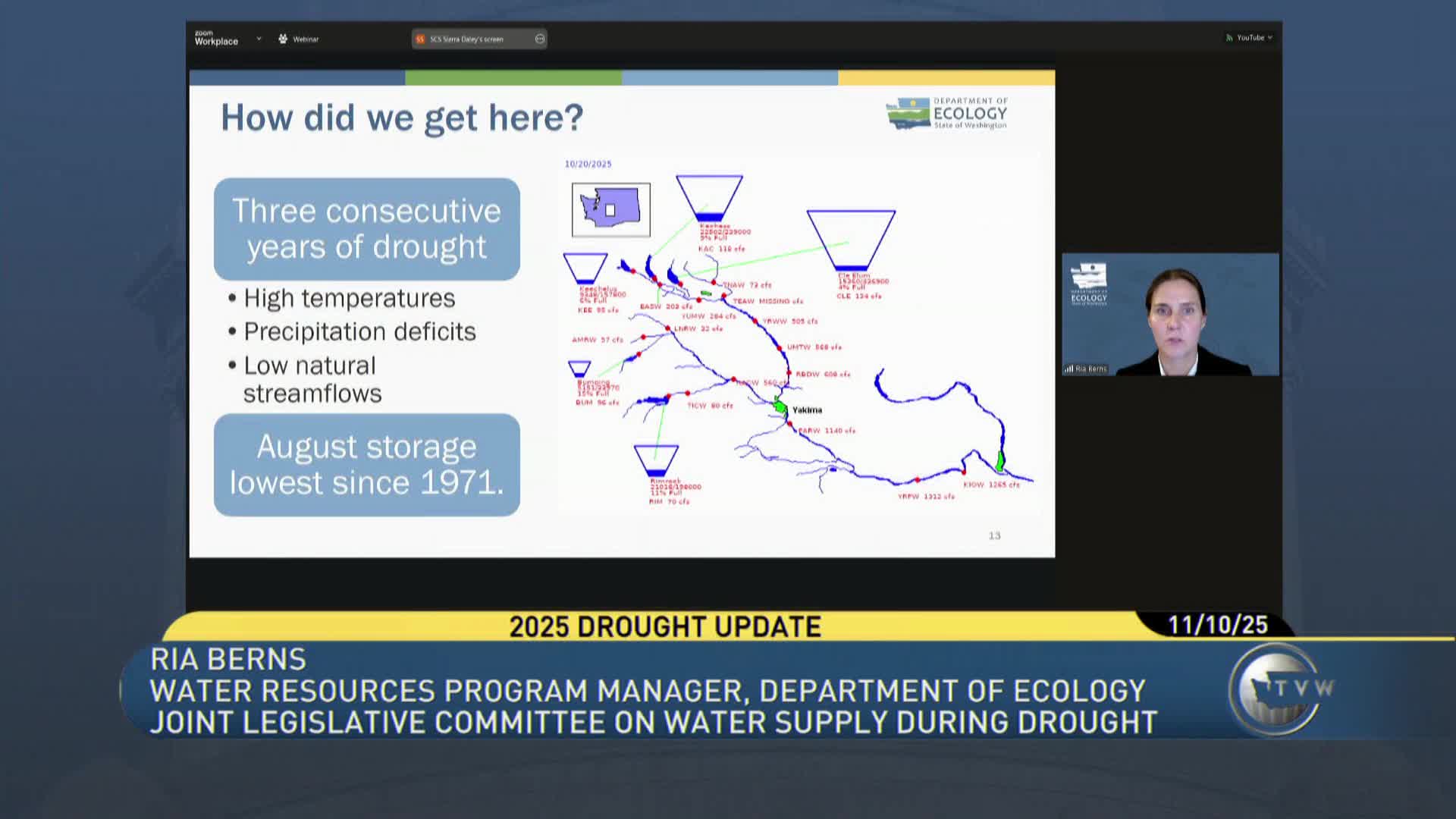
Department of Ecology officials described this year's unprecedented curtailments in the Yakima Basin, telling the joint committee that a combination of multi-year low storage and rapid spring melt produced conditions in which even the most senior water rights could not be satisfied.
Rhea Burns and Ecology staff explained the Yakima Project (managed by the Bureau of Reclamation) has five reservoirs that store water for farms, municipalities and fish. Because the basin is adjudicated, Ecology has an ordered priority system for surface water rights; officials said the adjudication (final decree completed in 2019) clarified allocations but could not prevent this year's shortfall.
Ecology said reservoirs were nearly empty by early October and that, in late September and early October after coordinating with the Bureau of Reclamation, it issued curtailment orders to surface water users in the watershed. Burns said Ecology sent roughly 1,500 curtailment notices with an October 6 curtailment date, meaning most surface water users needed to stop diverting on that date; some cities and towns switched to alternative supplies while others curtailed nonessential uses.
Officials told the committee nearly all senior surface water rights were turned off in October for the first time in state history and that compliance with the orders was widespread. Ecology said impacts would have been much worse without prior investments under the Yakima Basin Integrated Plan but stressed the events illustrate the basin's vulnerability and the need for continued resilience work.
Committee members pressed Ecology on how curtailments were implemented and how residents and farms were notified. Ecology acknowledged implementation challenges and said it plans to improve federal coordination and the timing of orders in future years, citing strains from federal staffing changes and a federal shutdown that complicated joint work.
Ecology emphasized that recovery in Yakima depends on multiple converging factors: normal or above-normal precipitation through winter, cold winter temperatures to store snow, a cold spring to limit early melt, no large rain-on-snow events and a mild summer to reduce demand. Given current low reservoir storage, Ecology said Yakima would likely remain in drought next year without those conditions.