State Investment Board: $230 billion under management, climate work evaluated through fiduciary lens
Loading...
Summary
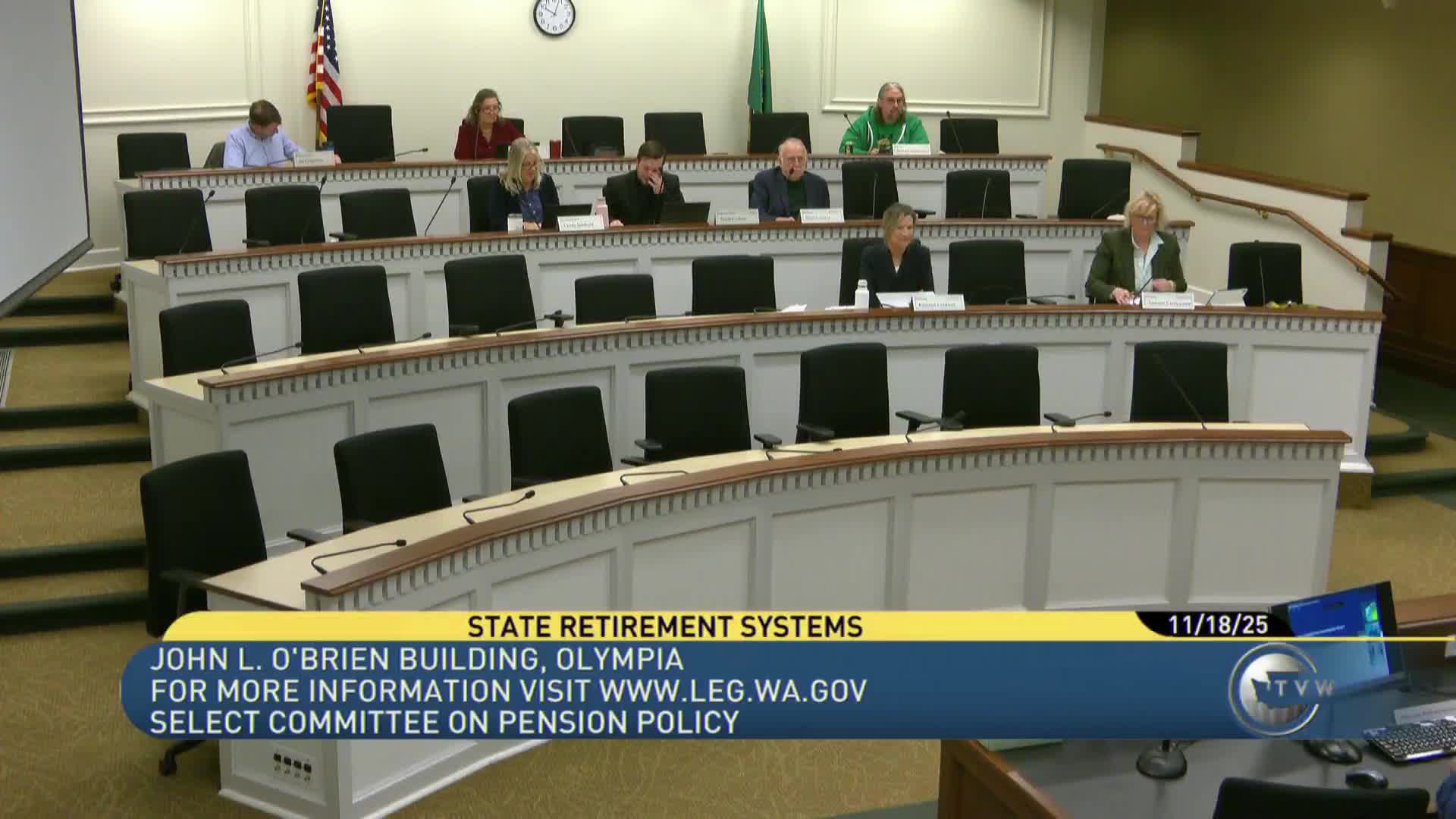
State Investment Board staff briefed the pension select committee on governance, asset allocation and historic returns, saying the board’s duty is to maximize returns ‘at a prudent level of risk’ while assessing climate and ESG impacts through financial analysis.
David Schumacher, a State Investment Board official, told the Select Committee on Pension Policy that the board’s structure and process are shaped by fiduciary obligations and long‑term horizons. He said the board ‘shall establish investment policies and procedures designed exclusively to maximize return at a prudent level of risk,’ and described the SIB’s membership and oversight model.
Schumacher told members the board and its nonvoting expert advisors oversee roughly $230,000,000,000 in assets, with the overwhelming majority — about 87% — held in retirement funds. He described the commingled trust fund as the organization’s largest vehicle and pointed to a 20‑year average return of about 8.4 percent, noting outlier performance in 2021 (28.7 percent) that helped state finances but also illustrates return volatility.
He said the board would set new strategic asset allocation targets later the same week, a change that will drive investment weighting across fixed income, public equity, private equity and real assets. Schumacher explained the difference between inner‑circle target allocations and the outer‑circle, month‑to‑month actuals, and described regular rebalancing to manage overweight or underweight positions.
On climate and other ESG concerns, Schumacher emphasized the board’s fiduciary standard: SIB conducts scenario and sustainability analysis to judge whether exposures present financial risk or opportunity, and takes action based on that financial assessment rather than political pressure. He said the agency performs engagement with companies and considers divestment only where the investment case justifies it.
Committee members asked about Washington’s national ranking and how other states organize investment of public funds. Schumacher said Washington’s model — an independent SIB with appointed public officials and beneficiary representatives — is one of many approaches used across the country. He described Washington’s long‑term performance as comparatively strong over 10‑ and 20‑year horizons.
The briefing provided background committee members said they will use when reviewing bills that could change fund structure or transfer assets between plans.