Get Full Government Meeting Transcripts, Videos, & Alerts Forever!
Get email alerts on the County Classification topic
No spam. Unsubscribe anytime.
Committee backs bill to add revenue metric and five‑year review to county classification
Summary
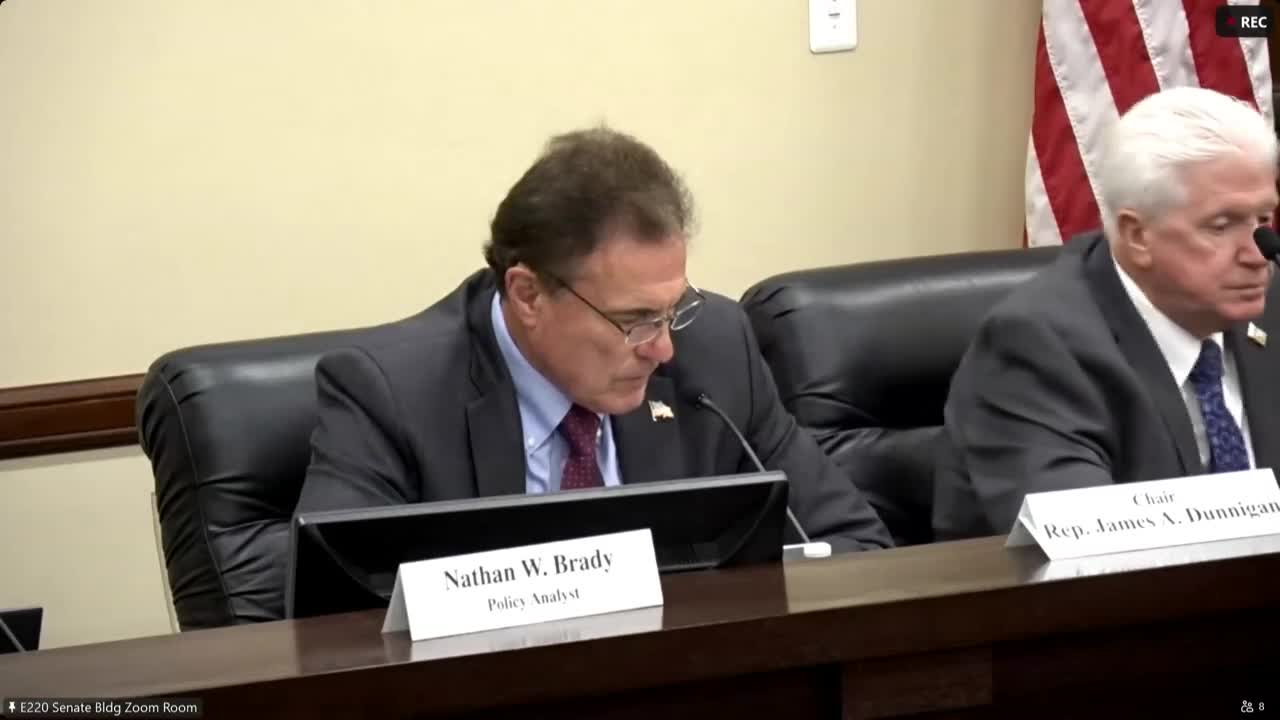
The Political Subdivisions Interim Committee recommended favorably a bill that would require counties to meet both population and revenue thresholds (each at 200% of class averages) and institute five‑year reviews to trigger reclassification, amid debate and three public testifiers.
The Political Subdivisions Interim Committee voted to favorably recommend draft legislation that would change how Utah determines county classification, adding a revenue test to the long‑standing population measure and setting a five‑year review cycle.
Senator Winterton, sponsor of the committee bill, told the committee the measure is intended to give counties ‘‘some certainty as to changing classifications and how that would happen’’ by using a two‑metric test. Under the draft language outlined to the committee, a county would only be eligible for reclassification if it met both population and revenue triggers — each defined as 200% of the current average for the county’s classification — with the data to come from the state population committee and the State Tax Commission.
The bill’s sponsor said the combined test aims to prevent counties from being bumped into higher classes based solely on population growth when their revenue base is not comparably strong. He highlighted Wasatch County, which is growing rapidly but is not expected to meet the 200% population threshold until decades out, and contrasted Washington County (near the population threshold but low on revenue) with Summit County (higher revenue but not population), to illustrate why both metrics are necessary.
Representative Miller asked whether revenue is a new metric; Winterton confirmed it is and said it is meant to balance eligibility for state incentives against a county’s ability to fund services. Representative Peterson asked how the metric would affect Utah County; Winterton said Utah County’s revenue is below the 200% threshold now and that population projections would push any classification change far into the future.
Lincoln Church of the Association of Counties testified in support of separating governance structure from classification, arguing population alone does not capture a county’s administrative sophistication and that counties with similar populations may have very different service responsibilities and budgets. The Association urged continued work with counties to refine any budget‑related measures.
Representative Peterson moved to issue a favorable recommendation. The committee recorded opposition from Senator Harper, Sam Dunnigan, Representative Miller and Senator Bullen; the motion was approved and the committee recommended the draft bill as a committee bill.
The chair later noted (for committee context) that the same county‑classification language had been tied in the senate but passed the house 4–3 during the most recent session and therefore advanced in the Legislature. The sponsor said he is open to adjustments and to working with counties on the details.
What’s next: The committee’s favorable recommendation advances the draft as a committee bill; sponsors and stakeholders said they expect further technical work before final enactment and that the effective review process would begin after the bill’s operative date as written in the legislation.