Get Full Government Meeting Transcripts, Videos, & Alerts Forever!
Get email alerts on the Hospice Regulation topic
No spam. Unsubscribe anytime.
Oregon hearing examines hospice licensing, new research on private‑equity ownership
Summary
Oregon officials, researchers and hospice providers told a Senate committee that existing licensing covers most care but that private‑equity and publicly traded ownership may change patient mix and staffing; witnesses urged better state oversight, certificate‑of‑need rules and mandatory quality reporting to guard access and quality, especially in rural areas.
State health regulators, industry representatives and independent researchers told the Interim Senate Committee on Health Care that Oregon’s hospice licensing system relies heavily on federal Medicare rules but leaves room for state policy to shape who can open a hospice and how quality is monitored.
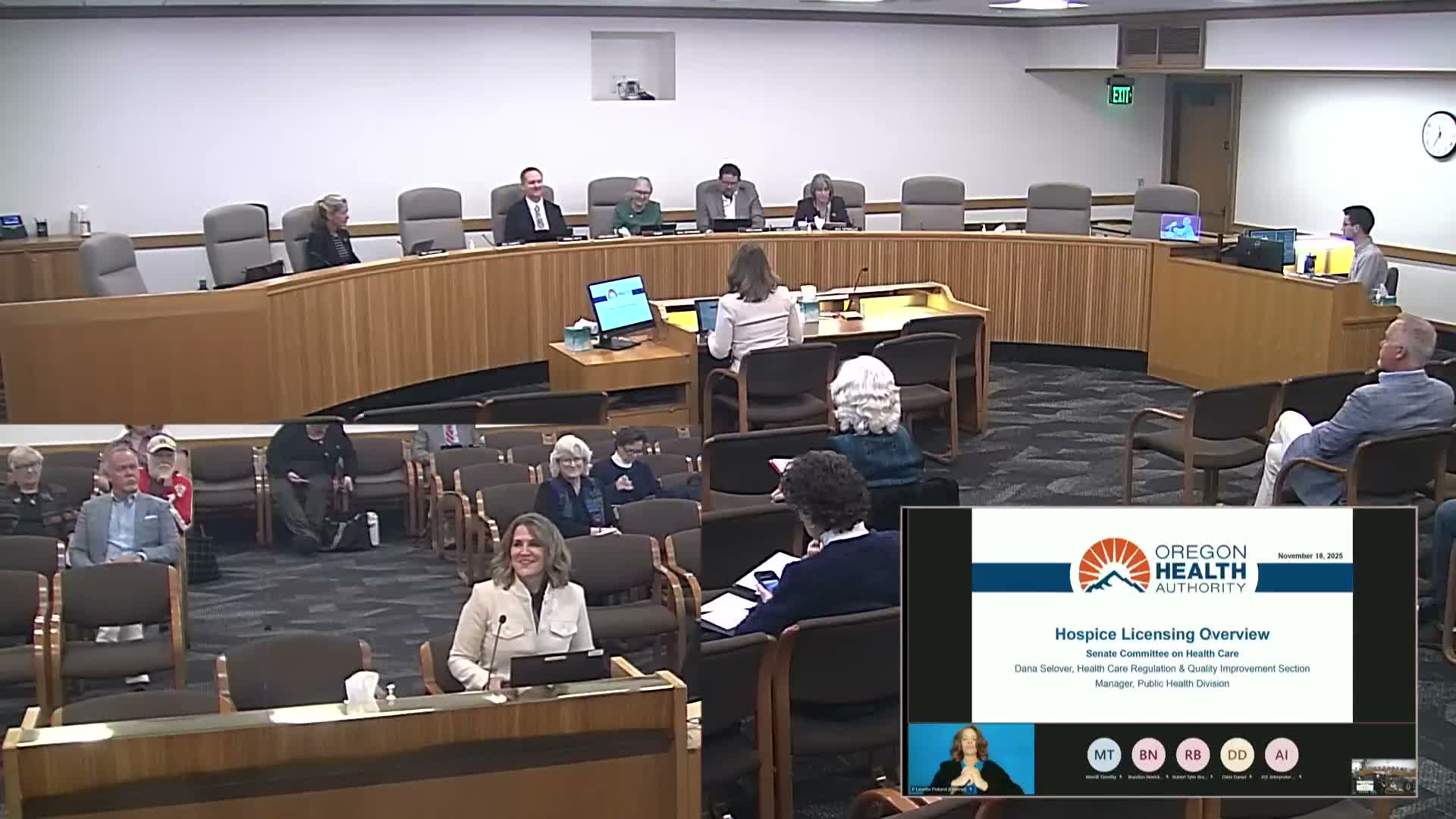
“Hospice regulations in Oregon mostly align with the CMS conditions of participation,” Dana Selover of the Oregon Health Authority said, summarizing the agency’s role as the delegated state survey agency and listing state‑only requirements such as geographic service areas, interpreter services and clinical records retention. Selover reported that Oregon has 75 licensed hospice agencies and that 34 are deemed through accrediting organizations approved by CMS.
The hearing then turned to independent research on corporate ownership. Dr. Robert Tyler Braun of Cornell University said institutional investors and private equity find hospice attractive because “their stable Medicare payments, relatively easy market entry and minimal capital requirements” reduce the need for heavy upfront investment. Braun summarized studies showing privately owned hospices account for a growing share of the market and that some acquisitions are followed by changes in patient mix and staffing levels.
Braun described two patterns his team found: after acquisition, some for‑profit hospices enrolled higher proportions of dementia and other longer‑stay patients, and preliminary analyses suggested a decline in registered‑nurse and social‑worker minutes per beneficiary at certain acquirers. “It’s important to explore the heterogeneity of these deals,” he said, noting that a small number of large acquirers drove much of the observed effect.
Policy experts and advocates framed those findings as evidence for stronger state oversight. Brandon Novick of the Center for Economic and Policy Research argued that the Medicare per‑diem payment structure creates incentives for volume and selection: “What is more important, allowing companies to profit from taxpayer money meant to care for the dying or incentivizing nonprofit mission driven care that has been shown to best benefit patients and their families?” he asked the committee, advocating for tools such as certificate of need rules, ownership restrictions for private equity and publicly traded firms, and stricter on‑site inspections.
Industry and rural providers pushed back on one‑size‑fits‑all policy prescriptions. Barb Hansen, CEO of the Oregon Hospice and Palliative Care Association, said Oregon’s hospice landscape has changed rapidly—her group reported a rise from 65 hospice providers in 2024 to 75 in recent counts—and stressed that access gaps remain in many rural counties. “We don’t need any more hospices in Portland or Eugene or Salem, frankly,” Hansen said, while showing county utilization maps that identify low‑service areas in eastern and central Oregon.
Troy Kribbins, who runs a small for‑profit hospice in rural Coos County, told the committee that rural communities deserve access to quality care and supported a needs‑based certificate of need as one approach to balancing access and gatekeeping.
Witnesses described specific policy levers already used in other states: California’s emergency regulations include nurse‑to‑patient limits, limits on management working across multiple hospices, increased on‑site visits and a temporary moratorium on new licenses; New York has considered bans on expansion of for‑profit hospices; and several states use certificate of need laws to limit new providers where no unmet need exists. Witnesses urged Oregon lawmakers to consider requiring quality reporting, increasing routine oversight, and using gatekeeping measures to prevent the emergence of low‑quality, high‑volume operations.
The committee did not take any formal votes. Members said they expect the informal work group studying hospice policy to continue refining proposals for the 2026 session and to weigh trade‑offs between access in rural areas and stricter gatekeeping measures.