
Oregon DOJ launches SPIRE pilot in Washington County to pursue organized crime
Get AI-powered insights, summaries, and transcripts
Subscribe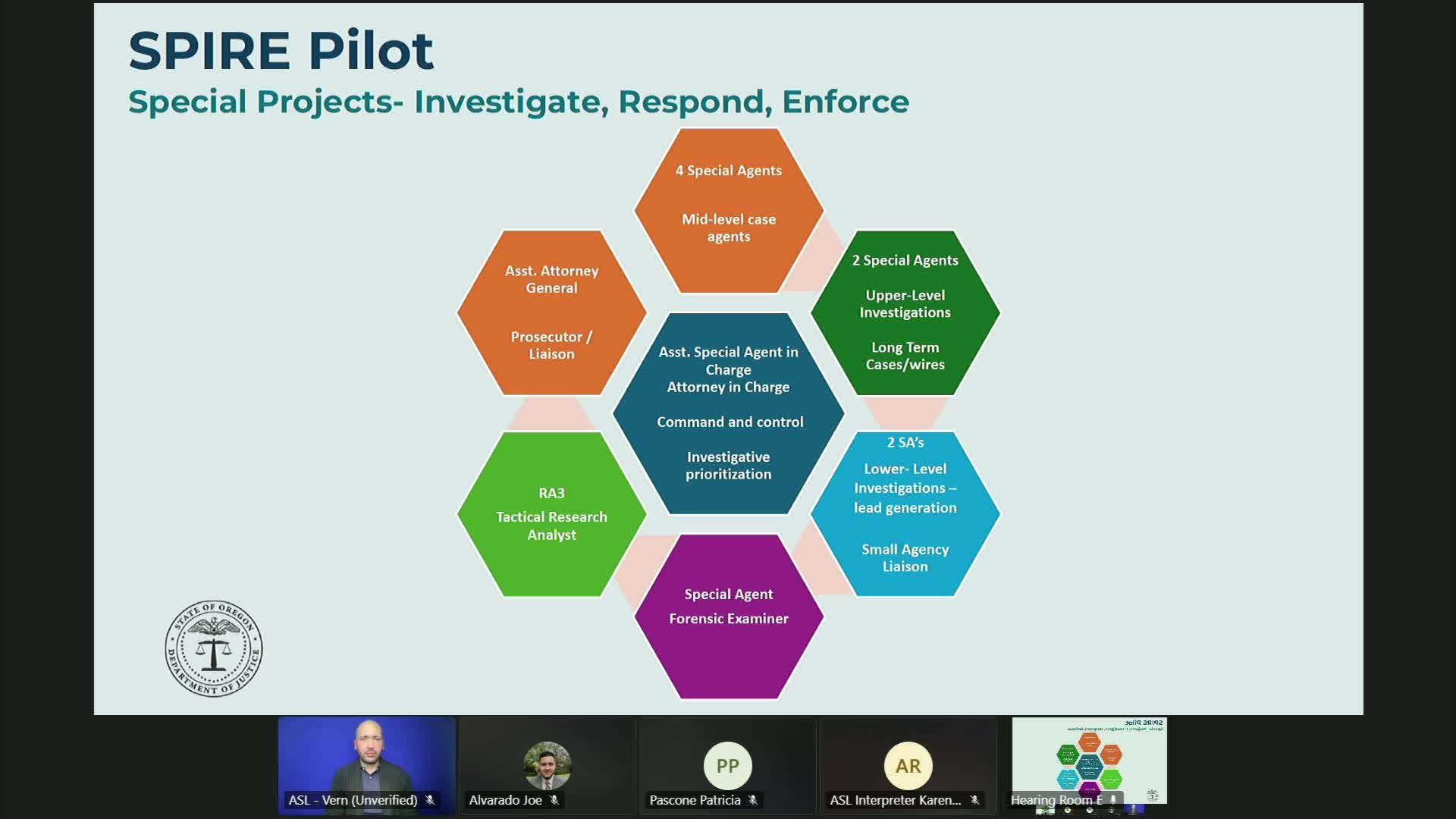
Summary
Oregon Attorney General Dan Rayfield and local prosecutors described a Department of Justice pilot deploying investigative teams to assist county law enforcement on complex, cross‑jurisdictional organized-crime cases, citing a catalytic-converter ring as proof of concept and plans to evaluate wider rollout.
Attorney General Dan Rayfield told the Senate Interim Committee on Judiciary that the Oregon Department of Justice has begun a SPIRE pilot in Washington County to shift DOJ resources from reactive work to proactive investigations of organized crime.
"We wanted to create a program and shift the way that we're using the resources of the Department of Justice to be more proactive and engaged when it comes to organized crime," Rayfield said, introducing the pilot and promising follow-up reports on progress.
Washington County District Attorney Kevin Barton described the local partnership and the catalytic-converter investigation that helped shape the pilot. He said the collaboration exposed networks involved in fencing stolen goods, illicit massage businesses tied to trafficking, organized burglary rings and drug-trafficking operations that span multiple counties.
"A couple of years ago, we had a police officer in Beaverton who pulled over a vehicle... and realized there were many, many catalytic converters in the back of a truck," Barton said, describing how local investigation and DOJ support led to prosecutions and illustrated gaps the pilot aims to fill.
Rich Austria, Special Agent in Charge for the DOJ—s Criminal Justice Division, laid out the pilot—s investigative structure: a mix of agents focused on low-level and mid-level activity with the ability to peel off resources to address upper-level organizers and to bring in federal partners when needed. He described DOJ capabilities the pilot relies on, including intelligence, forensics and technical surveillance.
"There I think there are 40,000 catalytic converters. You're talking about 40,000 possible individual victims," Austria said, underscoring the claimed scale of harm in a single network and the rationale for statewide capacity-building.
Committee members signaled support for the pilot and asked DOJ to return with progress updates and any legal or budgetary needs. The Attorney General said DOJ will look at additional tools that could complement the pilot as investigations mature.
What happens next: DOJ and Washington County will continue the pilot; the Attorney General indicated the department will report back to the committee and explore whether the model could be expanded statewide.