Get AI Briefings, Transcripts & Alerts on Local & National Government Meetings — Forever.
House Advances $3.275 Billion BRIGHT Act to Revitalize Public Higher Education
Loading...
Summary
The Massachusetts House passed House Bill 4750, the BRIGHT Act, sending it to be engrossed after approving a consolidated amendment. The bill authorizes $3.275 billion in special-obligation bonds to fund campus repairs, decarbonization, lab modernization and other projects, with allocations for UMass, state universities and community colleges.
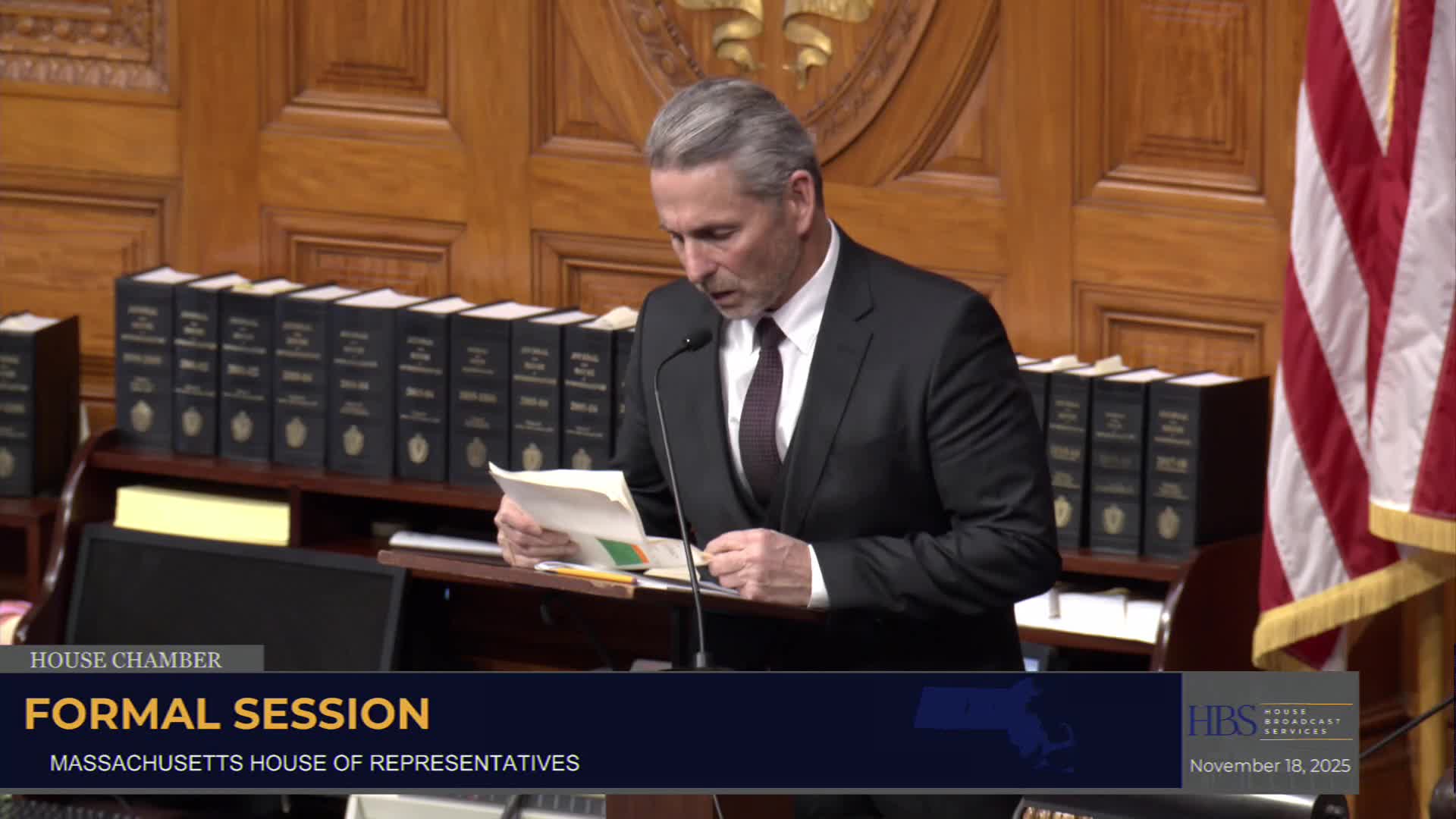
The Massachusetts House on Nov. 17 advanced House Bill 4750, known as the BRIGHT Act, authorizing $3.275 billion in special-obligation bonds to finance capital work across public higher education campuses. Members approved a consolidated amendment and voted to pass the bill to be engrossed.
The bill’s sponsor and floor supporters described the package as a generational reinvestment in the state’s colleges and universities. Representative Rogers of Cambridge told colleagues the bill authorizes $3,275,000,000 to ‘revitalize our public higher education campuses’ and detailed initial allocations: $1.25 billion for the UMass system, $1.25 billion for state universities and community colleges, and $275 million for the Massachusetts College of Art and Design.
Supporters said the authorization also includes targeted line items. Representative Rogers and other proponents listed $100 million for converting campus facilities to housing and mixed-use, $80 million for decarbonization projects, $120 million for laboratory modernization, $30 million for campus master plans, and additional funds for grants, technology projects and a $100 million skills capital grant administered by the Executive Office of Education.
Proponents emphasized governance and oversight changes in the bill. The measure raises the DCAM (Division of Capital Asset Management and Maintenance) delegation threshold for projects from $5 million to $10 million, permits the Massachusetts State College Building Authority (MSCBA) to oversee academic buildings as well as nonacademic facilities, and adds two nonvoting MSCBA seats to represent community colleges and state universities. The bill also establishes a higher-education property disposition fund allowing colleges to retain proceeds from certain property sales or leases, with notice to local communities and public-hearing requirements for large projects.
Lawmakers framed the financing as tied to revenue from the voter-approved surtax (the 'fair share' amendment) and described the bonds as special obligations that will not count against the Commonwealth’s statutory debt limit. Representative Michael Finn of West Springfield said the model will mirror existing state funds and estimated the construction activity could support roughly 20,000 jobs over 15 years.
Floor debate included campus-specific examples of deferred maintenance that supporters said motivated the bill: bracing on Bartlett Hall at UMass; deferred repairs at UMass Lowell’s Fall Hall dorm; heating and energy upgrades at UMass Boston; learning-center renovations at Worcester State; and laboratory and HVAC needs at Bunker Hill Community College and Springfield Technical Community College.
On the floor, members adopted a consolidated amendment (Consolidated Amendment A) by roll call, the clerk displaying a tally of 149 ayes and 4 nays. A subsequent roll call on final passage to be engrossed showed 148 ayes and 5 nays; the presiding officer announced the bill 'passed to be engrossed.'
Representative Badger of Plymouth, Representative O’Day of West Boylston and others gave personal and constituent-focused remarks urging support, highlighting equity, accessibility (ADA upgrades), and regional distribution of funds.
Next steps: the bill was ordered to be engrossed as amended and will proceed through the legislative process (third reading and subsequent steps required by the House and Senate before any final enactment).