Get Full Government Meeting Transcripts, Videos, & Alerts Forever!
Oregon estate tax: who pays, how natural-resource exemptions work and how threshold changes affect revenue
Summary
Legislative Revenue Office data presented to the Senate Finance and Revenue Committee show Oregon's estate tax is concentrated among a small number of very large estates; LRO projects a rise in the filing share and estimates raising the exemption to $2 million would cut estate-tax revenue by about 36%.
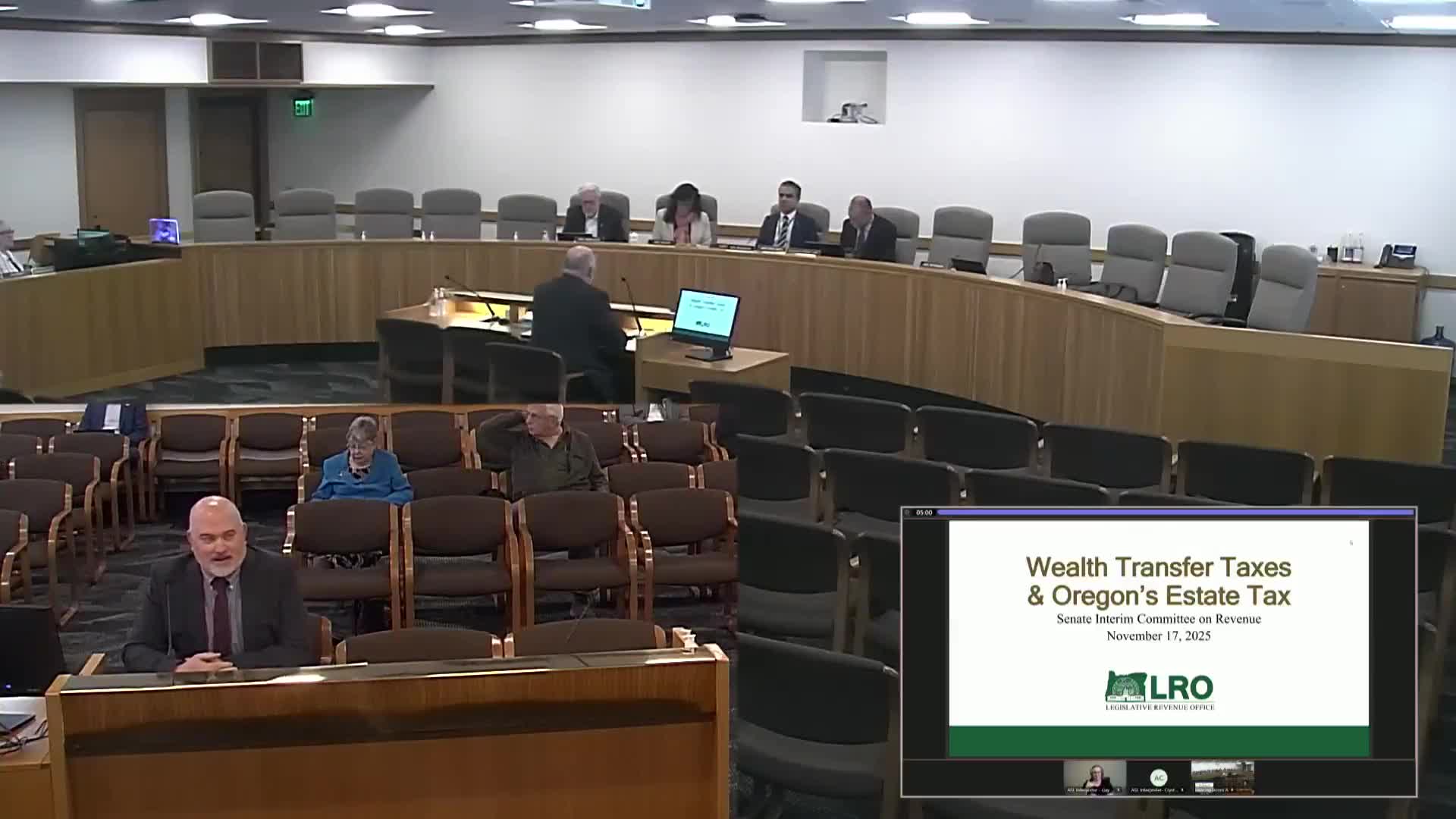
The Senate Interim Committee on Finance and Revenue heard a detailed briefing from the Legislative Revenue Office on how estate, inheritance and gift taxes work and how Oregon's estate tax affects state finances.
John Hart, an economist with the Legislative Revenue Office, told senators the state's tax code treats gifted assets differently from inherited assets: "gifted assets have what's called a carryover basis" while inherited assets often receive a "stepped up basis" at death. He used a stock example to illustrate why capital gains matter to transfer-tax policy: a $100 purchase sold later for $1,000 produces a realized gain of $900 that is taxed on realization.
Hart said the federal system combines gift and estate taxes and that key federal parameters (annual exclusion, unified lifetime exclusion and the top rate) shape taxpayer behavior. Using LRO's 2023 data on Oregon estates, he described the distribution of returns and…
Already have an account? Log in
Subscribe to keep reading
Unlock the rest of this article — and every article on Citizen Portal.
- Unlimited articles
- AI-powered breakdowns of topics, speakers, decisions, and budgets
- Instant alerts when your location has a new meeting
- Follow topics and more locations
- 1,000 AI Insights / month, plus AI Chat