
Oregon estate tax: who pays, how natural-resource exemptions work and how threshold changes affect revenue
Get AI-powered insights, summaries, and transcripts
Subscribe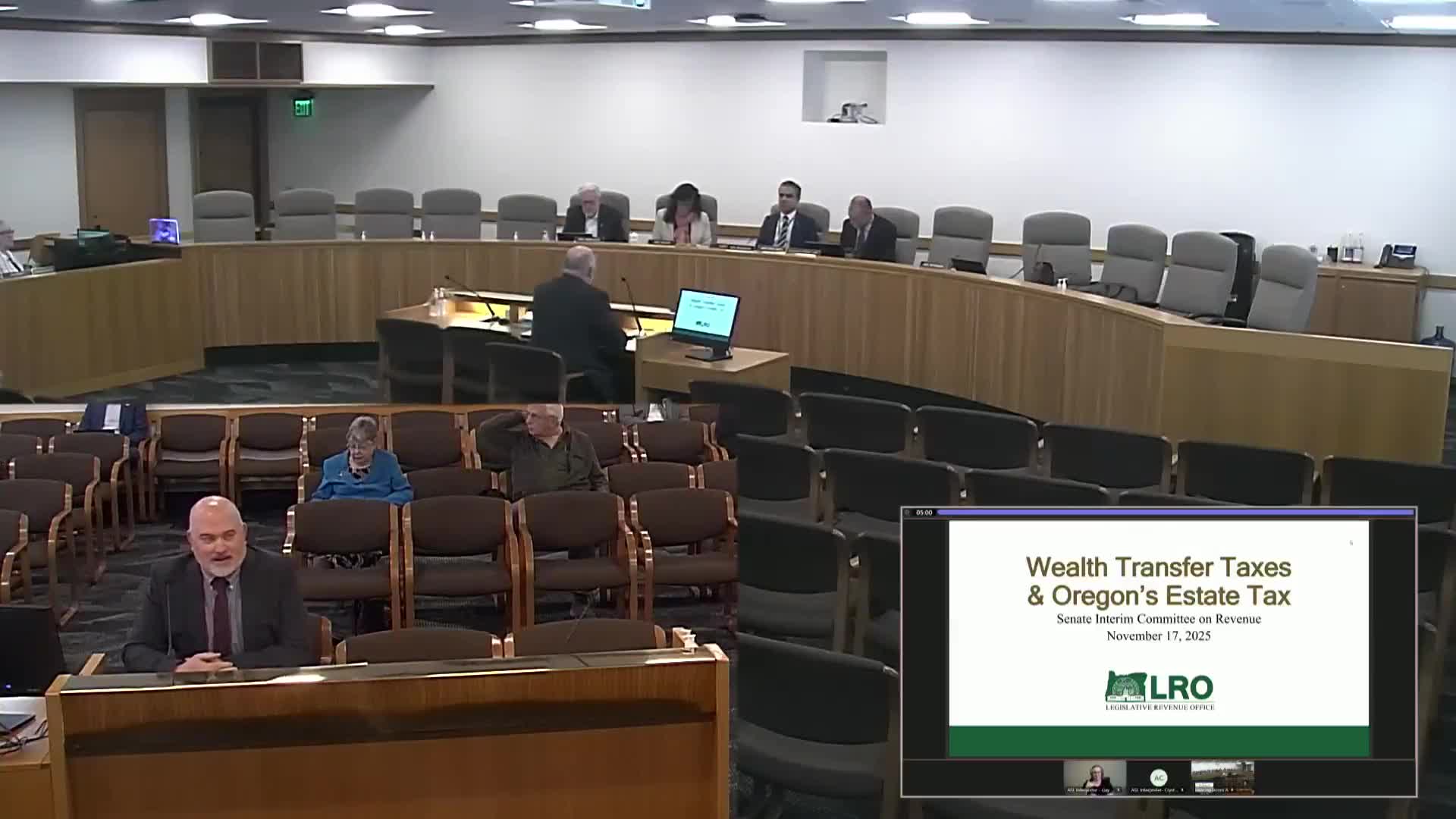
Summary
Legislative Revenue Office data presented to the Senate Finance and Revenue Committee show Oregon's estate tax is concentrated among a small number of very large estates; LRO projects a rise in the filing share and estimates raising the exemption to $2 million would cut estate-tax revenue by about 36%.
The Senate Interim Committee on Finance and Revenue heard a detailed briefing from the Legislative Revenue Office on how estate, inheritance and gift taxes work and how Oregon's estate tax affects state finances.
John Hart, an economist with the Legislative Revenue Office, told senators the state's tax code treats gifted assets differently from inherited assets: "gifted assets have what's called a carryover basis" while inherited assets often receive a "stepped up basis" at death. He used a stock example to illustrate why capital gains matter to transfer-tax policy: a $100 purchase sold later for $1,000 produces a realized gain of $900 that is taxed on realization.
Hart said the federal system combines gift and estate taxes and that key federal parameters (annual exclusion, unified lifetime exclusion and the top rate) shape taxpayer behavior. Using LRO's 2023 data on Oregon estates, he described the distribution of returns and payments: about 3,134 estate-tax returns have been received for the 2023 tax year, and the payments are heavily concentrated — 67 estates with taxable values over $9.5 million (roughly 2% of returns) accounted for about 44% of the tax paid.
Oregon's statutory structure and recent policy changes were central to the presentation. Hart explained the calculation: start with the gross estate, subtract debts and allowable deductions (including spousal and charitable bequests and resource exemptions), and then apply the state tax table to determine liability. He cautioned that Oregon's rate table is an artifact of a shift from federal to state-based rules and can be administratively awkward to change without careful drafting.
The presentation described two recent policy tools for qualifying rural property: a 2023 natural-resource exemption and an alternative natural-resource credit. The exemption excludes qualifying farm, forest or fishing property (limited to $15 million of qualifying property) and includes participation requirements tied to family involvement; the credit is a separate option with stricter qualifications and a $7.5 million limit. Hart said the exemption was available for the latter half of 2023 and that planning and timing influenced how estates used the exemption or credit that first year.
On the policy implications, Hart presented modeling results for changing the exemption threshold: "if the estate threshold were to change... the example highlighted here is an increase in the threshold to $2,000,000, [which] is estimated to reduce the state tax collections by 36%." He added that raising the threshold further (for example to $7,000,000) would reduce estimated estate-tax revenue by roughly 73%, though he noted model caveats.
Senators pressed LRO staff on data gaps. Committee members asked whether there are central measures of how many eligible estates do not file returns; Hart said LRO lacks a reliable non-filer estimate because wealth is difficult to measure from income tax returns. The office also committed to pulling comparative breakdowns for other states on request.
The committee heard that estate-tax revenue is material but concentrated. Hart summarized the general-fund contribution from estate taxes as having grown in recent years and that the LRO's near-term projection put annual estate-tax contributions closer to $400 million than the $500 million figure sometimes cited for later fiscal years.
The committee did not take formal action; members and staff said they would continue analyzing distributional and migration questions and review technical bill language in the interim.
The Legislative Revenue Office plans follow-up analyses and the presentation materials will be used to inform bill drafts for the 2026/2027 legislative work on estate-tax thresholds and natural-resource provisions.