
Oregon officials credit quicker initial attack, mitigation for limiting 2025 wildfire damage
Get AI-powered insights, summaries, and transcripts
Subscribe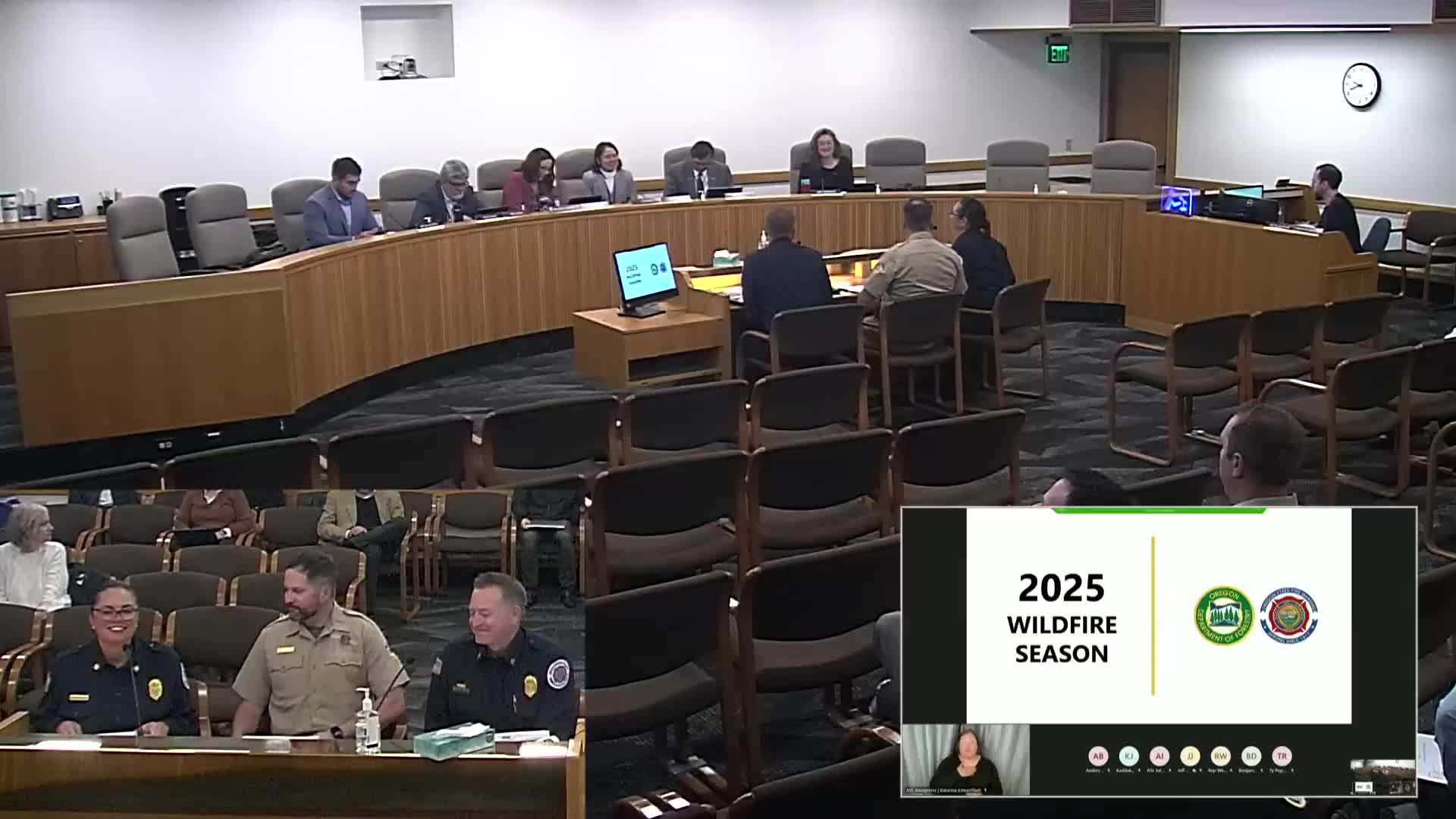
Summary
State forestry and fire‑marshal officials told legislators the 2025 season produced many fires but far fewer acres than 2024; officials credited mitigation, mutual aid and rapid initial attack (including the engine program) for limiting structure loss, while noting costly contracted resources and an hour‑long drone delay to air operations on the Flat Fire.
State wildfire officials told the House Interim Committee on Emergency Management and Veterans that the 2025 season reflected a new norm of frequent incidents that often start close to communities. Kyle Williams, deputy director of fire protection for the Oregon Department of Forestry, reported 1,160 fires on ODF‑protected lands and roughly 25,000 acres burned this summer, and he said the season nonetheless produced more structure loss in some areas than 2024.
Officials credited investments in mitigation, mutual aid and an engine program for improved outcomes. "We had 39 apparatus mobilized," Travis Madema of the State Fire Marshal’s Office said of an engine program funded through prior legislation, and he described staffing grants and other programs that added capacity to local fire services.
The Flat Fire in Central Oregon illustrated the gains from pre‑season work and coordinated response. Rick Fletcher, assistant district forester for Central Oregon, said more than 22,000 acres burned in Jefferson and Deschutes counties but praised the "Central Oregon Way" of coordinated mitigation and closest‑resources dispatching. He said the first engine arrived nine minutes after initial tone and that within the first hour crews and equipment included 17 engines, dozers, hand crews and single‑engine air tankers. Fletcher estimated the incident cost taxpayers and agencies but noted the effort saved many homes around Sisters: "we lost, either 5 or 6 primary residences … we saved 827 that were directly on the fire perimeter or within the fire perimeter."
Panelists warned about the expense of modern firefighting and the role of contractor aviation. Williams said Oregon’s gross firefighting costs were about $130 million this season with a $56 million net figure that agencies expect to partially recover from federal partners. Committee members asked for a breakdown of contract versus personnel costs; ODF said aviation and heavy contract resources contributed substantially but that specifics would require further analysis.
Agency witnesses also raised operational risks beyond fuel and staffing. Fletcher and colleagues said a private drone operating in the Flat Fire airspace delayed firefighting aircraft by about "an hour or an hour and 35 minutes" while airspace was deconflicted — a delay lawmakers and local officials called significant for aerial firefighting.
Speakers urged durable investment in mitigation and landscape resiliency, not just suppression. Officials described grants, landscape treatments and community Firewise programs as part of a long‑term effort to reduce risk and keep fires small enough for effective initial attack. The committee did not vote on legislation during this informational presentation but members discussed follow‑up briefings on mitigation and community hardening.