Panel flags INMP summary tables, auditing and coalition roles as key implementation challenges
Summary
Panelists reviewed INMP summary tables and reporting templates and raised implementation questions about multi-crop fields, soil data, coalition vs. grower calculation of R, and the need for staged QA/QC rather than immediate, heavy auditing.
Panelists spent substantial time on Question 5 discussing what growers report in INMP summary tables, who calculates R (nitrogen removed), and how auditing should be handled.
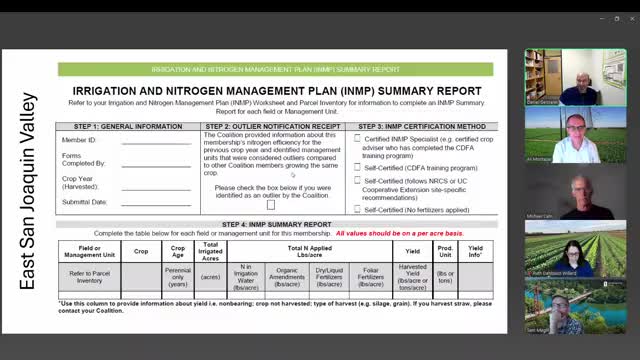
Daniel Geisler and Ali Montazar reviewed example summary tables used by an East San Joaquin Valley coalition and noted the extensive per-field data being requested (irrigation methods, irrigation efficiency practices, applied nitrogen, yields, crop age, acres, and other entries). Panelists flagged ambiguities for multi-crop fields and urged adding soil texture/series to the form to improve interpretation of leaching risk.
Panelists debated whether coalitions or growers should calculate R. In the Central Valley coalitions typically calculate R from grower-reported yields and regional coefficients; on the Central Coast growers often do more of the calculation themselves. Michael Khan stressed the need for a clear narrative or process to document how A and R were computed so future audits are traceable: "It would be good to have information on what was the process in coming up with A," he said.
On auditing and QA/QC, the panel recommended a pragmatic approach: allow an initial learning period (staff and coalitions suggested two to three years) before instituting comprehensive audits, and have coalitions screen for outliers and contact growers about anomalous values. The panel cautioned against instantly publishing highly granular field-level data without consideration of privacy and practical implications.
Panel direction: staff will accept written edits and clarifications (requested by Dec. 1) and consolidate them for the next meeting, with the intent to standardize where feasible but preserve regional flexibility in summary templates.