
Researchers flag shifting nutrient dynamics and possible berm effects on Great Salt Lake ecology
Get AI-powered insights, summaries, and transcripts
Subscribe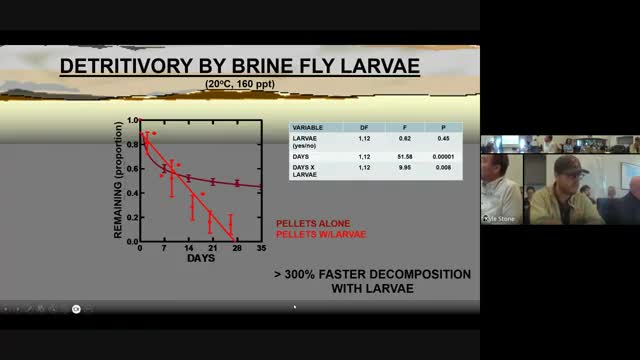
Summary
Scientists reported unusual January–February chlorophyll dips, rising diatom counts and evidence that brine fly larvae accelerate nitrogen turnover; model comparisons suggest the 2022 berm modification changed nutrient and plankton dynamics, and the monitoring team is switching hypersaline nutrient analysis to Chesapeake Biological Labs.
Gary Golowski and other researchers presented lab results and model diagnostics suggesting unexpected changes in nutrient dynamics and plankton composition at the Great Salt Lake, and they discussed how recent causeway/bioberm modifications may be altering those dynamics.
Gary described laboratory experiments showing that brine fly (lake fly) larvae accelerate decomposition of brine shrimp pellets and therefore can substantially influence nitrogen cycling in the lake. "What this is telling us is that the brine fly larvae are playing a tremendous having a tremendous impact on the nitrogen cycling within the lake," Gary said, arguing that larvae-mediated decomposition may matter beyond the larvae’s role as bird food.
Gary and colleagues reviewed a multi‑decadal model for open‑water plankton dynamics (1996–present). He said the model matches observations well since 2006 but performed poorly in earlier years and that recent changes after mid‑2022 (when managers adjusted the causeway/berm) show a departure from prior predictive relationships. He linked spikes of diatoms and cyanobacteria to short cold or high‑wind events that can release microbes from microbialites and biofilms into the pelagic, and he cautioned that the berm may be changing how those inputs are distributed in the lake.
The USGS/GCLIP team (Christine and others) provided complementary monitoring results: seasonal lake elevations, flow measurements at the causeway openings, and salinity profiles across arms of the lake. Christine noted discrete flow measurements have trended down since the berm modification in July 2022 and that north→south flows are now minimal; she also summarized salinity values at specific sites and the group’s plans to use surface velocity and camera data to improve continuous flow estimates.
Laboratory processing issues and a provider change were discussed at length. Staff reported that the National Water Quality Laboratory has stopped running hypersaline nutrient analyses, forcing a switch to Chesapeake Biological Labs. Presenters emphasized the need for a documented lab‑comparison to identify any step changes between historical NWQL results and new CBL results so long‑term trends are interpreted correctly.
Participants raised alternative explanations for observed chlorophyll dips in winter, including low temperatures reducing photosynthetic rates and nutrient export to the North Arm. Presenters said the data are not yet definitive and additional mass‑balance and decomposition analyses are planned; a draft nutrient mass‑balance and a related manuscript are expected for internal review and public release in coming months.
Next steps include completing the nutrient mass‑balance analysis, documenting lab comparison results, refining models to incorporate cyst hatching and stochastic events (wind/cold), and presenting a fuller interpretation at future meetings.