
Prosecutor tells commissioners rising caseloads, cyber needs and benefits are driving budget pressures
Get AI-powered insights, summaries, and transcripts
Subscribe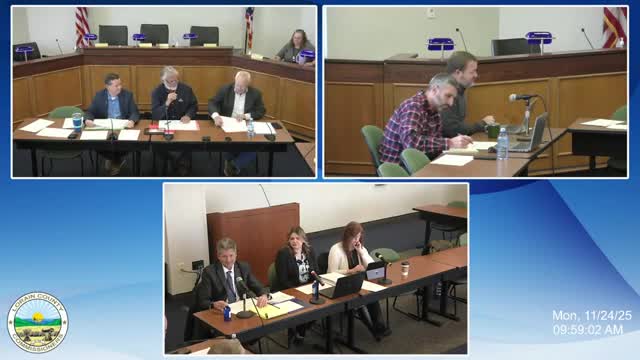
Summary
At the Nov. 24 work session the county prosecutor described reorganizations, benefit-cost increases and one-time cybersecurity upgrades (about $209,009.34) and said some staffing costs can be shifted to special revenue but that those sources are limited long term.
The commissioners asked the county prosecutor's office to explain increases in personnel and special-revenue use. At the session's start the chair signaled the agenda would move to the prosecutor's budget; in response Speaker 9 summarized several drivers of rising costs and the office's efforts to manage them.
On contracted program positions, Speaker 9 described "4D" (child support) and "4E" (children's services) contract positions that are mostly funded by state and levy dollars. The prosecutor said a predecessor had used about $134,000 of general-fund money to supplement those contracts and that the current office is removing that supplement and seeking reimbursement through the appropriate 4D/4E accounts.
The office flagged delinquent-tax special revenue as a partial offset for personnel costs: Speaker 9 said the maximum legally allowable transfer to employee costs in the current plan is about $692,000, while acknowledging average annual delinquent-tax receipts are closer to $400,000—$500,000 and the balance as of October appeared near $2.5 million. "That's a temporary fix," the prosecutor said, warning heavy reliance on that stream is not sustainable.
Cybersecurity and information-technology costs were a focal point. Staff said about $209,009.34 is budgeted as a one-time conversion/hardening expense under a Convergent/Conversant engagement to meet Criminal Justice Information Services (CJIS) compliance; recurring costs discussed included Matrix (about $130,000/year) and Microsoft 365 licensing (about $51,000/year). Commissioners debated whether the one-time capital cybersecurity expense and some licensing should be centralized under the commissioners' IT budget rather than allocated to the prosecutor's office.
Speaker 9 also described personnel strategies: reorganizing juvenile and criminal work to cover more with fewer senior hires, hiring younger prosecutors with higher training costs in the short term but lower salaries initially, and controlling supplies and postage by reallocating responsibilities. The office said it achieved a general-fund personnel reduction roughly equivalent to 3% overall and that hospitalization/benefits account for much of the remaining increase (hospitalization shown near $511,000 this year and $520,000 next year).
On workload, the prosecutor said increased indictments and jury trials, mandatory sentences tied to certain gun specifications and fentanyl-related enforcement are increasing case volume and costs. "It's like putting a band aid on an amputee," Speaker 9 said when describing temporary budget fixes, and asked commissioners to consider broader structural solutions.
Commissioners asked staff to continue refining line items, to review special-revenue allowances and to present options that limit general-fund exposure while sustaining required services.