
Panel: A-minus-R is a valid regulatory metric but models must be regionally tailored
Get AI-powered insights, summaries, and transcripts
Subscribe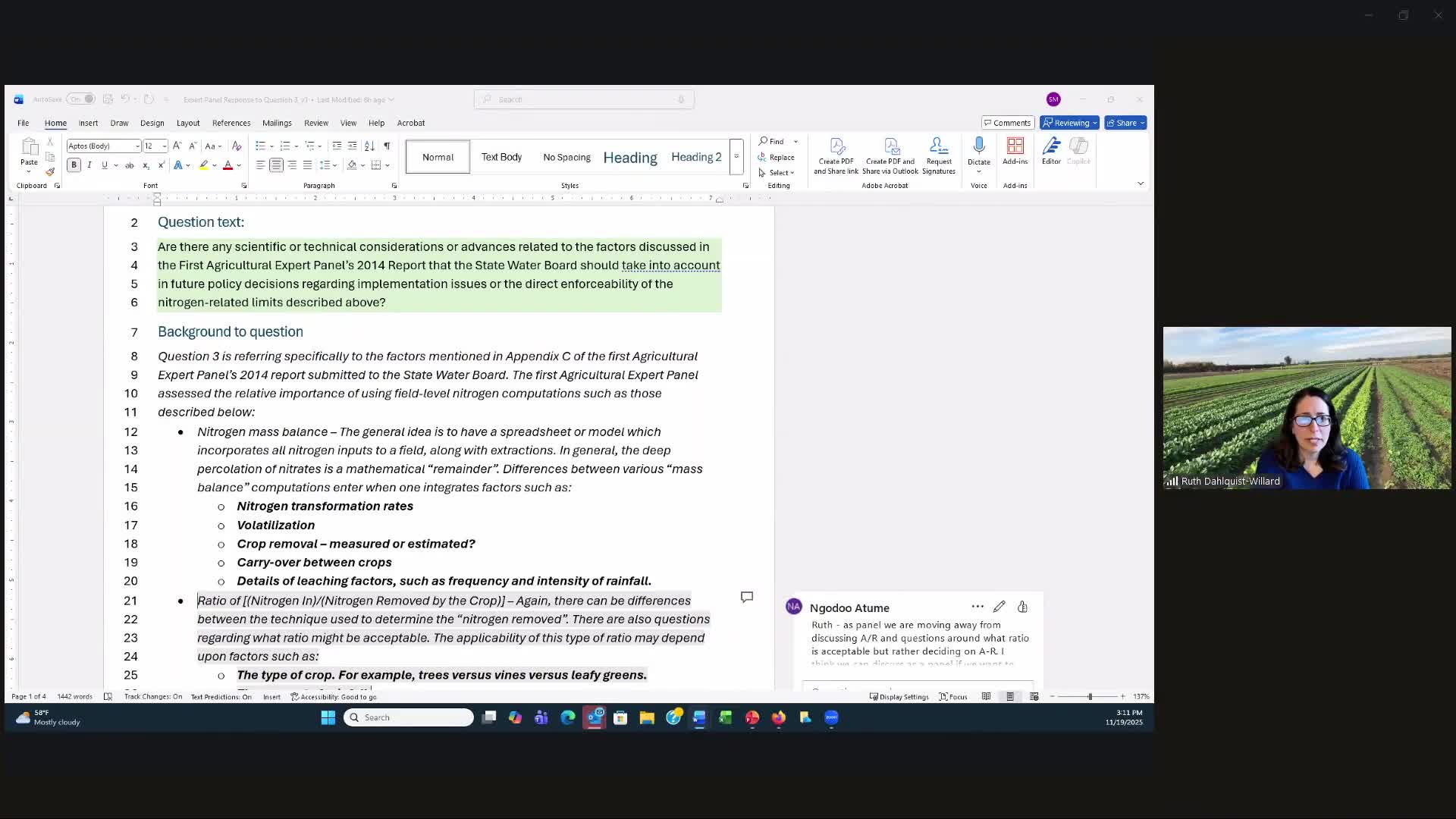
Summary
At a Nov. 19 State Water Resources Control Board expert-panel meeting, panelists endorsed A-minus-R as a valid metric to estimate potential nitrate discharge while urging flexibility in model choice and more region-specific calibration before imposing a single-model mandate.
An expert panel convened by the State Water Resources Control Board on Nov. 19 recommended using the A-minus-R (A–R) metric to estimate potential nitrate discharges but stressed the need for region-specific modeling and clearer guidance before any statewide mandate. The panel also recommended allowing regional coalitions or third parties to select and calibrate the hydrologic or hydrogeologic models that best fit local conditions.
The panel’s chair of technical contributors, Daniel Geiser, extension specialist at UC Davis, said the group ‘‘agreed that A menos R es una métrica válida a utilizar para, pues, estimar o calcular los descargas potenciales de nitrato’’ and emphasized that the metric is accessible to growers and useful for setting region-level goals. Geiser also cautioned that A–R is less useful for agronomic decision‑making and should be paired with other modeling approaches where needed.
Panelists discussed the use of SWAT/CVSwap and other hydrogeologic models. Kenneth Miller, introduced by staff as a panel expert, argued that SWAT ‘‘is capable of integrating datasets and providing context’’ that can be useful both for estimating leaching potential and for outreach to growers. But stakeholders from the Central Coast warned against a single-model requirement. Sara López, speaking as a Central Coast stakeholder, said earlier attempts to calibrate a landscape-scale SWAT model in her region had failed and that the Central Coast lacks the hydrogeologic datasets and funding that supported SWAT work in the Central Valley.
Panelists recommended the draft report language be revised to: (1) call A–R an appropriate regulatory metric for estimating nitrate discharge potential where farmers can report required inputs; (2) acknowledge A–R’s agronomic limits and that supplemental hydrogeologic modeling may be needed to capture processes such as denitrification and time‑of‑travel to groundwater; and (3) avoid prescribing a single modeling tool statewide, instead noting examples (Region 5 crop‑specific coefficients, Region 3 systems approaches) and urging regionally appropriate model selection and calibration.
Panelists also flagged specific modeling factors the report should discuss, including volatilization, denitrification and irrigation‑source nitrate, and encouraged inclusion of guidance on how coalitions or third parties might perform regional model runs to inform objectives. The discussion closed with staff instructions to capture suggested edits and circulate a consolidated draft prior to the next meeting.
The panel left open the question of whether and when regions that lack calibrated hydrogeologic models should be required to adopt model‑based targets; the group recommended additional research and regional calibration work before a regulatory requirement would be appropriate.