Get Full Government Meeting Transcripts, Videos, & Alerts Forever!
Get email alerts on the Housing Vacancy Policy topic
No spam. Unsubscribe anytime.
Baltimore committee holds oversight hearing on "whole-block" strategy for vacant properties
Summary
The House and Economic Development Committee heard agency officials describe the mayor's Reframe Baltimore whole-block strategy, tools (receivership, fixed pricing, bundling), disposition timelines (BOE 120 days, typical 90-day settlement), staffing and compliance measures to return vacant properties to productive use.
Baltimore City's House and Economic Development Committee held an oversight hearing on LO 25029 on Aug. 18, 2025, to review the city's "whole-block" strategy for vacant and abandoned properties and the timeline for taking properties through acquisition and disposition.
Chair James Torrance opened the meeting and said he supports the approach as a way to redress historic discrimination and bring investment to redlined communities. "Often I always tell people in government that we need to be innovative and bold, and I will say that this is both bold and innovative," Torrance said in his opening remarks.
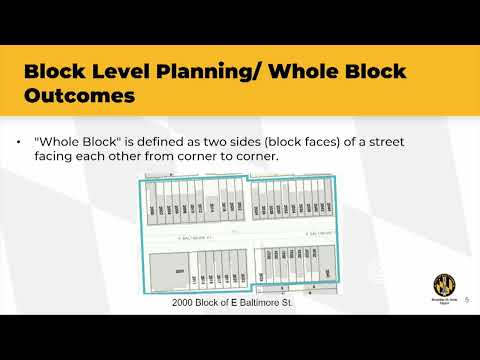
Commissioner Kennedy of the Department of Housing and Community Development told the committee that the mayor's Reframe Baltimore strategy is a $3,000,000,000 initiative to reduce vacant properties over the next 15 years and that whole-block planning treats blocks holistically: owners, renters, vacant lots, infrastructure and green space. She described a suite of tools the agency uses to pursue whole-block outcomes, including targeted acquisition, demolition, receivership, site assembly and bespoke disposition approaches in partnership with community development organizations (CDOs).
Kennedy used the 2600 block of Loyola Northway as an example: in January 2020 the block had 18 vacant-building notices and four owner-occupied units; through receivership, strategic acquisitions and CDO partnership, most buildings have been renovated though five vacant properties remain. Kennedy said the city combines state and city funds along with grants and CDO resources to support renovations.
On disposition timelines, the agency described two related benchmarks: internal tracking for Board of Estimates (BOE) approval within 120 days and, thereafter, a typical 90-day window for settlement. Kennedy emphasized the city does not control post-BOE steps such as the buyer's choice of title company or the buyer's financing schedule and said the city is using front-loaded developer RFQs and a fixed-pricing program to reduce delays.
Deputy Commissioner Wendy Redfern described the agency's compliance and asset-management systems: a software platform that tracks legal filings, acquisitions and disposition status, and a compliance team that checks LDAs and transfers at least quarterly. Redfern said the average LDA length for a single property is about 12 months, but that LDAs and timelines can extend for larger bundled projects because of financing and required capital.
Council members pressed agency staff on several operational issues: how the city engages neighborhoods with limited existing assets (Harlem Park), how the city expands homeownership for working earners (shared-equity models, community land trusts, down-payment assistance and a housing-coaching pilot called "Protect the Nest"), the criteria used to vet developers and whether staffing capacity is sufficient for an accelerated disposition pipeline. Commissioner Kennedy and Deputy Redfern committed to follow up with additional staffing numbers, developer qualification lists and refined disposition metrics.
No vote or formal action was taken during the hearing; the committee closed with a request for follow-up materials and additional oversight in a future hearing.
Next steps: the committee asked DHCD for a six-month benchmark on the fixed-pricing/disposition metrics (July 1'Dec. 31, FY25) and for examples and decision trees the agency would use to consider recapture or receivership if a developer fails to meet LDA obligations.