
Expert panel affirms A minus R as useful field metric but urges regional modeling, audit and phased reporting
Get AI-powered insights, summaries, and transcripts
Subscribe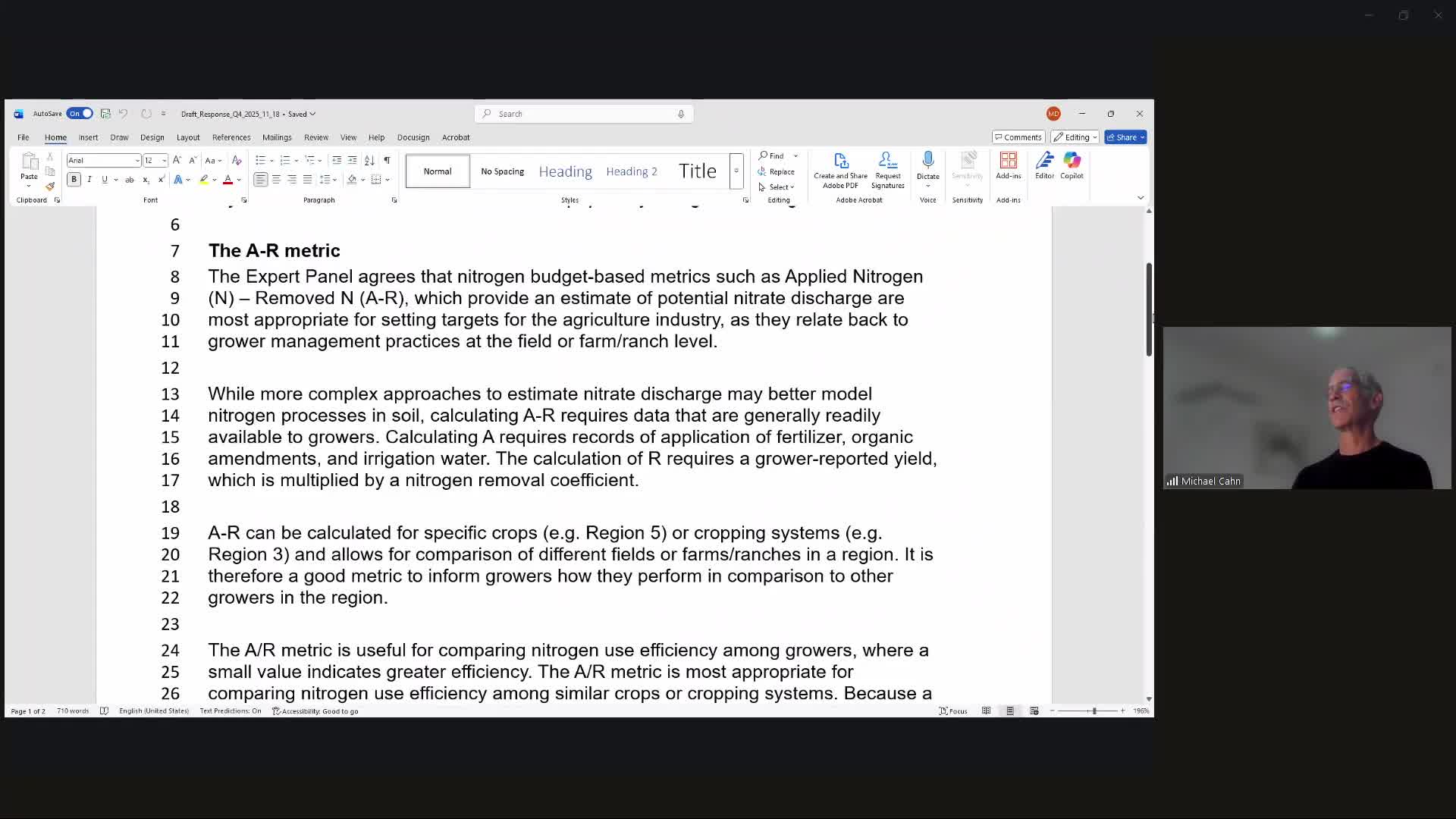
Summary
At a Nov. 19 State Water Resources Control Board panel meeting, experts said A minus R is a practical field-scale metric for estimating nitrate discharge but recommended using regional hydrogeological models (e.g., SWAT) for broader assessment, stepped implementation across regions, strengthened audit procedures and clearer reporting guidance for growers.
Daniel Geiser, a UC Cooperative Extension specialist and chairing the panel, opened a Nov. 19 working session of the State Water Resources Control Board’s expert panel, which focused on draft responses to technical questions about nitrogen mass-balance metrics and modeling.
Panelists broadly agreed that the metric A minus R (applied nitrogen minus nitrogen removed) is a valid, accessible field-scale measure for estimating potential nitrate discharge and for communicating performance among growers. “A menos R es una métrica válida a utilizar para estimar o calcular los descargas potenciales de nitrato,” the panel summary stated, reflecting the group’s view that the metric can be practical for comparisons and for informing growers. At the same time, panelists cautioned that A minus R does not capture all subsurface processes (for example, denitrification) and should be complemented by hydrogeological modeling where appropriate.
Experts discussed the regional limits of the SWAT (Soil and Water Assessment Tool) model, which was presented as useful in the Central Valley because it integrates multiple datasets and can be scaled from field to municipal levels. Kenneth Miller, a modeler invited to comment, told the panel that SWAT “is capable of integrating datasets and providing context to A minus R” and that, when calibrated, it can inform outreach and regional-scale target-setting. Sara López, representing regional coalition experience, urged caution: the Central Coast lacks hydrogeologic models and prior attempts to scale SWAT at landscape level there “failed,” so staff should not mandate SWAT use across regions without funding and local calibration.
On regional coefficients for R (the removal term), panelists described uneven development: Region 5 (Central Valley) has many crop-specific coefficients available; other regions, including Region 7, are still developing values and some expect results by 2027. Panelists recommended flexibility so regional coalitions can choose representative crops or mixed-crop composite coefficients where developing full crop lists is impractical. One practical suggestion was to allow coalitions or third-party entities to calculate R for growers rather than requiring each grower to compute and report detailed coefficients.
Reporting burden and data quality were recurring concerns. Daniel Geiser and other panelists emphasized the need for clear guidance and auditing: early coalition reports showed notable data errors, and staff should develop audit procedures and reporting templates to ensure usable data. Staff agreed to compile panel comments and return a revised draft of responses by Dec. 1 and to aim for a consolidated draft report for the panel’s Jan. 14 meeting. The panel calendar includes a public listening session on Dec. 17 and additional panel meetings (Dec. 5, Jan. 7) to finalize answers prior to public release.
Panel recommendations reflected a layered approach: retain A minus R as a field-level, grower-accessible metric; use regional hydrogeological models (where available and appropriately funded) for regional objectives and to inform implementation; develop practical options (representative coefficients, composite methods, sensitivity analyses) for small or mixed operations; and strengthen audit and compilation practices so coalitions produce reliable R estimates. Staff noted Bagley-Keene constraints for handling public comments once draft responses enter the formal public-comment period and described the planned editorial and compilation workflow.
The panel closed with staff action items: staff will compile and distribute a revised draft, provide the meeting transcript by Nov. 24, and circulate clean draft responses for questions 6 and 8. The next panel working meeting is scheduled for Dec. 5; a public listening session is scheduled for Dec. 17, and the panel aims to meet Jan. 14 to review a consolidated draft for public posting.